
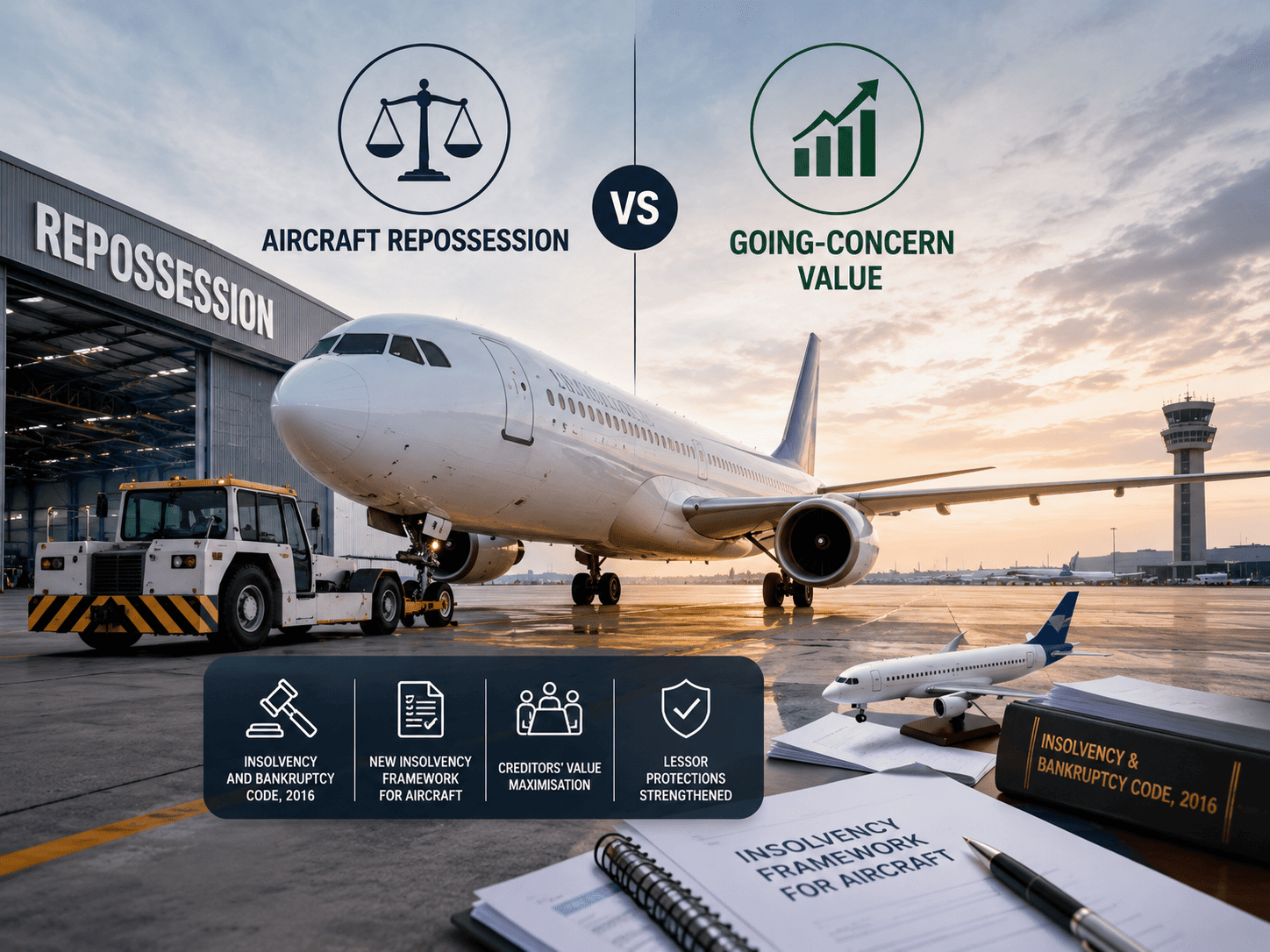
Aircraft Repossession vs Going-Concern Value: How India’s New Insolvency Framework Changes the Position of Aircraft Lessors
Introduction
Airline insolvency presents a particularly difficult problem for insolvency law because the assets most critical to keeping the airline operational may not belong to the airline at all. Aircraft are frequently held under operating leases. When an airline enters insolvency, therefore, the resolution professional (“RP”) may be required to preserve the corporate debtor as a going concern while the aircraft lessor seeks to enforce its contractual and international-law rights to recover possession of its aircraft.
This tension was brought sharply into focus during the insolvency proceedings of Jet Airways (India) Limited and Go Airlines (India) Limited (Go First). In both cases, aircraft lessors faced significant uncertainty concerning the interaction between the moratorium under the Insolvency and Bankruptcy Code, 2016 (“IBC”), the terms of the aircraft leases, the Irrevocable Deregistration and Export Request Authorisation (“IDERA”) mechanism and India’s obligations under the Cape Town Convention and the Aircraft Protocol.
The legal landscape has since changed materially. The Protection of Interests in Aircraft Objects Act, 2025 (“PIAO Act”), which came into force on 1 May 2025, gives domestic legal effect to the Cape Town Convention and the Protocol on Matters Specific to Aircraft Equipment (“Aircraft Protocol”). The Protection of Interests in Aircraft Objects Rules, 2026 (“PIAO Rules”), notified in January 2026, further operationalise the framework, including the insolvency “waiting period” mechanism. The central question, therefore, is no longer simply whether an RP should prioritise the going-concern value of an airline over an aircraft lessor’s repossession rights. The more precise question is: How does the new statutory framework allocate the competing interests of the airline, the insolvency estate and the aircraft lessor during the insolvency process?
Why Airline Insolvency Is Different
Section 20 of the IBC requires the RP to manage the operations of the corporate debtor as a going concern during the Corporate Insolvency Resolution Process (“CIRP”). This objective reflects the broader purpose of the IBC: preserving and maximising the value of a viable business rather than allowing its assets to be dismantled prematurely.
For an airline, however, the aircraft fleet is often indispensable to that objective. Unlike a manufacturing company that may own its machinery and inventory, an airline may operate a substantial part of its fleet under operating leases. The aircraft may therefore be essential to the airline’s going-concern value while simultaneously remaining the property of third-party lessors. This creates a structural conflict. From the RP’s perspective, loss of aircraft can severely diminish the value of the airline and make resolution more difficult. From the lessor’s perspective, continued possession by an insolvent operator may expose the aircraft to deterioration, unpaid rentals and further loss of value.
The problem becomes particularly acute where the lease has already been terminated before insolvency proceedings commence.
Jet Airways: The Early Test of the Conflict
The insolvency of Jet Airways brought the problem into sharp focus. Following the admission of insolvency proceedings against Jet Airways in July 2019, the moratorium under Section 14 of the IBC restricted actions against the corporate debtor and its assets. A significant portion of Jet Airways’ fleet consisted of leased aircraft.
For aircraft lessors, this raised an important issue. They had contractual rights and, in several cases, had executed IDERAs in accordance with the Cape Town Convention framework. Yet the operation of the IBC moratorium created significant practical obstacles to the exercise of those rights. For the RP, meanwhile, retaining access to aircraft was critical to any attempt to preserve the airline as a going concern.
The consequences of the uncertainty were significant. The resolution process continued for years, while the airline’s operational position deteriorated substantially. The Jet Airways experience demonstrated that, in airline insolvency, delay itself can destroy value: an aircraft that remains grounded for an extended period may lose commercial value even though it remains physically intact. The case therefore exposed a fundamental weakness in the absence of a clear and predictable mechanism governing the relationship between insolvency proceedings and aircraft lessor remedies.
Go First: The Conflict Becomes a Direct Legal Question
The Go First insolvency in 2023 brought the same problem before the adjudicatory authorities in a more direct form. Go Airlines filed an application under Section 10 of the IBC on 2 May 2023, citing, among other factors, the grounding of aircraft following problems relating to Pratt & Whitney engines. The NCLT admitted the application on 10 May 2023, triggering the statutory moratorium.
Aircraft lessors challenged the admission and argued, among other things, that several lease agreements had already been terminated before the admission of the insolvency application. Their position was that, following termination, the aircraft were no longer assets over which the corporate debtor had a right of possession and therefore the moratorium should not prevent the lessors from recovering them. The issue was significant because it went beyond the ordinary operation of Section 14.
The question was essentially whether the moratorium could protect an aircraft merely because it remained physically in the corporate debtor’s possession when the contractual right to possess that aircraft had already been terminated.
What Did the NCLAT Decide in Go First?
In SMBC Aviation Capital Ltd. v. Interim Resolution Professional of Go Airlines (India) Ltd., the NCLAT, by its order dated 22 May 2023, upheld the admission of Go First’s Section 10 application. Importantly, however, the NCLAT did not finally determine all the substantive disputes concerning the aircraft leases. The lessors were permitted to approach the NCLT with applications concerning:
- the applicability of the moratorium to aircraft where the leases had been terminated before admission;
- possession of the aircraft;
- the consequences of lease termination; and
- other claims arising between the lessors and the IRP.
The NCLAT also left open the lessors’ ability to pursue an application under Section 65 of the IBC concerning an allegedly fraudulent or malicious initiation of insolvency proceedings. Thus, the decision preserved the immediate insolvency process while leaving several aircraft-specific disputes to be considered by the adjudicating authority.
This distinction is important. It would be inaccurate to characterise the decision simply as a finding that aircraft lessors had no repossession rights. Rather, the decision demonstrated the procedural and jurisdictional uncertainty that existed at the time concerning the interaction between the IBC and the Cape Town framework.
The October 2023 Notification: A Significant Shift
The Go First proceedings were followed by an important intervention by the Central Government. On 3 October 2023, exercising its powers under Section 14(3)(a) of the IBC, the Central Government notified that the Section 14(1) moratorium would not apply to transactions, arrangements or agreements under the Cape Town Convention and Aircraft Protocol relating to aircraft, aircraft engines, airframes and helicopters. This was a significant development because it sought to remove a key source of conflict between the IBC moratorium and India’s obligations under the Cape Town framework.
However, the notification was not the final word on the subject. The broader statutory framework required a more comprehensive mechanism governing aircraft interests, insolvency and enforcement. That framework ultimately emerged through the PIAO Act and the subsequent PIAO Rules.
The Protection of Interests in Aircraft Objects Act, 2025
The Protection of Interests in Aircraft Objects Act, 2025 was enacted to provide statutory protection to interests in aircraft objects and to implement India’s obligations under the Cape Town Convention and Aircraft Protocol. The Act came into force on 1 May 2025. Section 3 provides for the application of the Convention and Protocol in India, while Section 6 specifically addresses remedies in insolvency. It provides that Article XI of the Aircraft Protocol, subject to India’s applicable declaration, applies to insolvency remedies under Indian law where the statutory conditions are satisfied.
Those conditions include, among other things, that:
- the debtor is an Indian body corporate, firm or qualifying person;
- the relevant international interest has been registered in accordance with the Convention and Protocol; and
- the parties have not expressly excluded the application of Section 6 by written agreement.
The Act also contains an overriding provision under Section 9, making its provisions prevail in the event of inconsistency with other laws, subject to the terms of the Act itself. The significance of this framework is considerable. It moves the issue away from an uncertain case-by-case conflict between the IBC moratorium and aircraft lessor rights and towards a statutory regime specifically designed to govern aircraft-related insolvency remedies.
The Two-Month Insolvency Waiting Period
The PIAO Rules, 2026 provide the operational framework for the insolvency mechanism. Under Rule 11, where the relevant conditions are satisfied, a waiting period of two calendar months applies from the insolvency commencement date. During this period, the insolvency professional has obligations relating to preservation and maintenance of the aircraft object and its value. The creditor is also entitled to access the aircraft and relevant technical and maintenance records in accordance with the Rules.
The framework is based on the Alternative A mechanism under Article XI of the Aircraft Protocol. The basic principle is that the insolvency process does not provide an indefinite shield against enforcement of the lessor’s rights. At the same time, the lessor is not necessarily entitled to immediate repossession merely upon commencement of insolvency proceedings.
Instead, the statutory framework provides a defined period during which the aircraft can be preserved while the insolvency process and the lessor’s interests are accommodated.
Can the Resolution Professional Retain the Aircraft After the Waiting Period?
The answer is subject to the statutory framework and the relevant contractual obligations. Under Article XI, where the debtor or insolvency administrator seeks to retain possession beyond the applicable point at which the creditor becomes entitled to possession, the relevant defaults other than a default constituted solely by the commencement of insolvency proceedings must be cured, and future obligations under the agreement must be undertaken to be performed. This is an important change in emphasis.
The RP’s objective of preserving the airline as a going concern remains relevant. However, that objective does not by itself create an indefinite right to retain leased aircraft against a lessor whose rights are protected under the Cape Town framework. The going-concern objective and aircraft repossession rights must therefore operate within the statutory structure created by the PIAO Act and Rules.
The PIAO Framework and the RP’s Dilemma
The central dilemma identified in the earlier Jet Airways and Go First proceedings has therefore not disappeared; rather, it has been restructured by legislation. Before the PIAO framework, the RP and the lessor could become locked in a dispute over whether Section 14 of the IBC prevented repossession and whether the aircraft could be treated as an asset protected by the moratorium. The new framework introduces a more predictable sequence.
For the resolution professional
The RP must consider:
- whether the aircraft is subject to a registered international interest;
- whether the PIAO Act and Rules apply;
- the date on which the insolvency commencement event occurred;
- the applicable waiting period;
- preservation and maintenance obligations;
- access rights of the creditor; and
- whether the conditions for continued retention are satisfied.
For the aircraft lessor
The lessor must consider:
- whether its international interest has been properly registered;
- whether an event of default has occurred;
- whether the required default notification has been made;
- whether an IDERA has been properly recorded;
- the expiry of the applicable waiting period;
- applicable aviation safety requirements; and
- the procedural requirements for deregistration and export.
The Rules also establish procedures relating to information, default notifications and the exercise of remedies.
Why the PIAO Act Matters for Airline Insolvency
The significance of the PIAO framework lies less in creating an entirely new right of repossession and more in making the enforcement of existing international interests more predictable within Indian insolvency proceedings. Aircraft financing depends heavily on predictability. Lessors and financiers price risk based on their ability to recover and redeploy aircraft when an airline defaults.
If an aircraft can remain tied up in insolvency proceedings for an uncertain period, the commercial consequences extend beyond the particular airline involved. They may affect lease pricing, financing costs and the willingness of international lessors to place aircraft with Indian operators. The PIAO Act and Rules therefore have significance not only for insolvent airlines but also for the broader Indian aviation finance market.
Does the New Framework Eliminate Judicial Uncertainty?
Not entirely. The statutory framework substantially reduces the uncertainty that characterised the Jet Airways and Go First proceedings, but disputes may still arise concerning:
- whether the PIAO Act applies to a particular transaction;
- whether an international interest has been validly registered;
- whether a default has occurred;
- whether contractual termination was valid;
- whether statutory or non-consensual interests have priority;
- compliance with aviation safety requirements;
- the calculation and payment of relevant dues; and
- the precise interaction between insolvency proceedings and the Convention framework in a particular factual situation.
The PIAO Rules also require compliance with procedural steps before remedies are exercised. Accordingly, the new regime should be viewed as a structured framework for resolving the conflict, rather than as a complete elimination of all disputes.
From Jet Airways and Go First to the PIAO Framework
The development can broadly be understood as a progression through three stages.
First, Jet Airways exposed the problem: The insolvency process demonstrated how difficult it could be to reconcile the preservation of an airline’s going-concern value with aircraft lessor rights.
Second, Go First brought the issue before the adjudicatory authorities more directly: The NCLAT’s 2023 decision demonstrated that questions concerning terminated leases, possession and the application of the moratorium could not easily be resolved within the limited scope of an appeal against admission of insolvency proceedings.
Third, the Government responded with a dedicated statutory framework: The October 2023 notification addressed the immediate conflict between Section 14 of the IBC and the Cape Town framework. The PIAO Act, 2025 and PIAO Rules, 2026 subsequently provided a broader and more structured legal regime. This progression is important because it demonstrates how insolvency law has had to adapt to the unique asset structure of the aviation industry.
What This Means for Indian Airlines and Aircraft Lessors
For airlines, the new framework makes it more important than ever to assess aircraft lease obligations before financial distress becomes an insolvency event. Airlines should maintain accurate records of lease obligations, defaults and aircraft-related dues and ensure that contractual and regulatory documentation is properly maintained.
For lessors, the framework reinforces the importance of ensuring that international interests are properly registered and that IDERA and related documentation is correctly maintained. For resolution professionals, aircraft cannot simply be treated as ordinary assets of the corporate debtor. Their legal ownership, lease status, international registration and the applicable Cape Town framework must be examined at the beginning of the CIRP. For lenders and investors, the PIAO framework provides greater visibility into the enforcement environment and therefore has potential implications for the risk assessment of Indian aviation assets.
Conclusion
The conflict between going-concern value and aircraft repossession is one of the most distinctive challenges in airline insolvency. Jet Airways demonstrated the consequences of uncertainty. Go First brought the underlying legal conflict into sharper focus, particularly where aircraft leases had been terminated before the commencement of insolvency proceedings. The subsequent legal developments have materially changed the landscape.
The October 2023 notification addressed the immediate conflict between the IBC moratorium and the Cape Town framework. The PIAO Act, 2025 gave statutory force to the Convention and Aircraft Protocol framework, while the PIAO Rules, 2026 introduced the operational mechanisms, including the two-calendar-month insolvency waiting period.
The fundamental tension, however, remains economically real. An airline may need aircraft to preserve its going-concern value, while the lessor needs a predictable mechanism to recover an asset that it owns or in which it holds a protected international interest. The significance of the new framework is therefore not that it makes one interest disappear. Rather, it creates a defined legal pathway through which those competing interests can be balanced within a predictable timeframe.
For India’s aviation sector, that predictability may ultimately be as important as the repossession right itself. The effectiveness of the framework will now depend on how consistently the PIAO Act and Rules are implemented in future airline insolvencies and whether the lessons of Jet Airways and Go First translate into a faster, clearer and more commercially workable insolvency process for Indian aviation.
Frequently Asked Questions
1. Why is airline insolvency different from other corporate insolvencies?
2. What did the NCLAT decide in the Go First case?
3. What is the Protection of Interests in Aircraft Objects Act, 2025?
4. What is the two month insolvency waiting period under the PIAO Rules?
5. Can a resolution professional keep the aircraft after the waiting period ends?
Last Updated on 27 August, 2026

By entering the email address you agree to our Privacy Policy.