
Project Finance in India vs UK: A Strategic Legal Comparison for Global Infrastructure Investors

As global infrastructure investment continues to expand across both developed and emerging economies, international investors are increasingly comparing project finance frameworks before allocating long-term capital. Among the most closely watched comparisons today is India versus the United Kingdom: two markets that represent very different infrastructure investment stories.
The UK offers institutional maturity, regulatory predictability and sophisticated capital markets. India, meanwhile, presents one of the world’s largest infrastructure growth opportunities, driven by renewable energy expansion, digital infrastructure, logistics modernisation and large-scale public spending.
For sovereign wealth funds, infrastructure lenders, private equity investors and project developers, understanding the legal and regulatory differences between these jurisdictions is critical to structuring investments, managing risk and evaluating recoverability.
India vs UK Infrastructure Market: Two Very Different Investment Stories
The starting point for any project finance comparison is understanding the nature of the underlying infrastructure economy.
| India | United Kingdom |
| Expansion-led infrastructure economy | Mature infrastructure economy |
| Greenfield development opportunities | Brownfield and operational asset focus |
| Rapid policy evolution | Regulatory stability |
| High-growth renewable energy market | Institutional transition infrastructure |
| Large capital demand | Sophisticated refinancing ecosystem |
| Significant implementation risk | Lower operational volatility |
The most fundamental distinction between the two jurisdictions lies in the nature of their infrastructure ecosystems.
India remains a high-growth infrastructure market focused heavily on greenfield development across sectors such as renewable energy, transportation, urban infrastructure, logistics and data centres. Government-led infrastructure initiatives and increasing foreign participation continue to drive demand for long-term capital.
The UK, by contrast, is a mature infrastructure market where investment activity is more concentrated around operational assets, refinancing transactions, regulated utilities and energy transition infrastructure.
Regulatory Framework: Complexity vs Predictability
One of the biggest differences for international investors is the regulatory environment.
India’s Multi-Layered Regulatory Environment
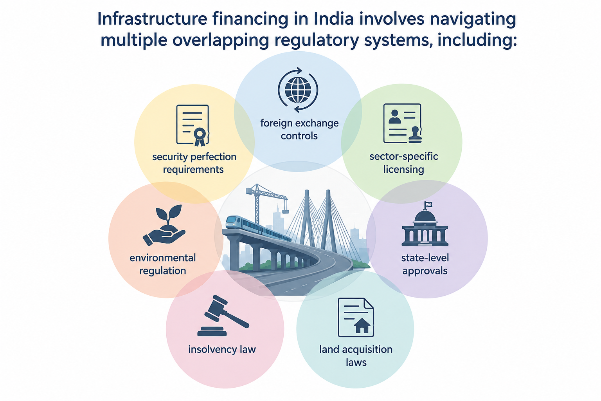
India’s project finance market operates through a multi-layered framework involving foreign exchange regulations, sector-specific approvals, insolvency laws, environmental compliance and state-level regulations. Key regulators include the Reserve Bank of India and the Securities and Exchange Board of India.
Foreign investment into Indian infrastructure projects is regulated under FEMA and India’s FDI policy framework. While many sectors permit 100% foreign ownership under the automatic route, investors must still navigate pricing rules, reporting requirements, security creation restrictions and repatriation conditions.
The UK’s Streamlined Regulatory Framework
The UK framework is comparatively streamlined and institutionally mature. Unlike India, the UK does not impose broad exchange control restrictions, making capital movement, refinancing and offshore financing structures considerably simpler.
Financing Structures and Capital Markets
India’s infrastructure market was historically dominated by public sector bank lending. Today, however, the market increasingly includes sovereign wealth funds, infrastructure debt funds, InvITs, offshore bond investors and private credit platforms.
Recent RBI reforms, including the RBI Project Finance Directions, 2025, have also strengthened lender monitoring and risk management standards.
The UK market benefits from a far more developed institutional financing ecosystem, including pension fund participation, sophisticated bond markets and long-established PPP financing models. This allows for greater refinancing flexibility and lower regulatory friction.
PPPs and Infrastructure Development
Public-private partnerships have played an important role in both jurisdictions, but with very different trajectories.
India’s earlier PPP wave faced challenges involving land acquisition delays, aggressive bidding and concession disputes. Modern concession structures now place greater emphasis on balanced risk allocation, lender protections and termination compensation frameworks.
The UK, as one of the pioneers of PPP and PFI models, benefits from decades of institutional experience in concession drafting, availability-based payment systems and infrastructure refinancing structures.
Security Enforcement and Insolvency
Security enforcement remains one of the most important considerations in cross-border project finance.
Indian project finance structures generally involve complex security packages comprising mortgages, hypothecation, receivables assignments and share pledges. Enforcement may involve SARFAESI proceedings, insolvency resolution under the IBC and coordination with sectoral regulators.
India’s Insolvency and Bankruptcy Code, 2016 significantly improved creditor rights and introduced time-bound resolution mechanisms. However, infrastructure insolvencies can still involve operational and regulatory complexities.
The UK enforcement framework is comparatively more streamlined and predictable, supported by mature insolvency jurisprudence, efficient restructuring procedures and sophisticated rescue mechanisms.
Renewable Energy and Digital Infrastructure
Both India and the UK are witnessing strong growth in renewable energy and digital infrastructure investment, though the market dynamics differ significantly.
India offers large-scale opportunities in solar, wind, battery storage, green hydrogen and data centre development. The market continues to attract global ESG-focused capital due to its scale and long-term growth potential.
The UK renewable market is more mature and concentrated around offshore wind, grid modernisation and operational energy transition assets, with more standardised financing structures and lower development risk.
Which Market Is More Attractive?
The answer ultimately depends on investor objectives.
What India Offers
- Higher growth potential
- Large-scale infrastructure demand
- Greenfield investment opportunities
- Long-term expansion potential
What the UK Offers
- Regulatory predictability
- Stable cashflow assets
- Mature capital markets
- Lower enforcement risk
Increasingly, global infrastructure investors are allocating capital to both — using UK assets for stability and Indian assets for growth.
Conclusion
India and the UK represent two strategically important but fundamentally different project finance markets.
India continues to emerge as one of the world’s most dynamic infrastructure investment destinations, driven by infrastructure expansion, renewable energy growth and digital transformation. The UK, meanwhile, remains a highly sophisticated and institutionally stable project finance jurisdiction with strong enforcement mechanisms and mature financing ecosystems.
For international investors and lenders, understanding the legal, regulatory and commercial differences between these jurisdictions is essential for structuring transactions, allocating risk and optimising long-term infrastructure investment strategy.
Last Updated on 13 May, 2026

By entering the email address you agree to our Privacy Policy.