
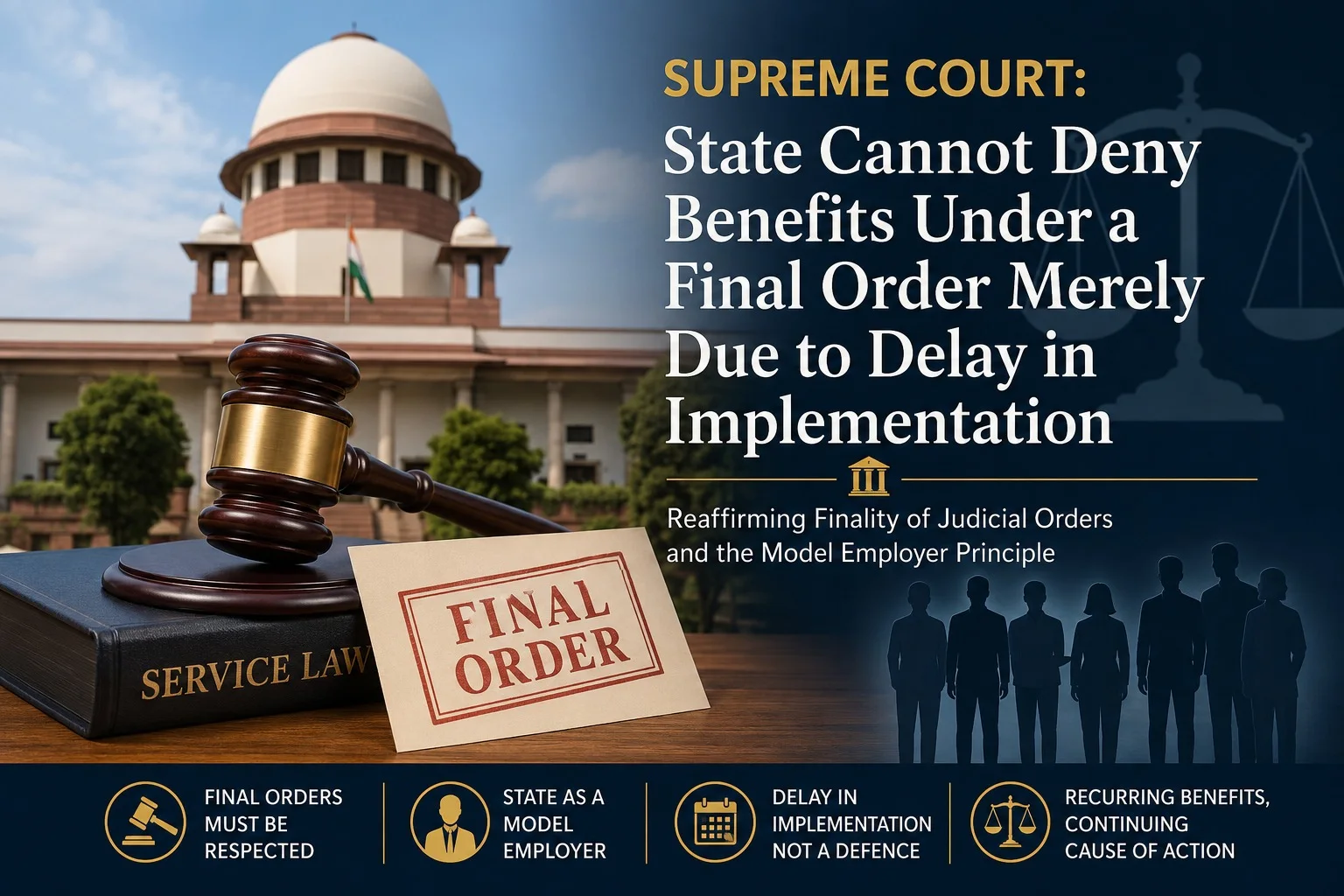
State Cannot Deny Benefits Under a Final Judicial Order Merely Because Employees Delayed Seeking Its Implementation: Supreme Court Reaffirms Finality of Judicial Decisions
Introduction
Can a government department refuse to implement a judicial order that has already attained finality simply because the affected employees approached the court several years later seeking its enforcement?
The Supreme Court has answered this question with a clear no. In B. Yerraji & Ors. v. State of Andhra Pradesh & Ors. (2026), the Court reaffirmed a fundamental principle of Indian service jurisprudence: once a judicial or tribunal order has become final, the State cannot avoid complying with it by relying upon delay, laches or administrative inaction.
The decision is significant far beyond the facts of the case. It reinforces the constitutional obligation of the State to function as a model employer, clarifies the distinction between delay in instituting a legal claim and delay in enforcing an already adjudicated right, and reiterates that recurring service benefits such as salary, pension and regularisation cannot ordinarily be defeated through technical objections based on limitation.
For government employers, public sector undertakings, service law practitioners and employees alike, the judgment is another reminder that bureaucratic delay cannot be converted into a legal defence against compliance with binding judicial orders.
Background of the Dispute
The dispute arose from claims made by a group of Grade-IV employees serving under the State of Andhra Pradesh. The employees had previously approached the State Administrative Tribunal seeking regularisation of their services and consequential monetary benefits. The Tribunal allowed their claim and directed the State to extend the service benefits due to them.
Importantly, the State did not successfully challenge the Tribunal’s order. Consequently, the decision attained finality. Despite this, the order remained unimplemented for years.
When the employees eventually initiated contempt proceedings seeking implementation of the Tribunal’s directions, the State resisted enforcement by arguing that the employees themselves had remained inactive for several years and were therefore guilty of delay and laches.
The central legal issue before the Supreme Court was therefore straightforward: Can a final judicial order become unenforceable merely because its beneficiaries approached the court belatedly for its implementation? The Court answered the question in the negative.
The Larger Legal Issue: Delay in Filing a Claim vs Delay in Enforcing a Final Order
One of the most important aspects of the judgment is the distinction the Court drew between two entirely different legal situations. The first concerns a person approaching the court for the first time after an unreasonable delay. In such cases, the doctrine of laches or statutory limitation may legitimately defeat the claim. The second concerns a person who has already obtained a final judicial determination in their favour.
Once a competent judicial forum has conclusively recognised a person’s rights, the nature of the dispute fundamentally changes. The controversy is no longer about whether the claimant is entitled to relief but about whether the State can refuse to obey a binding judicial decision. The Supreme Court made it clear that these situations cannot be treated alike. A delay in initiating litigation may sometimes be fatal. A delay in seeking implementation of an already binding order generally is not.
Why Finality of Judicial Decisions Matters
Indian courts have consistently emphasised that litigation must eventually come to an end. The doctrine of finality serves several constitutional purposes:
- ensuring certainty in legal rights;
- preserving public confidence in the judicial process;
- preventing repetitive litigation; and
- maintaining the authority of courts and tribunals.
Once all available appellate remedies have either been exhausted or allowed to lapse, the judgment becomes binding upon the parties. At that stage, the successful litigant is no longer required to prove the merits of the case. The State’s obligation shifts from contesting liability to implementing the decision faithfully and within a reasonable period.
Allowing government authorities to reopen settled issues merely because implementation was sought after some delay would undermine the entire concept of judicial finality.
The Supreme Court’s Reasoning
The Bench comprising Justice Ahsanuddin Amanullah and Justice Vipul M. Pancholi rejected the State’s objection. The Court observed that the Tribunal’s earlier decision had already attained finality. Since the order had become binding, the government could not reopen the issue indirectly by arguing that the employees had approached the court late for enforcement.
The Court further noted that the State itself had failed to comply with the judicial order for years. Permitting the government to rely upon that very delay would effectively allow it to benefit from its own continuing default which is an approach fundamentally inconsistent with constitutional fairness.
Accordingly, the Court directed implementation of the Tribunal’s order and release of the consequential benefits. However, considering the employees’ own conduct, particularly their delay and lack of disclosure regarding earlier proceedings, the Court declined to award interest on the arrears. This illustrates the Court’s attempt to balance equities without diluting the enforceability of the principal relief.
Reinforcing the “Model Employer” Principle
Perhaps the most significant aspect of the judgment is its reaffirmation of the State’s obligation to function as a model employer. Unlike a private litigant, the government carries constitutional responsibilities that extend beyond winning individual disputes.
The Supreme Court has repeatedly held that public authorities should not rely upon technical objections, procedural loopholes or avoidable litigation strategies to deny legitimate service benefits.
Instead, government departments are expected to implement binding judicial decisions voluntarily, particularly where employees have already succeeded before competent judicial forums. The present judgment reinforces that expectation. It makes clear that a government employer cannot simply wait for employees to initiate contempt proceedings before complying with judicial directions.
Continuing Wrong and Recurring Service Benefits
The judgment also aligns with the well-established doctrine of continuing wrong in service jurisprudence. Salary, pension, increments and several other service benefits are recurring obligations. Every month that an employee is denied a legally recognised benefit constitutes a fresh injury. Consequently, each recurring denial gives rise to a fresh cause of action.
This principle has assumed particular importance in disputes involving:
- pay fixation;
- pension revision;
- service regularisation;
- promotional benefits;
- annual increments;
- retirement benefits; and
- arrears flowing from judicial orders.
The Court’s reasoning recognises that the State cannot indefinitely postpone compliance and then argue that time itself has extinguished the employee’s rights.
Consistency with Earlier Supreme Court Precedents
The judgment builds upon an established line of Supreme Court decisions dealing with delay, recurring causes of action and implementation of judicial orders. In Kusheshwar Prasad Singh v. State of Bihar1, the Supreme Court recognised that recurring service benefits generate recurring causes of action, making the defence of delay considerably weaker where continuing violations persist.
Similarly, M.P. Housing Board v. Kalyan Singh2 emphasised that public authorities cannot compel employees to repeatedly litigate for enforcement of rights already recognised by courts. The Court’s observations also resonate with the broader principle that the government should function as a responsible litigant rather than an adversarial party seeking to defeat legitimate claims through procedural objections. Viewed together, B. Yerraji does not introduce an entirely new legal principle.
Instead, it strengthens and consolidates existing jurisprudence by applying these doctrines to the enforcement of final tribunal orders.
Practical Implications
The judgment has important consequences for multiple stakeholders.
For Government Departments
Authorities should promptly implement final judicial and tribunal orders instead of waiting for contempt proceedings. Administrative delay will not ordinarily provide a valid legal defence against compliance.
For Government Employees
Employees who have already secured favourable judicial orders retain the right to seek implementation even if enforcement proceedings are initiated after some delay. While unexplained delay may affect discretionary relief such as interest, it does not ordinarily extinguish the substantive rights recognised by the court.
For Public Sector Undertakings
PSUs frequently face disputes concerning promotions, pay revision, pension fixation and regularisation. The decision reinforces that implementation strategies should prioritise compliance rather than technical resistance once litigation has concluded.
For Service Law Practitioners
The judgment offers valuable authority when governments attempt to oppose execution or contempt proceedings solely on grounds of delay after the underlying judgment has already attained finality.
Key Takeaways
The Supreme Court’s ruling establishes several important propositions:
- A final judicial or tribunal order cannot ordinarily be defeated by invoking delay in its enforcement.
- Delay in seeking implementation is fundamentally different from delay in initiating litigation.
- The State cannot derive an advantage from its own prolonged failure to comply with binding judicial directions.
- Service benefits involving recurring obligations continue to generate fresh causes of action.
- Courts may refuse ancillary relief such as interest where the employee’s own conduct warrants it, without denying the principal relief itself.
Conclusion
The Supreme Court’s decision in B. Yerraji & Ors. v. State of Andhra Pradesh & Ors. is an important reaffirmation of two foundational principles of Indian administrative law: the finality of judicial decisions and the State’s obligation to act as a model employer.
By rejecting the government’s attempt to rely upon delay after allowing a tribunal’s order to attain finality, the Court has reinforced that constitutional governance requires faithful compliance with judicial decisions rather than procedural resistance. At the same time, by declining to award interest, it demonstrated that equitable considerations remain relevant even while protecting substantive rights.
The ruling is therefore likely to assume considerable significance in future disputes involving service regularisation, pension claims, pay fixation, promotional benefits and implementation of tribunal or court orders. More broadly, it serves as a reminder that once litigation has conclusively settled the rights of the parties, the State’s duty is not to continue the dispute, but to honour the judgment.
Last Updated on 13 July, 2026

By entering the email address you agree to our Privacy Policy.