
India Project Finance Laws 2026: A Complete Guide for Foreign Investors and Lenders

India’s infrastructure and project finance sector is entering a transformative era driven by regulatory reforms, large-scale infrastructure expansion and increasing participation from global capital markets. As one of the world’s fastest-growing major economies, India continues to attract foreign institutional investors, sovereign wealth funds, multilateral lenders, infrastructure funds, export credit agencies and international commercial banks seeking long-term exposure to infrastructure and energy assets.
The Indian Government’s continued emphasis on renewable energy, logistics, transportation, digital infrastructure, airports, urban development and manufacturing has created substantial demand for long-term project financing. Simultaneously, regulatory reforms under the Reserve Bank of India (“RBI”), the Insolvency and Bankruptcy Code, 2016 (“IBC”), the Foreign Exchange Management Act, 1999 (“FEMA”) and sector-specific frameworks have significantly altered the legal landscape governing infrastructure finance transactions.
For foreign investors and lenders, India presents compelling opportunities but also a highly nuanced regulatory environment requiring careful structuring, due diligence and compliance planning.
This article provides a comprehensive overview of the Indian project finance legal framework in 2026 and highlights the key legal, regulatory and practical considerations for foreign investors and lenders evaluating Indian infrastructure opportunities.
India’s Project Finance Market: Why Global Capital Is Increasingly Interested
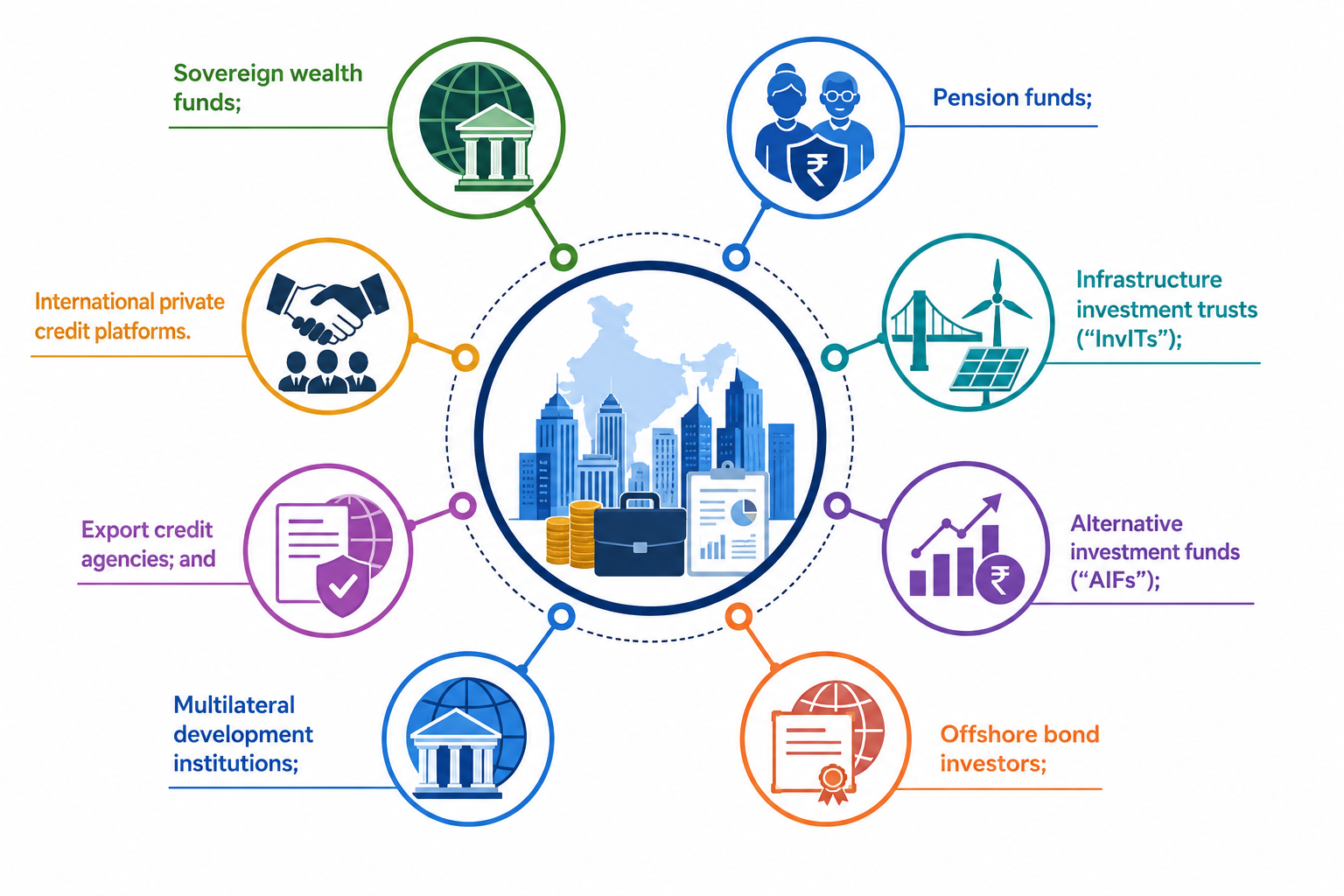
Historically dominated by domestic public sector bank lending, the market has now diversified to include:
This transformation has been driven by:
- Rapid infrastructure demand;
- Government-backed infrastructure programmes;
- Renewable energy expansion;
- Greater policy stability; and
- Increasing maturity of financing and restructuring frameworks.
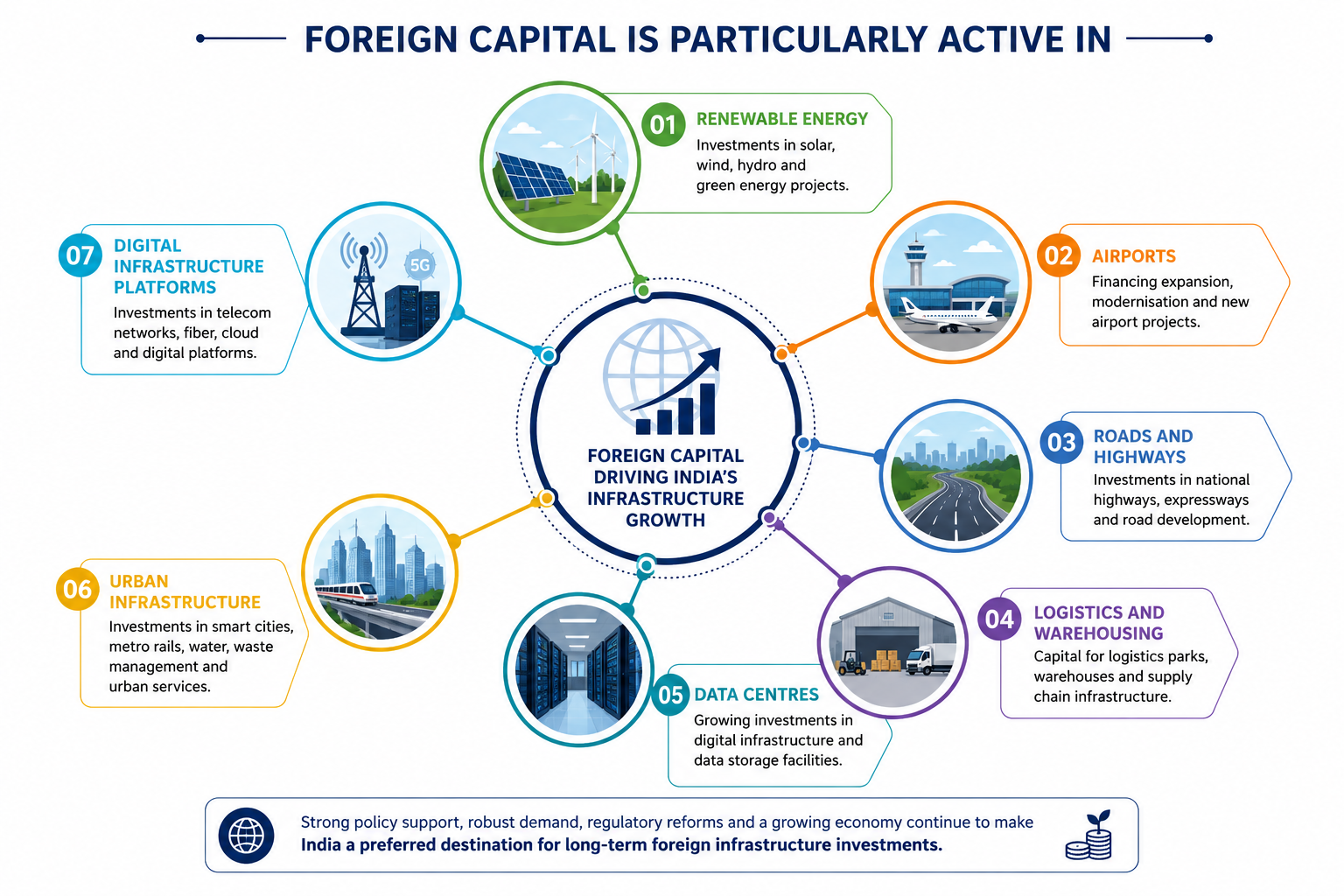
Foreign capital is particularly active in:
The Legal Framework Governing Project Finance in India
Project finance transactions in India are governed by a combination of:
- Corporate law;
- Banking and financial regulations;
- Insolvency law;
- Exchange control regulations;
- Security enforcement laws;
- Tax laws; and
- Sector-specific regulatory frameworks.
The principal legal statutes governing project finance include:
- The Companies Act, 2013;
- The Insolvency and Bankruptcy Code, 2016;
- FEMA and related RBI regulations;
- The Transfer of Property Act, 1882;
- The Securitisation and Reconstruction of Financial Assets and Enforcement of Security Interest Act, 2002 (“SARFAESI”);
- The Arbitration and Conciliation Act, 1996; and
- Sector-specific concession and regulatory statutes.
Understanding how these laws interact is critical for structuring enforceable and bankable project finance transactions.
RBI Project Finance Directions 2025: A Major Regulatory Shift
One of the most important recent developments has been the introduction of the RBI (Project Finance) Directions, 2025. The Directions create a harmonised prudential framework applicable to:
- Banks;
- NBFCs; and
- All India Financial Institutions.
The framework introduces:
- Milestone-based disbursement structures;
- Enhanced project monitoring obligations;
- DCCO-linked provisioning;
- Lifecycle-based project classification; and
- Standardised restructuring principles.
For foreign lenders participating in Indian infrastructure financing, the PF Directions are particularly important because they influence:
- Consortium lending dynamics;
- Project implementation obligations;
- Monitoring requirements; and
- Refinancing structures.
Foreign investors should expect Indian financing transactions to become increasingly compliance-driven and monitoring-intensive.
Foreign Investment Rules and FEMA Compliance
Foreign participation in Indian project finance transactions is primarily regulated under FEMA and the Foreign Direct Investment (“FDI”) framework.
Automatic Route vs Government Approval Route
Foreign investments in many infrastructure sectors are permitted under the automatic route, meaning prior government approval is not required. However, certain sectors remain subject to:
- Sectoral caps;
- Conditional approvals; or
- Government approval requirements.
Foreign investors must carefully assess:
- Whether the target sector permits foreign investment;
- Applicable investment limits;
- Pricing guidelines;
- Downstream investment restrictions; and
- Reporting obligations.
Press Note 3 and Border Country Investments
Investments originating from countries sharing land borders with India continue to attract additional scrutiny under the Press Note 3 framework. Although the framework is evolving, foreign investors must carefully assess beneficial ownership structures before investing in Indian infrastructure assets.
External Commercial Borrowings (ECBs): A Preferred Offshore Financing Route
External Commercial Borrowings (“ECBs”) remain one of the most commonly used financing mechanisms for Indian infrastructure projects. The RBI’s ECB framework governs:
- Eligible borrowers;
- Eligible lenders;
- Permitted end uses;
- Minimum average maturity requirements;
- Hedging obligations; and
- Reporting compliance.
Infrastructure companies frequently utilise ECBs because they provide:
- Access to lower-cost offshore capital;
- Longer tenor financing;
- Foreign currency funding flexibility; and
- Institutional lender participation.
However, ECB transactions require careful structuring to ensure compliance with:
- FEMA regulations;
- Security creation rules;
- Withholding tax obligations; and
- End-use restrictions.
Security Creation in Indian Project Finance Transactions
Typical project finance security includes:
- Mortgage over immovable property;
- Hypothecation of movable assets;
- Assignment of project contracts and receivables;
- Charge over project bank accounts; and
- Pledge of shares.
Mortgage and Immovable Property Security
Security over land and immovable assets is generally created through Mortgage deeds; or deposit of title deeds. Foreign lenders must note that enforcement involving immovable property can be subject to FEMA-related limitations. In many cases, enforcement rights are exercised through security trustees or authorised domestic entities.
Share Pledges
Pledge of shares remains one of the most important forms of security in Indian project finance transactions. Security over dematerialised shares is generally easier to enforce compared to physical securities. Foreign investors should also evaluate:
- Regulatory approvals;
- FEMA implications; and
- Enforcement mechanics when structuring share security arrangements.
CERSAI and Security Perfection
Registration of security interests with the Registrar of Companies (“RoC”); and CERSAI is critical for preserving enforcement priority and insolvency rights. Failure to properly perfect security may materially impair creditor recovery prospects.
Insolvency and Restructuring Under the IBC
The IBC has fundamentally changed the creditor enforcement landscape in India. The framework provides a time-bound restructuring and insolvency mechanism for corporate debtors.
Moratorium Impact on Lenders
Once insolvency proceedings commence Enforcement actions are stayed; Security enforcement is restricted; and Creditors must participate through the insolvency process. This can materially affect lender recovery timelines.
Committee of Creditors (“CoC”)
Financial creditors participate in the Committee of Creditors, which controls key restructuring decisions. Voting rights are determined based on financial exposure. The IBC has significantly strengthened creditor influence compared to pre-IBC restructuring regimes.
Distressed Infrastructure Investments
The “clean slate” principle under the IBC has improved investor appetite for distressed infrastructure acquisitions. Resolution applicants acquiring distressed assets through approved plans generally receive protection from historical liabilities. This has led to increasing activity by:
- Distressed asset funds;
- Infrastructure investors; and
- Special situations platforms.
Sector-Specific Regulatory Considerations
Project finance transactions in India frequently involve sector-specific regulatory frameworks.
Renewable Energy
Renewable energy projects require evaluation of:
- Power purchase agreements (“PPAs”);
- Grid connectivity;
- Open access regulations;
- Renewable purchase obligations; and
- Land acquisition restrictions.
Hybrid renewable projects and battery storage systems introduce additional technical and regulatory complexity.
Airports and Aviation
Airport projects typically involve:
- Concession agreements;
- Substitution rights;
- Government approvals; and
- Aviation regulator oversight.
Foreign investors should carefully review concession termination compensation frameworks and step-in rights.
Data Centres
Data centres have emerged as a major infrastructure asset class. Key legal considerations include:
- Power supply arrangements;
- Data privacy compliance;
- ESG obligations;
- State-level incentives; and
- Technology infrastructure risk allocation.
Arbitration and Governing Law in Cross-Border Transactions
International project finance transactions involving foreign lenders frequently adopt:
- English law-governed financing documents; and
- International arbitration frameworks.
Indian law typically governs Security documents, project agreements involving Indian assets, and local regulatory compliance matters. India’s arbitration framework has matured significantly and Indian courts generally adopt a pro-enforcement approach toward foreign arbitral awards.
However, lenders must still carefully assess:
- Public policy considerations;
- Non-arbitrable subject matters; and
- Enforcement practicalities.
Taxation and Withholding Considerations
Foreign lenders and investors must carefully structure transactions from a tax perspective. Key considerations include:
- Withholding tax on interest payments;
- Capital gains tax exposure;
- Treaty benefits under Double Taxation Avoidance Agreements (“DTAAs”);
- Stamp duty implications; and
- Goods and Services Tax (“GST”) exposure.
Infrastructure transactions frequently require multi-jurisdictional tax structuring to optimise efficiency and minimise leakage.
ESG and Sustainability Financing
Environmental, social and governance (“ESG”) considerations have become central to infrastructure financing. Global investors increasingly require:
- Sustainability-linked financing frameworks;
- Climate-related disclosures;
- Labour compliance monitoring;
- Governance oversight; and
- Environmental impact assessment compliance.
Projects aligned with sustainability objectives often benefit from:
- Better financing access;
- Reduced financing costs; and
- Wider institutional participation.
Renewable energy, green hydrogen and sustainable urban infrastructure continue to attract strong ESG-driven capital flows.
GIFT City and Offshore Capital Market Opportunities
India’s International Financial Services Centre (“IFSC”) at GIFT City is becoming increasingly relevant for cross-border financing structures. GIFT City provides:
- Tax efficiencies;
- Regulatory flexibility;
- Easier access to offshore investors; and
- Enhanced capital market connectivity.
Several Indian infrastructure companies have successfully utilised GIFT City platforms for offshore bond issuances and structured financing arrangements. This trend is expected to accelerate as India seeks to position the IFSC as a global financial hub.
Key Risks Foreign Investors and Lenders Must Evaluate
Despite the strong growth potential, project finance transactions in India require careful assessment of:
- Land acquisition risks;
- Regulatory approval dependencies;
- Environmental clearances;
- Implementation delays;
- Currency fluctuation exposure;
- Political and policy risks;
- Enforcement timelines; and
- Counterparty creditworthiness.
Well-structured due diligence and transaction documentation remain essential.
Conclusion
India’s project finance market in 2026 presents one of the most significant infrastructure investment opportunities globally. The combination of:
- Rapid infrastructure demand;
- Regulatory reforms;
- Expanding institutional participation;
- Renewable energy transition; and
- Digital infrastructure growth
continues to attract substantial global capital.
At the same time, India’s regulatory environment remains highly sophisticated and increasingly compliance-intensive.
For foreign investors and lenders, successful participation in Indian infrastructure transactions requires:
- Deep regulatory understanding;
- Careful structuring;
- Robust due diligence;
- Strong local execution capabilities; and
- Sector-specific legal expertise.
As infrastructure financing structures continue to evolve, stakeholders who combine long-term investment vision with regulatory preparedness will be best positioned to capitalise on India’s infrastructure growth story.
Last Updated on 9 May, 2026

By entering the email address you agree to our Privacy Policy.