
The Masala Dosa Economy: The Law Behind India’s Supply Chains
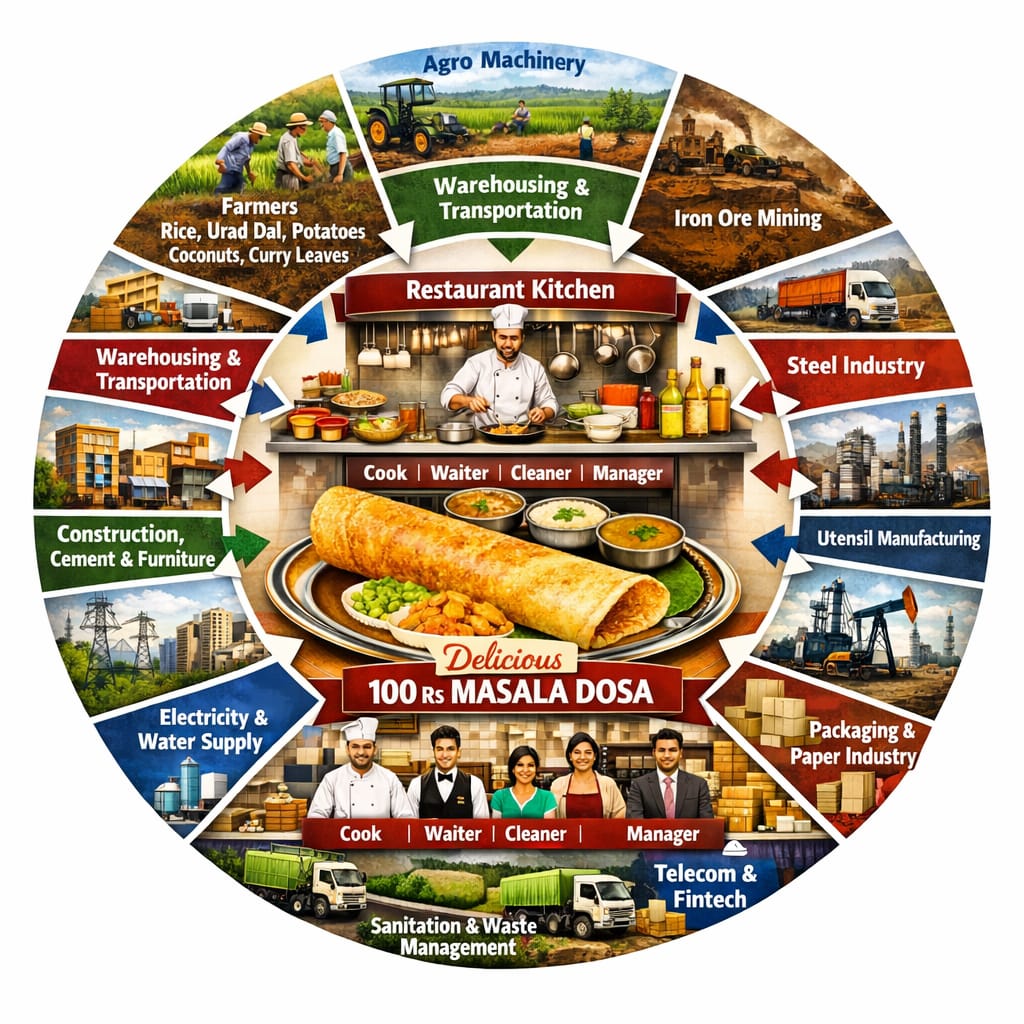
A masala dosa served for ₹100 looks deceptively simple. But behind that single plate lies an entire economy farmers, miners, refiners, manufacturers, logistics operators, warehouses, and restaurants, each link governed by a distinct legal architecture.
Introduction
A plate of masala dosa priced at ₹100 may appear simple, but its existence depends on a vast and interconnected economic ecosystem. From agricultural production and energy supply to mining, manufacturing, logistics, finance, digital infrastructure, and retail, numerous industries contribute to bringing this everyday food item to the consumer. Each of these sectors operates within its own regulatory environment, shaped by distinct statutory frameworks, compliance requirements, and contractual relationships.
Modern supply chains are therefore not merely operational networks but legally structured systems that coordinate multiple stakeholders across jurisdictions and industries. The movement of raw materials, the transformation of inputs into finished products, the storage and transportation of goods, and the final delivery to consumers all occur within a complex matrix of regulatory oversight and commercial obligations.
This article traces this very journey, from soil to stove, and examines the legal architecture that makes it possible. Understanding how law shapes supply chains is essential for any business that aspires to resilience, scalability, and long-term competitiveness in the Indian market.
Table of Contents
Agriculture: Seeds, Fertilizers and Farm Inputs
Every dosa begins with agricultural produce namely rice, urad dal, potatoes, coconut, and spices but agriculture itself depends on an upstream ecosystem that is heavily regulated.
Seed quality, fertilizer pricing, and contract farming arrangements all shape the reliability and cost of raw inputs. Without legal certainty at the farm input level, the supply chain begins with instability that cascades through every downstream stage.
For businesses sourcing agricultural commodities, understanding this regulatory landscape is critical to managing procurement risk and structuring enforceable supplier relationships.
Key Stakeholders
| ▸ Farmers and cultivators | ▸ Farm equipment companies |
| ▸ Seed companies | ▸ Agri-technology platforms |
| ▸ Fertilizer manufacturers | ▸ Agricultural credit institutions |
Governing Legal Frameworks
- The Seeds Act, 1966
- The Fertiliser (Control) Order, 1985
- The Essential Commodities Act, 1955
- State APMC (Agricultural Produce Market Committee) Regulations
Critical Legal Issues
- Seed quality certification and intellectual property protection for plant varieties
- Fertilizer subsidy frameworks and price controls affecting supply economics
- Contract farming disputes between processors and farmers
- Agricultural credit access and crop insurance compliance
Required Protections
- Transparent and efficient seed certification systems
- Robust enforceability of contract farming arrangements
- Comprehensive crop insurance and financial risk mitigation
- Fair pricing frameworks preventing market distortion
Energy Backbone: Oil, Gas, Fuel and Electricity
Cooking a dosa requires energy including LPG for the restaurant stove, electricity for cold storage and refrigeration, diesel for the trucks that deliver ingredients. That energy travels through its own complex supply chain before it ever reaches a kitchen.
The energy sector is among the most heavily regulated in India, and with good reason. Price instability, infrastructure failures, or regulatory uncertainty in this sector have immediate knock-on effects across every other link in the supply chain.
For businesses operating in food, logistics, and manufacturing, energy regulatory risk is often underappreciated until a tariff revision or supply disruption exposes just how exposed they are.
Key Stakeholders
| ▸ Crude oil exploration companies | ▸ Electricity generation companies |
| ▸ Petroleum refining companies | ▸ Transmission and distribution utilities |
| ▸ LPG and gas distributors | ▸ Renewable energy producers |
Governing Legal Frameworks
- Petroleum and Natural Gas Regulatory Board Act, 2006
- Electricity Act, 2003
- The Petroleum Act, 1934 and Petroleum Rules, 2002
- Central Electricity Regulatory Commission regulations
Critical Legal Issues
- Energy pricing, subsidies, and tariff regulation affecting operational costs
- Infrastructure access rights and pipeline easements
- Safety regulations governing LPG and gas distribution
- Power purchase agreements and renewable energy obligations
Required Protections
- Stable, predictable regulatory frameworks for energy pricing
- Investment protection for energy infrastructure
- Rigorous safety compliance regimes for gas distribution
- Contractual clarity between energy suppliers and industrial consumers
Mining and Industrial Raw Materials
The steel griddle on which a dosa is cooked requires iron ore mined in Odisha or Jharkhand, processed in a steel plant, formed into flat-rolled products, and shaped by a kitchen equipment manufacturer. The plastic packaging for spice pastes involves a petrochemical chain of equal complexity.
Mining and heavy industry form the industrial foundation of virtually every supply chain in India including food. Environmental clearances, mining lease disputes, and royalty frameworks directly affect the availability and pricing of the materials used throughout the chain.
Legal counsel with cross-sector expertise in resources, environment, and industrial regulation is increasingly essential for businesses navigating this space.
Key Stakeholders
| ▸ Mining and extraction companies | ▸ Plastic and packaging producers |
| ▸ Metal processing industries | ▸ Industrial equipment manufacturers |
| ▸ Petrochemical manufacturers | ▸ Environmental compliance consultants |
Governing Legal Frameworks
- Mines and Minerals (Development and Regulation) Act, 1957
- Environment (Protection) Act, 1986
- The Forest (Conservation) Act, 1980
- Occupational Safety, Health and Working Conditions Code, 2020
Critical Legal Issues
- Mining lease allocations and competitive bidding transparency
- Environmental clearances and impact assessments causing project delays
- Worker safety and occupational health compliance
- Royalty structures and state-level taxation frameworks
Required Protections
- Transparent and competitive resource licensing regimes
- Streamlined environmental clearance without compromising accountability
- Robust occupational safety enforcement systems
- Long-term policy predictability to incentivise infrastructure investment
Manufacturing and Food Processing
Raw agricultural materials are transformed into consumer-ready goods through milling, refining, and food processing. This is where supply chain risk intensifies: food safety failures at this stage can trigger product recalls, regulatory action, and significant civil liability.
The Food Safety and Standards Authority of India has progressively tightened compliance requirements across the food manufacturing sector. Businesses that treat FSSAI compliance as a checkbox exercise rather than a genuine risk management function expose themselves to operational and reputational consequences that can be difficult to reverse.
Product liability in the food sector deserves particular attention. As consumer litigation matures in India following the Consumer Protection Act, 2019, manufacturers must have clear contractual and insurance arrangements covering liability across the supply chain.
Key Stakeholders
| ▸ Rice mills and dal processing plants | ▸ Packaging manufacturers |
| ▸ Edible oil refineries | ▸ Food technology companies |
| ▸ Spice and condiment manufacturers | ▸ Contract manufacturers |
Governing Legal Frameworks
- The Food Safety and Standards Act, 2006 (FSSAI)
- The Factories Act, 1948
- The Legal Metrology Act, 2009
- Bureau of Indian Standards (BIS) regulations
Critical Legal Issues
- FSSAI licensing and food safety compliance across manufacturing operations
- Worker safety and factory inspection obligations
- Product liability exposure for contaminated or mislabelled goods
- Intellectual property protection in food innovation and proprietary formulations
Required Protections
- Robust quality control and documentation standards
- End-to-end compliance management systems
- Clear product liability and recall frameworks
- IP protection mechanisms for food product innovation
Warehousing and Cold Storage
Before ingredients reach any restaurant or retailer, they typically pass through warehouses and cold storage facilities, sometimes for extended periods. The legal regime governing warehousing directly affects whether goods can be financed, insured, and reliably recovered.
Warehouse receipt financing has emerged as a critical tool for agricultural commodity financing in India, enabling farmers and traders to unlock capital against stored goods. However, the legal architecture supporting these instruments remains underdeveloped in practice, with significant gaps in enforcement and documentation standards.
Cold chain infrastructure essential for perishables like dairy, vegetables, and seafood, operates under both food safety and logistics regulations, creating a complex compliance environment that requires careful navigation.
Key Stakeholders
| ▸ Warehouse operators and logistics parks | ▸ Inventory financiers and NBFCs |
| ▸ Cold chain logistics companies | ▸ Insurance companies |
| ▸ Commodity traders and aggregators | ▸ Technology platform providers |
Governing Legal Frameworks
- The Warehousing (Development and Regulation) Act, 2007
- Warehousing Development and Regulatory Authority (WDRA) Regulations
- The Negotiable Instruments Act, 1881 (for warehouse receipts financing)
- FSSAI food storage and hygiene regulations
Critical Legal Issues
- Warehouse receipt financing structures and enforceability
- Liability for loss, damage, or spoilage of stored goods
- Cold chain compliance and temperature documentation
- Insurance coverage adequacy for stored inventory
Required Protections
- Standardised and legally enforceable warehouse documentation
- Comprehensive insurance frameworks covering storage and transit risks
- Temperature and storage compliance monitoring systems
- Clear contractual allocation of liability between warehouse operators and depositors
Logistics, Transportation and Mobility
Transportation is the circulatory system of every supply chain. Ingredients sourced from Karnataka, Madhya Pradesh, and Tamil Nadu must travel, often across multiple state boundaries, before they arrive at a restaurant kitchen in Bengaluru or Mumbai.
The logistics sector in India has undergone significant regulatory transformation in recent years, including the introduction of the GST e-way bill system and evolving vehicle safety standards. The shift towards electric vehicles in freight is creating new contractual and regulatory questions around fleet financing, battery ownership, and maintenance obligations.
Carrier liability under Indian law remains significantly more limited than international standards, a gap that businesses often discover only after a transit loss. Properly structured logistics contracts and freight insurance are non-negotiable risk management tools.
| ▸ Truck operators and fleet companies | ▸ Third-party logistics (3PL) companies |
| ▸ Rail freight providers | ▸ Electric vehicle manufacturers |
| ▸ Shipping and port operators | ▸ Freight technology platforms |
Governing Legal Frameworks
- The Motor Vehicles Act, 1988
- The Carriage by Road Act, 2007
- The Central Goods and Services Tax Act, 2017
- The Multimodal Transportation of Goods Act, 1993
Critical Legal Issues
- Carrier liability for goods lost, damaged, or delayed in transit
- Interstate transport compliance and e-way bill documentation
- Road safety regulations and driver compliance
- GST compliance for multi-state movements of goods
Required Protections
- Clearly drafted logistics contracts with explicit liability allocation
- Standardised freight documentation and digital tracking systems
- Adequate cargo insurance covering all modes of transit
- GST-compliant invoicing and documentation frameworks
Utilities and Infrastructure
Restaurants and food businesses depend on utilities for their day-to-day survival: electricity to power refrigeration and cooking equipment, water for cleaning and preparation, gas for cooking. These utilities are so fundamental that their disruption can halt operations entirely.
The regulatory framework governing utilities in India is fragmented across central and state authorities, creating compliance complexity for multi-state food businesses. Tariff revisions and load-shedding policies can significantly affect operational economics with little advance notice.
For businesses investing in food infrastructure including cloud kitchens, processing facilities, restaurant chains, utility availability and pricing must be factored into site selection and investment decisions from the outset.
Key Stakeholders
| ▸ Electricity distribution companies (DISCOMs) | ▸ Telecom and digital infrastructure providers |
| ▸ Water utilities and municipal corporations | ▸ Industrial area development authorities |
| ▸ LPG and piped gas distribution companies | ▸ Smart city infrastructure operators |
Governing Legal Frameworks
- Electricity Act, 2003
- The Water (Prevention and Control of Pollution) Act, 1974
- State municipal laws and local body regulations
- Telecom Regulatory Authority of India regulations
Critical Legal Issues
- Service reliability obligations and compensation for outages
- Tariff regulation and the risk of sudden tariff revisions
- Utility licensing requirements for restaurants and food businesses
- Infrastructure disputes between operators and municipal authorities
Required Protections
- Enforceable service continuity obligations on utility providers
- Protection for infrastructure investments against regulatory reversals
- Transparent and predictable tariff regulatory oversight
- Efficient dispute resolution for commercial utility consumers
Retail, Hospitality and the Consumer Interface
The restaurant is where the supply chain meets the consumer and where legal liability becomes most visible. A food safety failure at this stage can attract regulatory action, consumer complaints before the National Consumer Disputes Redressal Commission, and reputational damage that travels at the speed of social media.
Food delivery platforms have introduced new complexity to the consumer interface. Questions of platform liability for the quality of food delivered, the employment status of delivery personnel, and data privacy obligations for consumer information are all areas where the law is still evolving and where early legal clarity confers competitive advantage.
The Consumer Protection Act, 2019 significantly expanded the rights of consumers and the mechanisms for enforcement. Businesses that have not updated their compliance frameworks to reflect this legislation are operating with unacknowledged legal exposure.
Key Stakeholders
| ▸ Restaurants, QSRs, and cafés | ▸ Dark kitchens and cloud kitchen operators |
| ▸ Food delivery aggregator platforms | ▸ Online grocery platforms |
| ▸ Retailers, supermarkets, and wholesalers | ▸ Consumer brands and D2C companies |
Governing Legal Frameworks
- The Consumer Protection Act, 2019
- FSSAI licensing and food safety regulations
- The Information Technology (Intermediary Guidelines) Rules, 2021
- State-level shops and establishment legislation
Critical Legal Issues
- Food safety compliance and FSSAI licensing obligations
- Consumer liability for defective or unsafe products
- Regulatory obligations for food delivery aggregator platforms
- Employment regulation and gig worker status for delivery personnel
Required Protections
- Accessible and effective consumer grievance redressal mechanisms
- Regular compliance audits and food safety inspections
- Comprehensive product liability insurance arrangements
- Clear regulatory fram
The Human Ecosystem: Labour and Professional Networks
Behind every operational layer of the supply chain lies a workforce and that workforce operates within one of the most complex labour regulatory environments in the world. The four Labour Codes enacted in 2019-2020 represent the most significant consolidation of Indian labour law in decades, but their implementation remains incomplete across states.
The rise of gig and platform workers across logistics, delivery, and food services has created a new category of legal uncertainty: are these workers employees, contractors, or something else entirely? The answer carries significant implications for social security contributions, liability, and regulatory compliance.
Businesses that invest in robust employment practices including clear contracts, compliant compensation structures, and genuine workplace safety systems reduce their exposure not only to regulatory risk but to operational disruptions that can be far more costly.
Key Stakeholders
| ▸ Agricultural and factory workers | ▸ Engineers and equipment designers |
| ▸ Unorganised and gig economy workers | ▸ Sales, marketing, and finance professionals |
| ▸ Scientists, food technologists, and R&D specialists | ▸ HR, operations, and compliance managers |
Governing Legal Frameworks
- The Code on Wages, 2019
- The Industrial Relations Code, 2020
- The Occupational Safety, Health and Working Conditions Code, 2020
- The Code on Social Security, 2020
Critical Legal Issues
- Worker protection standards across organised and unorganised sectors
- Employment contract enforceability and termination rights
- Gig and platform worker classification and social security entitlements
- Intellectual property ownership in employee-generated innovations
Required Protections
- Fair, clearly documented employment policies across all workforce categories
- Formal recognition and protection frameworks for gig workers
- Rigorous workplace safety compliance and incident reporting systems
- IP ownership clarity in employment contracts, especially in R&D roles
The digital transformation of India supply chains has made information technology the nervous system that connects every other layer from farm to fork. Inventory management systems track raw material movements; AI platforms forecast demand; e-invoicing systems satisfy GST compliance; and data analytics drive procurement decisions across thousands of suppliers simultaneously.
The Digital Personal Data Protection Act, 2023 represents the most significant shift in India technology regulatory landscape in over two decades. Supply chains that collect, process, or transfer personal data including customer data from delivery platforms, employee data, or supplier contact information must now navigate a compliance framework that carries significant financial penalties for non-compliance.
Platform liability is another area of escalating legal complexity. As food delivery aggregators, B2B procurement platforms, and logistics marketplaces grow in scale, questions of who bears responsibility for data breaches, transaction failures, and AI-generated errors demand careful legal structuring from the outset.
Key Stakeholders
| ▸ Enterprise software and ERP providers | ▸ AI and machine learning solution providers |
| ▸ E-commerce and marketplace platforms | ▸ Cybersecurity firms |
| ▸ Cloud computing and data centre operators | ▸ Digital payments and wallet platforms |
Governing Legal Frameworks
- The Information Technology Act, 2000
- The Digital Personal Data Protection Act, 2023
- The IT (Intermediary Guidelines and Digital Media Ethics Code) Rules, 2021
- CERT-In Directions on Cybersecurity Incidents, 2022
- National Data Governance Framework Policy, 2022
Critical Legal Issues
- Data localisation and cross-border data transfer obligations under the DPDP Act
- Platform liability for third-party content and transactions
- Cybersecurity incident reporting obligations within mandatory timeframes
- Intellectual property ownership in software, AI outputs, and proprietary algorithms
- Regulatory compliance for AI-driven decision-making in supply chain operations
Required Protections
- Comprehensive data governance and privacy compliance frameworks
- Robust contractual protections in technology licensing, SaaS, and cloud agreements
- Cybersecurity policies aligned with CERT-In and DPDP Act requirements
- Clear IP ownership clauses in technology development and vendor contracts
- Regulatory sandboxes and compliance monitoring for emerging AI deployments
Fintech and Financial Infrastructure: The Payment Backbone
No supply chain functions without money moving through it and in India today, that money moves through one of the world most innovative and rapidly regulated fintech ecosystems. UPI has transformed how suppliers are paid, how consumers transact, and how working capital flows across even the most fragmented supply chains.
Supply chain finance, the practice of unlocking working capital by discounting invoices or financing receivables has become a critical tool for small and medium suppliers who lack access to traditional bank credit. The TReDS platform, mandated by RBI for certain categories of buyers, exemplifies how regulatory design can directly improve supply chain liquidity. However, compliance with digital lending norms, KYC requirements, and data protection obligations demands sustained legal attention.
The intersection of fintech and cross-border supply chains introduces FEMA complexity that is frequently underestimated. Whether structuring payment terms for imported ingredients, managing foreign supplier contracts, or establishing overseas subsidiaries for procurement operations, FEMA compliance must be built into the transaction architecture from the start not retrofitted after the fact.
Key Stakeholders
| ▸ Banks and scheduled commercial lenders | ▸ UPI ecosystem participants and wallet providers |
| ▸ Non-Banking Financial Companies (NBFCs) | ▸ Supply chain finance and invoice discounting platforms |
| ▸ Payment aggregators and payment gateways | ▸ Insurance technology (insurtech) companies |
Governing Legal Frameworks
- The Reserve Bank of India Act, 1934 and RBI Master Directions
- The Payment and Settlement Systems Act, 2007
- The Insolvency and Bankruptcy Code, 2016
- SEBI regulations on trade receivables discounting (TReDS)
- Foreign Exchange Management Act, 1999
- RBI Guidelines on Digital Lending, 2022
Critical Legal Issues
- Payment aggregator licensing and RBI compliance obligations
- Data security standards for payment systems (PCI-DSS and RBI mandates)
- Invoice discounting and supply chain finance regulatory compliance
- KYC and AML obligations across fintech-enabled supply chain transactions
- Cross-border payment structuring and FEMA compliance for international sourcing
Required Protections
- Robust payment system compliance frameworks aligned with RBI guidelines
- Legally sound supply chain finance structures protecting both financiers and suppliers
- AML and KYC compliance systems integrated into digital payment workflows
- Insurance products tailored to supply chain risk across all transaction stages
- Clear contractual frameworks for invoice discounting and receivables financing
Telecom: The Connectivity Infrastructure
In the digital supply chain, telecom is the invisible infrastructure that makes everything else possible. Real-time GPS tracking of delivery vehicles, remote monitoring of cold storage temperatures, digital payment confirmations at point of sale, and AI-powered demand forecasting — all depend on reliable, low-latency connectivity that spans urban centres and rural agricultural zones alike.
The Telecommunications Act, 2023 which replaced the century-old Indian Telegraph Act represents a foundational reform of India telecom regulatory architecture. For businesses that rely on connectivity infrastructure, understanding the new licensing regime, right-of-way provisions, and spectrum allocation framework is essential for long-term infrastructure planning.
The emergence of IoT-enabled supply chains where sensors on refrigerated trucks transmit temperature data, RFID tags track inventory in real time, and automated reorder systems respond to stock depletion creates a new category of legal questions around device security, data ownership, spectrum compliance, and liability for connectivity failures that disrupt operations.
Key Stakeholders
| ▸ Telecom service providers and mobile network operators | ▸ Tower infrastructure companies |
| ▸ Internet service providers (ISPs) | ▸ IoT device manufacturers and connectivity providers |
| ▸ Satellite communication companies | ▸ Enterprise communication platform providers |
Governing Legal Frameworks
- The Telecommunications Act, 2023
- Telecom Regulatory Authority of India Act, 1997
- National Telecom Policy 2018
- TRAI Quality of Service Regulations
- The Indian Wireless Telegraphy Act, 1933
Critical Legal Issues
- Spectrum allocation, licensing, and right-of-way for telecom infrastructure
- Quality of service obligations for business-critical connectivity
- IoT device regulatory compliance and spectrum usage for connected supply chains
- Interception and lawful access obligations under the Telecommunications Act, 2023
- Data localisation obligations for telecom-originated data
Required Protections
- Reliable connectivity service level agreements with enforceable remedies
- Clear regulatory framework for IoT and machine-to-machine communications
- Licensing certainty for satellite communication services in remote areas
- Infrastructure sharing frameworks reducing cost and deployment barriers
- Dispute resolution mechanisms for service outages affecting business operations
Cross-Cutting Legal Challenges
Across every stage of the Masala Dosa supply chain from agriculture through to telecom, fintech, and information technology, four overarching legal challenges recur. These are not sector-specific; they are the structural legal requirements of any complex, multi-party, digitally-connected supply chain operating in India today.
| Contractual Certainty Multi-party supply chains depend on contracts that reliably allocate risk, define obligations, and are enforceable across jurisdictions. Weak or ambiguous contracts are the single most common source of supply chain legal disputes in India. | Insurance and Risk Allocation Goods must be protected against damage, delay, theft, and spoilage across every link. Insurance frameworks and contractual indemnity provisions must be carefully aligned gaps in coverage discovered only after a loss are both costly and avoidable. |
| Dispute Resolution Supply chains inevitably generate disputes over quality, delay, pricing, or performance. Well-structured arbitration clauses, effective mediation frameworks, and familiarity with the Arbitration and Conciliation Act, 1996 are essential tools for any business operating at scale. | Digital Governance Modern logistics increasingly rely on digital infrastructure: tracking platforms, e-invoicing systems, data-sharing arrangements, and AI-powered demand forecasting. The Digital Personal Data Protection Act, 2023 and evolving IT regulations create compliance obligations that businesses cannot afford to treat as afterthoughts. |
Conclusion: The Law That Holds It Together
The Masala Dosa Economy demonstrates a simple but powerful idea: no product exists in isolation. Every item we consume is the output of an interconnected web of industries, relationships, and transactions and every link in that web is governed by law.
A ₹100 plate of dosa depends on farmers and seed companies in multiple states, miners and manufacturers across India’s industrial heartland, energy companies maintaining the national grid, warehouse operators ensuring ingredient integrity, truck fleets navigating interstate regulations, and a restaurant balancing consumer expectations with regulatory compliance.
For India’s supply chains to become genuinely resilient and globally competitive, the legal ecosystem must deliver five things simultaneously:
| ▸ Regulatory clarity across sector-specific frameworks | ▸ Worker protection that scales from organised to gig economy |
| ▸ Contractual certainty enforceable across jurisdictions | ▸ Efficient dispute resolution that does not require years of litigation |
| ▸ Infrastructure governance that protects long-term investment |
Because behind every masala dosa lies not just a kitchen – but an entire economy held together by law.
By entering the email address you agree to our Privacy Policy.