
AI-Assisted Inventions in India: What Businesses Need to Know About Patentability and Disclosure
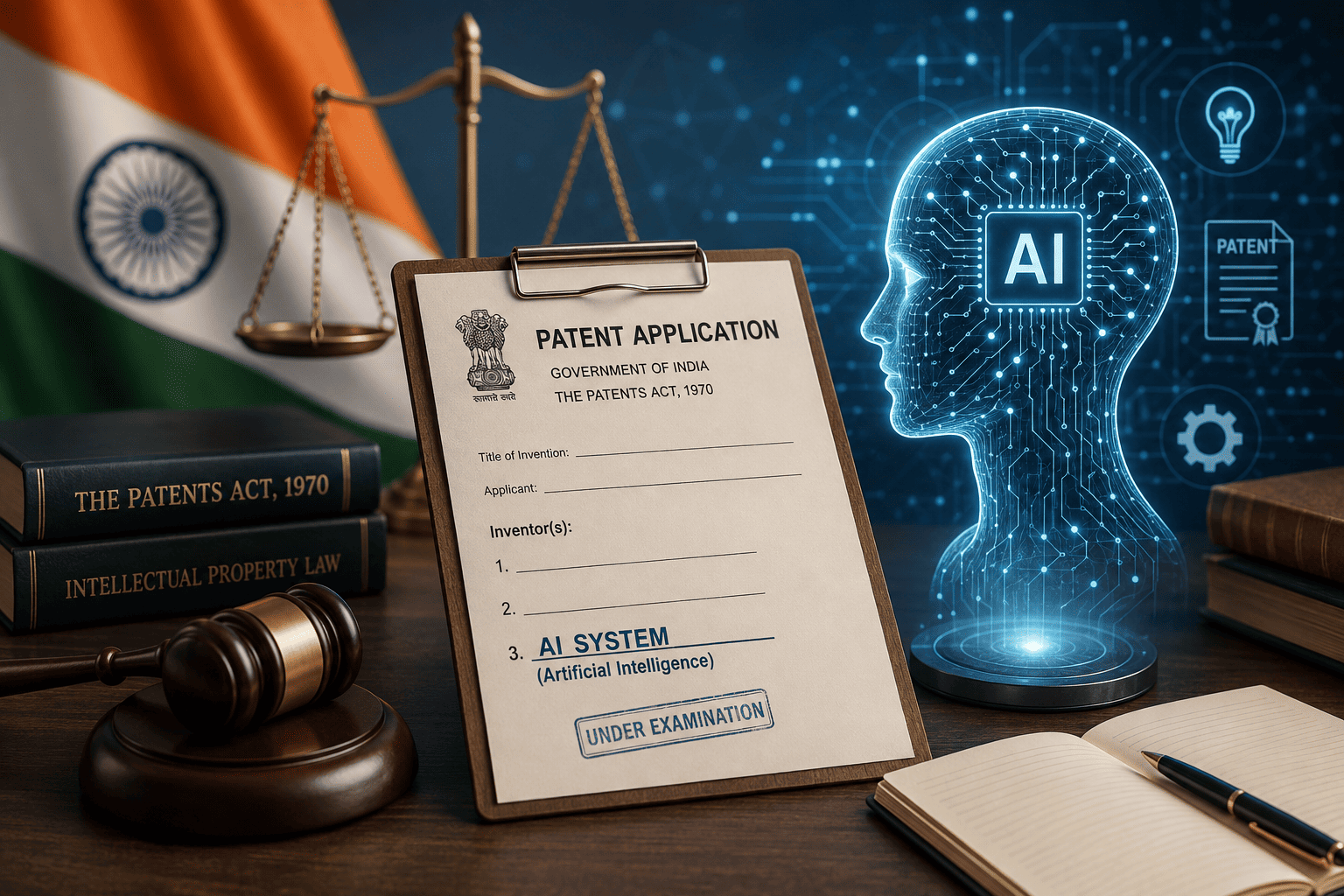
Artificial intelligence is changing not only how products are developed, but also how inventions are conceived, tested and refined. AI and machine learning systems are increasingly being used to identify new materials, optimise industrial processes, improve medical technologies, detect anomalies, develop software architectures and generate technical solutions that may ultimately form part of a patentable invention.
This creates a practical question for businesses: when AI is used during the inventive process, what must be demonstrated to obtain patent protection in India?
The answer is no longer limited to the question of whether AI can itself be named as an inventor. India’s Revised Guidelines for Examination of Computer Related Inventions (CRIs), 2025 provide specific guidance on AI, machine learning and deep learning inventions, including their treatment under Section 3(k) of the Patents Act, 1970 and the requirements for sufficient disclosure.
For businesses using AI in research and development, the more immediate issue is therefore not simply whether AI was used, but how the invention is characterised, what technical contribution it makes, and whether the patent specification adequately explains how that contribution can be achieved.
AI Use Does Not, by Itself, Prevent Patent Protection
The use of an AI system during research does not automatically make an invention unpatentable.
The 2025 CRI Guidelines distinguish between AI-generated inventions and AI-assisted inventions. AI-generated inventions are described as inventions created autonomously, or with very limited human intervention, whereas AI-assisted inventions involve AI being used as a tool in the inventive process. The Guidelines state that AI-assisted inventions are not categorically excluded from patentability under Section 3(k), provided the applicable patentability requirements are satisfied and the invention demonstrates the requisite technical effect through its tangible application.
This distinction is particularly important for companies because AI is increasingly becoming part of ordinary R&D workflows. A researcher may use an AI model to identify promising compounds, optimise parameters, simulate designs or analyse experimental results without the AI system replacing the human inventive process.
The legal assessment therefore needs to focus on the claimed invention and its technical contribution, rather than merely on whether an AI tool was involved somewhere in its development.
Section 3(k): Why the Technical Contribution Matters
One of the principal challenges for AI-related patent applications arises under Section 3(k) of the Patents Act, 1970, which excludes mathematical methods, business methods, computer programmes per se and algorithms from patentability. This becomes particularly relevant because many AI and machine learning systems rely fundamentally on mathematical models, algorithms, statistical techniques and computer-implemented processes.
The 2025 CRI Guidelines emphasise that an abstract mathematical or theoretical AI/ML/DL construct is not patentable merely because it is described in technical language. Patentability becomes possible where the underlying principles are implemented to produce a tangible, real-world technical application.
For applicants, this means that describing an AI model in isolation may not be enough. A stronger patent strategy should identify:
- the technical problem being addressed;
- the specific technical mechanism used to solve that problem;
- how the AI or ML system interacts with the relevant hardware, system or process;
- the technical improvement produced by the claimed implementation; and
- why the claimed solution is more than an abstract algorithm or computer programme per se.
The Real Risk: Describing the AI Instead of the Invention
A recurring drafting problem with AI-related inventions is that the specification can become heavily focused on the AI model itself. An applicant may describe:
- the type of neural network used;
- the algorithm;
- the training methodology;
- the datasets;
- the model architecture; and
- the predicted outputs.
But those details do not necessarily identify the patentable invention. The critical question is: what technical problem does the claimed system solve, and how does the claimed implementation solve it? The AI model may be only one component of that solution.
Accordingly, patent drafting for AI-related inventions should avoid treating the model as the invention by default. The specification should instead establish the relationship between the model, the underlying technical environment and the technical result achieved. This distinction can become particularly important when defending an application against a Section 3(k) objection.
Sufficiency of Disclosure Becomes Particularly Important
The 2025 CRI Guidelines place significant emphasis on sufficiency of disclosure for AI, ML and DL-related inventions. The Guidelines recognise that the theoretical, mathematical and algorithmic nature of AI-related inventions can make it possible to describe broad potential applications without providing enough technical information to actually reproduce the claimed invention. They therefore emphasise that the disclosure should be sufficient to enable reproducibility and performance verification without undue experimentation by a person skilled in the art.
This has practical consequences for patent applicants.A specification should be assessed not merely for whether it explains what the AI system is intended to achieve, but whether it provides enough information to explain how the claimed technical result is achieved.
Depending on the nature of the invention, relevant disclosure may include aspects such as:
- the architecture or configuration of the AI/ML model;
- relevant characteristics of the training data;
- data preprocessing techniques;
- training methodology;
- parameters or implementation features material to the claimed invention;
- the interaction between software and hardware;
- relevant testing or validation information; and
- the technical results achieved by the claimed implementation.
This does not mean that every AI patent application must disclose every internal detail of a proprietary AI system or hand over an entire training dataset. The level of disclosure must be considered in the context of the claimed invention and the requirement to enable a skilled person to perform it without undue experimentation.
For businesses, this creates a strategic tension between patent disclosure and protection of proprietary know-how.
Patent Protection vs. Trade Secrets: AI R&D Requires an Early Decision
AI-driven innovation frequently involves valuable information that companies may not want to disclose publicly. Training datasets, model parameters, optimisation techniques, source code, engineering workflows and internal performance benchmarks may themselves constitute commercially valuable know-how.
A patent, however, operates on a disclosure-based model: the applicant obtains a limited monopoly in exchange for disclosure of the invention in the patent specification. Businesses therefore need to determine early in the R&D process which elements should be:
- disclosed as part of a patent application;
- maintained as confidential know-how; or
- protected through a combination of patent and trade-secret strategies.
This decision should ideally be made before filing, rather than after the patent specification has already been prepared.
A company may, for example, patent the technical architecture or application that produces the commercial advantage while retaining certain implementation details as confidential information, provided those details are not essential to enabling the claimed invention and can legitimately be maintained as trade secrets.
AI-Generated and AI-Assisted Inventions: Why Internal Records Matter
The distinction between AI-generated and AI-assisted inventions also creates an important internal governance issue. Companies using AI in R&D should maintain contemporaneous records showing how the invention was developed.
Such records can help establish:
- who identified the technical problem;
- who selected the research objective;
- what role the AI system played;
- what technical alternatives were considered;
- who evaluated the AI-generated outputs;
- which outputs were rejected or modified;
- who made the final technical selections;
- how experiments were designed and conducted; and
- how the final solution was developed and validated.
This is not simply a question of maintaining an internal AI-use log. The objective is to preserve evidence of the human inventive contribution and the technical development of the claimed invention. This can become particularly important where an AI system generated multiple possible solutions and the eventual invention resulted from human selection, modification, experimentation or refinement.
Patent Drafting Should Begin Before the AI Output Exists
For traditional inventions, businesses often begin thinking about patent protection once a commercially promising solution has been identified. AI-assisted R&D requires a more proactive approach. If a company waits until the end of an AI-driven development cycle, it may discover that:
- the relevant human contribution was not documented;
- multiple teams used different AI systems;
- the origin of a particular technical feature is unclear;
- confidential information was inadvertently included in prompts or external AI platforms;
- the invention was publicly disclosed before filing; or
- the available technical records do not adequately support the level of disclosure required in the patent specification.
A better approach is to integrate IP review into the R&D process.
For significant AI-driven projects, businesses should consider establishing an invention-capture process under which potentially patentable developments are periodically reviewed before public disclosure, publication, product launch or external demonstration.
What AI R&D Teams Should Document
A practical AI-patent record can include the following:
1. The technical problem: Record the problem that the R&D team was attempting to solve and the limitations of existing approaches.
2. The human contribution; Identify the researchers who developed the technical approach, selected relevant parameters, designed experiments, interpreted results or refined the solution.
3. The AI contribution: Record the role played by AI, including whether it was used for prediction, optimisation, simulation, generation of candidate solutions, data analysis or another function.
4. The development process: Preserve relevant experimental records, iterations, design changes and validation results.
5. The technical result: Record measurable improvements wherever appropriate, such as reduced processing time, improved accuracy in a technical application, reduced resource consumption, improved system performance or another demonstrable technical advantage.
6. Confidentiality: Identify information that should remain confidential and ensure that external AI tools are not used in a manner inconsistent with the company’s confidentiality, data protection or IP policies.
What This Means for Patent Applicants
The 2025 CRI Guidelines do not create a separate patent system for AI inventions. Rather, they provide greater clarity on how existing patentability principles apply to emerging technologies, including AI, ML and DL. The Patent Office’s current guidelines specifically address AI-related inventorship, Section 3(k) considerations and sufficiency of disclosure.
For applicants, the practical lesson is that the presence of AI in the inventive process should not become the centre of the patent application unless it is itself necessary to the claimed invention. Instead, applicants should focus on three questions:
First, what is the technical invention?
The claims and specification should identify the concrete technical solution rather than merely describe an abstract model or algorithm.
Second, what human contribution resulted in the invention?
Where AI was used as a tool, the development record should make the human contribution identifiable and defensible.
Third, can the invention actually be reproduced from the disclosure?
The specification should contain sufficient technical information to satisfy the statutory disclosure requirements, taking into account the particular characteristics of AI/ML/DL inventions.
India’s Growing AI Patent Landscape Makes These Issues More Important
The importance of these questions is likely to increase as AI-related patenting expands. WIPO’s 2025 analysis places India fifth among the world’s leading economies for generative AI patenting, behind China, the United States, Japan and the Republic of Korea. WIPO also reports substantial growth in GenAI patent activity globally, with large language models emerging as the largest GenAI model category by patent volume.
For Indian companies developing AI-based technologies, patent strategy is therefore becoming an increasingly important part of product and R&D planning. The competitive advantage may not lie solely in owning an AI model. It may lie in protecting the technical application, architecture, system integration or process through which that model creates commercial value.
Conclusion
The legal question surrounding AI and patents in India is evolving beyond the headline issue of whether a machine can be called an inventor. For businesses, the more immediate question is how to protect inventions that emerge from increasingly AI-assisted R&D processes.
The 2025 CRI Guidelines provide an important framework by distinguishing AI-generated from AI-assisted inventions and by highlighting the importance of technical application and sufficient disclosure.
For companies developing AI-driven technologies, patent protection should therefore be considered as part of the R&D process itself. Identifying the technical contribution, documenting human involvement, protecting confidential information and preparing a sufficiently detailed specification can be just as important as the AI technology that produced the underlying solution.
As AI becomes more deeply integrated into innovation workflows, the strongest patent strategies are likely to be those that treat AI not merely as a technology to be protected, but as a tool whose role must be carefully understood, documented and positioned within the broader architecture of the invention.
Last Updated on 10 August, 2026

By entering the email address you agree to our Privacy Policy.