
Battery Energy Storage Systems (BESS) in India: The Next Big Opportunity in Project Finance

India’s renewable energy story is entering a decisive second phase. For years, the focus was simple, build more solar parks, add more wind capacity, and accelerate clean energy generation.
But as renewable penetration deepens, a new challenge has emerged: renewable power is not always available when the grid actually needs it.
Solar generation peaks during the day. Wind output fluctuates unpredictably. Meanwhile, electricity demand surges in the evening, industrial consumption remains volatile, and grid stability has become a growing concern for utilities and regulators alike.
This is where Battery Energy Storage Systems (BESS) are rapidly becoming one of the most strategic infrastructure asset classes in India.
Battery storage is no longer being viewed as a niche clean-tech experiment. It is increasingly becoming the backbone of India’s next-generation energy infrastructure, enabling renewable integration, grid balancing, peak demand management and long-duration energy reliability.
For lenders, infrastructure funds, sovereign investors and private credit platforms, utility-scale battery energy storage projects in India are now emerging as one of the most significant long-term project finance opportunities of the coming decade.
Why Battery Storage Matters More Than Ever
Renewable energy cannot scale efficiently without storage.
India’s grid operators are already dealing with:
- Renewable intermittency
- Peak demand stress
- Grid instability
- Curtailment of renewable power
- Frequency balancing challenges
- Increasing electrification pressure
Battery storage solves a fundamental infrastructure problem: it allows excess renewable power to be stored and dispatched later when demand rises.
In practical terms, BESS transforms intermittent renewable energy into dispatchable infrastructure. That changes the economics of the power sector entirely.
The Shift Happening Across India’s Energy Market
India’s energy transition is no longer just about generation capacity. It is increasingly about energy flexibility.
The rapid expansion of the following sectors is driving unprecedented demand for battery storage:
- Utility-scale solar parks
- Hybrid renewable projects
- Electric mobility
- Data centres
- Urban electrification
- Green hydrogen infrastructure
The result is a rapidly evolving market for BESS use cases across India:
| Emerging BESS Use Cases in India | |
| Grid balancing | Renewable integration |
| Peak shaving | Ancillary services |
| Industrial backup power | Energy arbitrage |
| RTC renewable supply | EV charging infrastructure |
| Data centre resilience | Smart urban infrastructure |
Battery storage is increasingly becoming a critical enabling layer across India’s infrastructure ecosystem.
Why Investors Are Suddenly Paying Attention to BESS
Battery storage sits at the intersection of nearly every major investment theme shaping global infrastructure capital:
- Energy transition
- ESG investing
- Decarbonisation
- Digital infrastructure
- Climate finance
- Grid modernisation
Unlike traditional renewable projects, however, BESS combines both infrastructure and technology risk. That creates complexity — but also significantly higher growth potential.
Global infrastructure investors increasingly view India’s BESS sector as a long-duration infrastructure opportunity comparable to the early phases of renewable energy investing a decade ago.
India’s Regulatory Push for Battery Storage
The Indian government has aggressively accelerated policy support for battery storage. Recent initiatives include:
- Viability Gap Funding (VGF) schemes
- Storage-linked renewable tenders
- Grid modernisation policies
- Infrastructure classification support
- Renewable integration frameworks
- Energy transition planning initiatives
This policy momentum is materially improving project bankability.
For lenders, regulatory visibility is one of the most important drivers of confidence in battery storage project financing in India.
The New Infrastructure Asset Class: How BESS Projects Are Structured
India’s battery storage market is evolving across multiple commercial models.
1. Standalone Utility-Scale BESS Projects
These projects operate independently from generation assets and are typically designed for grid balancing, reserve capacity, ancillary services, and peak load management.
2. Renewable + Storage Hybrid Projects
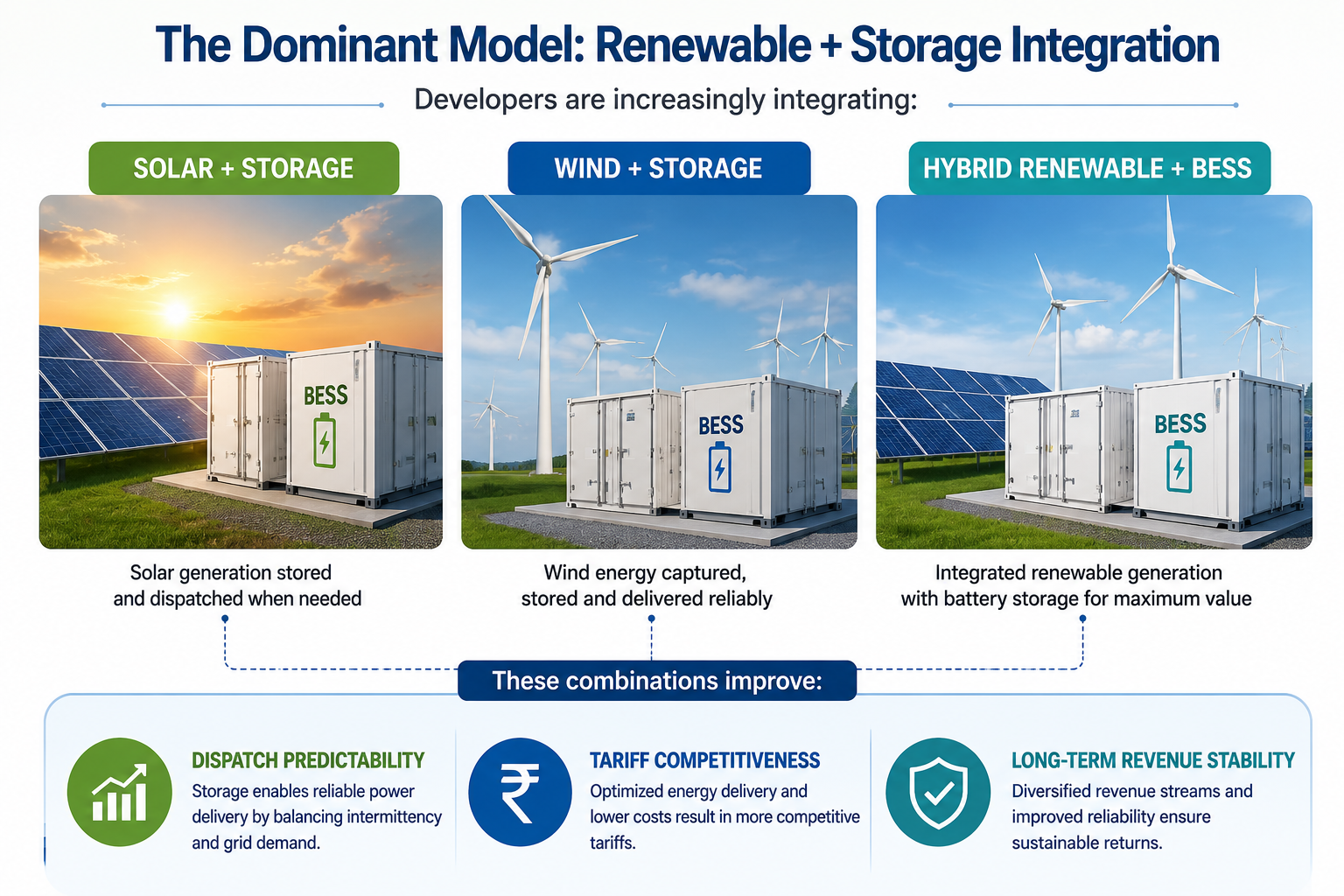
3. Commercial & Industrial (C&I) Storage
Large industrial consumers are increasingly deploying BESS for energy optimisation, backup resilience, renewable integration, and electricity cost reduction.
Data centres, manufacturing parks and logistics hubs are expected to become major consumers of storage infrastructure.
The Biggest Problem in BESS Financing: Technology Risk
Unlike roads or power plants, battery technology evolves rapidly. That makes lenders cautious.
A solar panel installed today may remain commercially viable for decades. Battery systems, however, face:
- Degradation risk
- Replacement uncertainty
- Technology obsolescence
- Evolving performance benchmarks
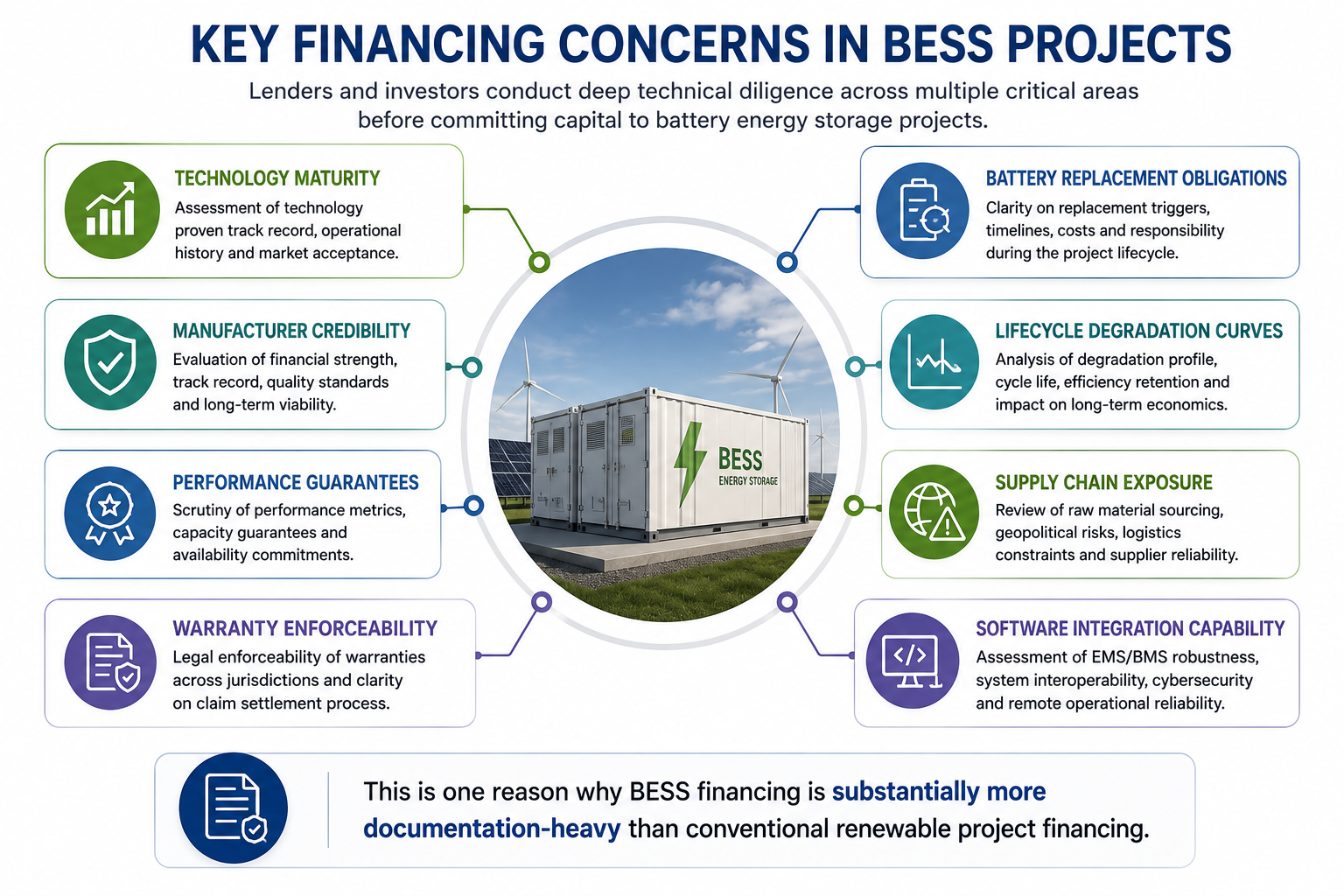
As a result, battery degradation risk in BESS financing has become one of the most heavily negotiated issues in project finance documentation.
What Lenders Actually Examine in BESS Transactions
Infrastructure lenders and private credit investors now conduct deep technical diligence on:
Revenue Visibility Remains the Biggest Bankability Challenge
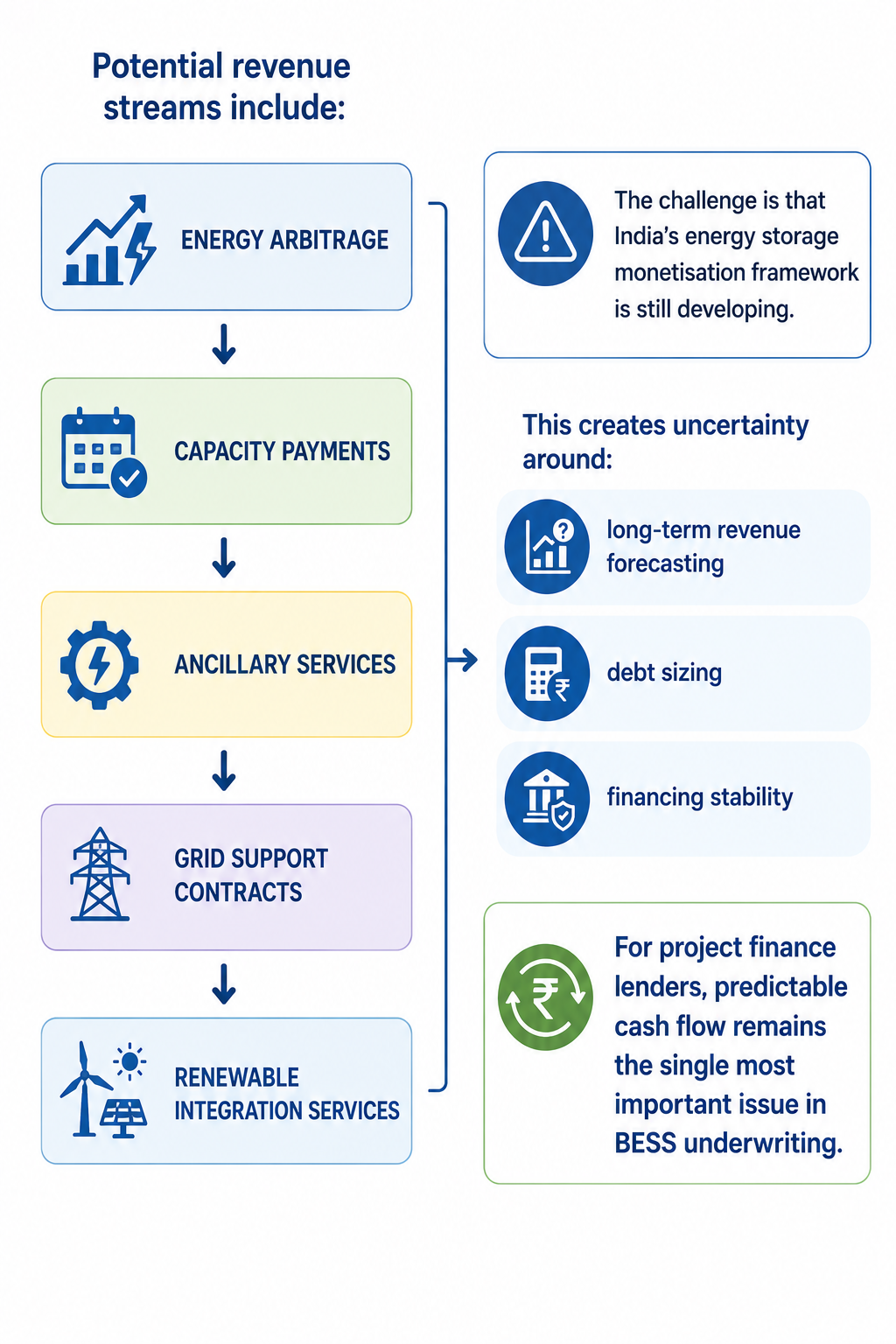
The long-term success of battery storage depends on one key issue: monetisation.
Unlike solar and wind projects, storage projects still operate within an evolving revenue framework.
Why SECI and Government Procurement Matter
Government-backed procurement remains central to early-stage BESS growth. Entities such as the Solar Energy Corporation of India (SECI) and state utilities are increasingly issuing storage-linked tenders.
These structures significantly improve:
- Revenue visibility
- Counterparty confidence
- Institutional lender participation
In many cases, sovereign-backed procurement mechanisms are acting as the bridge between early-stage technology adoption and mainstream infrastructure financing.
The RBI’s 2025 Project Finance Rules Could Reshape BESS Lending
The RBI Project Finance Directions, 2025 are expected to materially impact storage financing structures. Lenders are increasingly required to:
- Link disbursements to project milestones
- Strengthen technical oversight
- Enhance implementation monitoring
Given the technology-intensive nature of BESS projects, lenders are now demanding:
- Independent engineer certifications
- Expanded technical diligence
- Stricter operational monitoring frameworks
The era of lightly monitored infrastructure lending is ending, especially in emerging technology sectors like battery storage.
EPC Contracts Are Becoming More Complex
BESS projects are deeply dependent on technology contracting. Unlike conventional infrastructure assets, battery storage involves multiple integrated systems:
- Hardware procurement
- Software management systems
- Energy management platforms
- Long-term operational support services
This makes EPC and technology contracts significantly more sophisticated.
Key contractual focus areas now include:
| Major EPC & Technology Risks |
| Performance guarantees |
| Delay liabilities |
| Software integration failures |
| Liquidated damages |
| Long-term maintenance obligations |
| Operational uptime commitments |
Cybersecurity Is Emerging as a Serious Infrastructure Risk
Battery storage projects are increasingly software-driven infrastructure assets. That creates a new category of risk rarely associated with traditional project finance:
- Cybersecurity exposure
- Remote operational vulnerabilities
- Software failure risk
For large grid-connected BESS projects, operational resilience is now becoming as important as engineering performance.
ESG Investing Is Accelerating BESS Growth — But Also Creating New Risks
Institutional investors increasingly view battery storage as essential climate-transition infrastructure. BESS supports:
- Renewable integration
- Decarbonisation targets
- Emissions reduction
- Sustainable grid infrastructure
But ESG scrutiny is also intensifying. Investors now examine:
| ESG Risks in Battery Infrastructure |
| Lithium and mineral sourcing |
| Supply chain ethics |
| Battery disposal obligations |
| Recycling compliance |
| Environmental lifecycle exposure |
| Labour and governance standards |
As ESG due diligence becomes more sophisticated, storage developers are under growing pressure to demonstrate sustainable sourcing and lifecycle compliance.
Cross-Border Investment Is Flooding Into India’s Storage Sector
India’s BESS market is increasingly attracting:
- Sovereign wealth funds
- Infrastructure funds
- Global battery manufacturers
- Technology companies
- Multilateral lenders
Most large-scale transactions involve a combination of:
- FDI structures
- Offshore financing
- Technology licensing
- Joint ventures
- Structured investment platforms
This makes FEMA compliance in battery storage financing critically important.
Security Creation in BESS Financing Is More Complicated Than Traditional Infrastructure
Lenders still require conventional project finance security packages, including asset charges, receivables assignment, account control structures, and share pledges.
But battery projects introduce additional complexity because lenders must also evaluate residual battery value, replacement economics, technology obsolescence, and warranty enforceability.
In many transactions, technology risk is now influencing security valuation as much as land or fixed infrastructure assets.
Data Centres Could Become the Biggest Demand Driver for BESS
India’s rapidly expanding data centre industry is expected to become one of the largest long-term consumers of battery storage infrastructure.
Data centres increasingly require:
- Uninterrupted backup power
- Renewable integration
- Energy resilience
- Sustainability-linked infrastructure solutions
Green Hydrogen Could Unlock the Next Phase of Storage Demand
Battery infrastructure is also expected to play a critical role in:
- Green hydrogen production
- Industrial decarbonisation
- Round-the-clock renewable supply systems
As India scales its clean energy ecosystem, battery storage is likely to evolve from a supporting technology into a foundational infrastructure layer.
The Biggest Risks in BESS Financing
Despite enormous growth potential, battery storage financing remains risk-intensive.
Key BESS Financing Risks
| Risk Category | Impact |
| Technology obsolescence | Reduced project competitiveness |
| Battery degradation | Revenue decline |
| Regulatory uncertainty | Financing instability |
| Supply chain disruption | Cost escalation |
| Revenue volatility | Weak debt service coverage |
| Cybersecurity exposure | Operational risk |
| Recycling obligations | ESG liability |
| Software integration failures | System instability |
Successful transactions therefore depend heavily on:
- Technical diligence
- Contractual structuring
- Revenue visibility
- Sophisticated risk allocation mechanisms
The Future of Battery Storage in India
India’s BESS market is expected to expand exponentially over the next decade. The next growth wave is likely to be driven by:
- Falling battery costs
- Larger utility-scale projects
- Deeper renewable integration
- Ancillary service market expansion
- Domestic manufacturing growth
- Institutional capital inflows
Battery storage is no longer being treated as an experimental technology sector. It is increasingly being recognised as one of the most important infrastructure investment opportunities in India’s energy transition economy.
Conclusion
Battery Energy Storage Systems are rapidly reshaping India’s project finance and infrastructure investment landscape.
The convergence of renewable energy growth, grid modernisation, ESG capital, digital infrastructure demand and government policy support is creating a powerful long-term growth cycle for battery storage financing in India.
But unlike conventional infrastructure assets, BESS projects sit at the intersection of energy regulation, advanced technology, cybersecurity, ESG compliance and evolving revenue models.
That means successful battery storage financing requires far more than traditional project finance expertise. It requires deep understanding of technology risk allocation, regulatory frameworks, operational resilience and long-term infrastructure strategy.
As India moves toward a decentralised, renewable-driven and digitally integrated energy ecosystem, battery storage is expected to become one of the defining infrastructure asset classes of the next decade.
Last Updated on 18 May, 2026

By entering the email address you agree to our Privacy Policy.