
Data Centre Project Financing in India (2026): The New Digital Infrastructure Gold Rush

India’s data centre sector is no longer merely a real estate or technology play. In 2026, it has emerged as one of the country’s most strategic infrastructure asset classes sitting at the intersection of artificial intelligence, cloud computing, digital governance, cybersecurity and energy transition.
The explosive growth of:
- AI infrastructure;
- Cloud migration;
- Digital banking;
- OTT and streaming platforms;
- E-commerce ecosystems;
- Enterprise digitisation; and
- Data localisation requirements
has fundamentally altered India’s infrastructure priorities.
Data centres are now viewed as essential digital utilities powering the country’s economic and technological backbone. This transformation has triggered unprecedented institutional interest from:
- Sovereign wealth funds;
- Infrastructure platforms;
- Pension funds;
- Global hyperscalers;
- Private equity investors; and
- Long-term infrastructure lenders.
However, financing data centres is materially different from financing traditional infrastructure assets such as roads, ports or renewable energy projects. A modern data centre transaction requires simultaneous evaluation of:
| Traditional Infrastructure Risks | Digital Infrastructure Risks |
| Land acquisition | Cybersecurity exposure |
| Construction risk | Technology obsolescence |
| Regulatory approvals | Data protection compliance |
| Revenue stability | AI scalability requirements |
| Power availability | Network redundancy |
| ESG compliance | Operational uptime obligations |
As a result, data centre financing in India has evolved into one of the most sophisticated forms of infrastructure project finance.
Why Data Centres Have Become a Strategic Infrastructure Asset
India’s digital economy is expanding at extraordinary speed. The country’s increasing reliance on:
- AI systems;
- Cloud-based enterprise operations;
- Digital payment ecosystems;
- E-governance infrastructure; and
- Real-time data processing
has created massive demand for:
- Hyperscale storage capacity;
- High-density computing;
- Low-latency infrastructure; and
- Energy-intensive digital assets.
Unlike conventional commercial real estate, data centres operate as mission-critical infrastructure with near-zero tolerance for operational downtime. This is precisely why institutional investors now view data centres as long-duration infrastructure assets rather than merely technology facilities.
India’s Data Centre Boom: What Is Driving Investment?
Several structural factors are accelerating India’s data centre expansion.
Key Growth Drivers
| Growth Driver | Impact on Data Centre Demand |
| AI adoption | High-density computing demand |
| Cloud migration | Large-scale storage expansion |
| 5G rollout | Edge infrastructure growth |
| Data localisation trends | Domestic storage requirements |
| OTT & streaming growth | Processing and bandwidth demand |
| Digital banking | High-security infrastructure requirements |
Cities such as Mumbai, Chennai, Bengaluru, Hyderabad, Pune, and Delhi NCR, have emerged as major digital infrastructure hubs due to fibre connectivity, power availability and enterprise demand concentration. Several states are also offering:
- Power subsidies;
- Fast-track approvals;
- Stamp duty incentives; and
- Dedicated data centre policies.
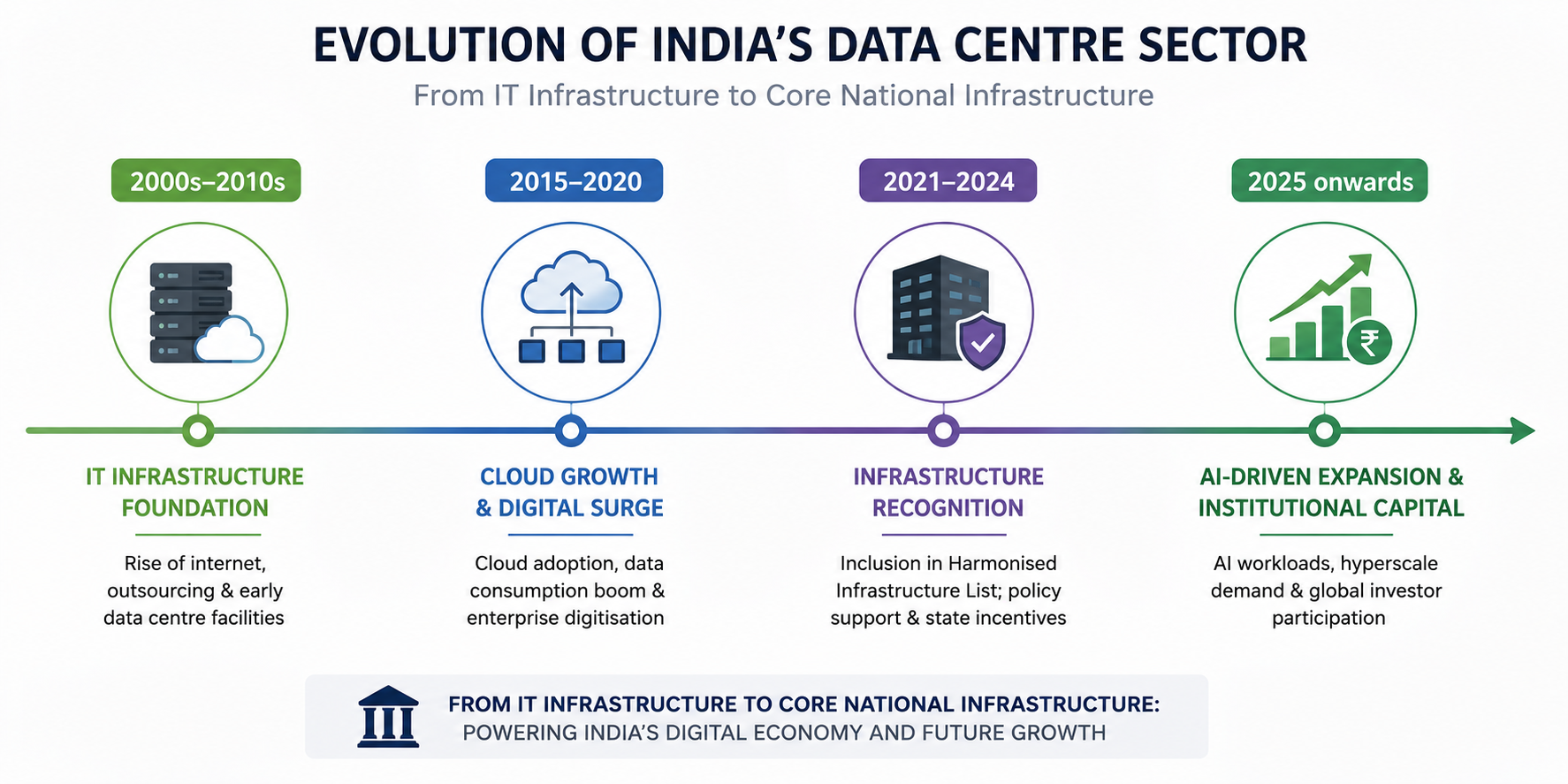
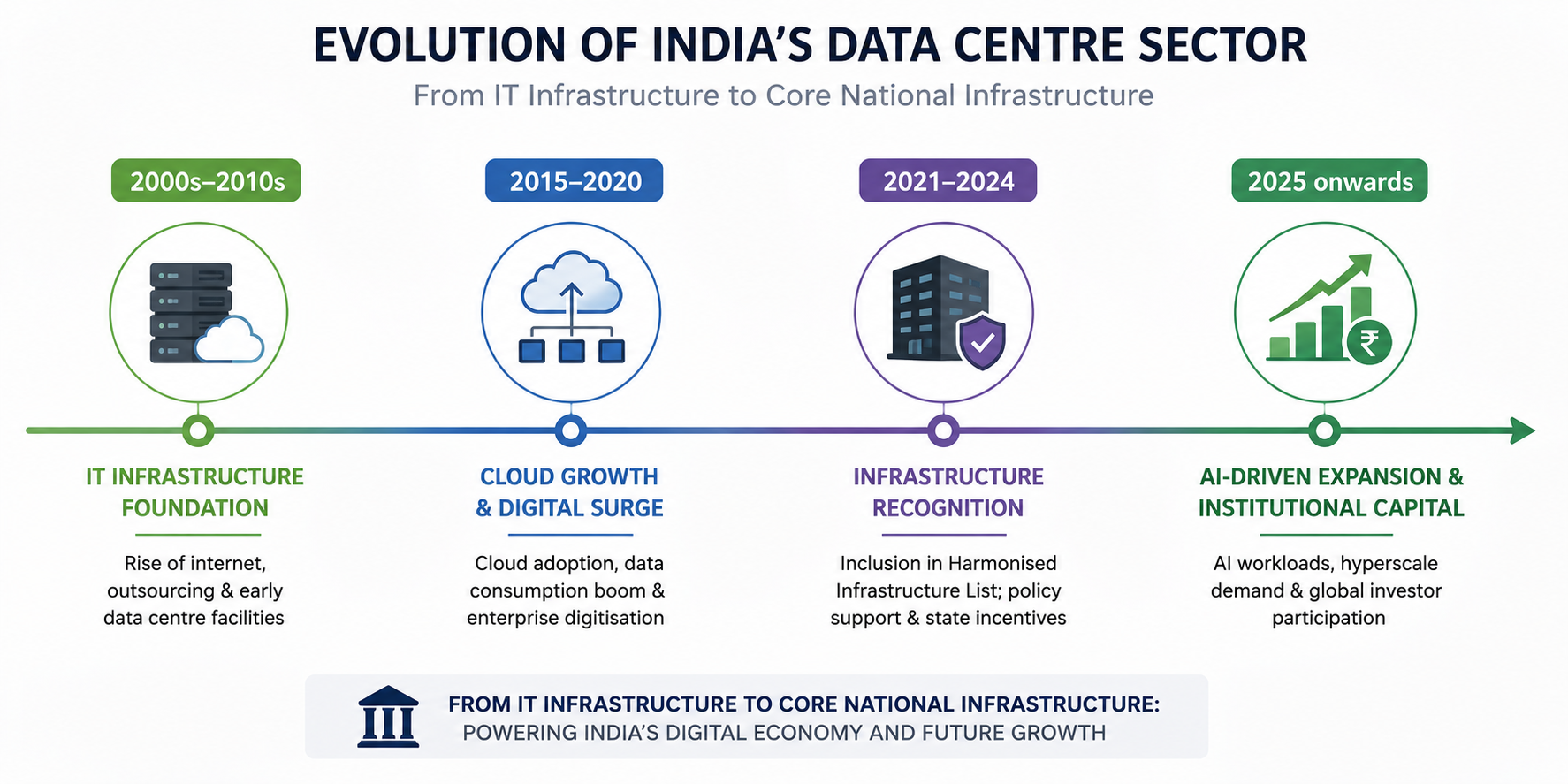
Infrastructure Status Changed the Financing Landscape
The inclusion of data centres within India’s Harmonised Infrastructure List was a watershed moment for the sector. Infrastructure recognition materially improved:
| Benefit | Financing Impact |
| Long-term debt access | Improved project bankability |
| Institutional lending participation | Lower financing barriers |
| Infrastructure fund eligibility | Increased investor participation |
| Structured project financing | Better capital efficiency |
This was critical because data centre projects require:
- Significant upfront capex;
- Long-term operational investment;
- High energy infrastructure costs; and
- Continuous technology upgrades.
Infrastructure status effectively repositioned data centres from speculative technology assets into financeable infrastructure platforms.
Data Centre Financing Is Now Infrastructure Finance: Not Real Estate Finance
One of the biggest misconceptions in the market is treating data centres as conventional commercial real estate assets. In reality, modern data centre financing resembles infrastructure project finance far more than property financing.
Why?
Because lenders increasingly underwrite:
- Operational uptime;
- Long-term energy security;
- Tenant stability;
- Technology resilience; and
- Revenue continuity.
rather than merely physical asset value.
What Lenders Evaluate Today
| Core Financing Factor | Why It Matters |
| Power redundancy | Downtime risk mitigation |
| Tenant quality | Revenue certainty |
| Technology scalability | Long-term viability |
| Cooling infrastructure | Operational efficiency |
| Cybersecurity systems | Regulatory and reputational protection |
| Renewable energy sourcing | ESG compliance and investor expectations |
The quality of the operational ecosystem is now often more important than the real estate itself.
Power Availability Has Become the Single Largest Financing Variable
For data centres, electricity is the foundation of the business model, a data centre without reliable power is effectively unfinanceable.
Key Power-Related Risks
- Grid instability;
- Renewable intermittency;
- Backup system failures;
- Rising power costs;
- State regulatory restrictions; and
- Energy transition uncertainty.
As a result, developers are increasingly adopting:
- Captive renewable projects;
- Open-access renewable procurement;
- Battery storage systems;
- Gas-based backup systems; and
- Long-term power purchase arrangements.
Why Investors Care Deeply About Energy Strategy
Institutional investors now closely examine:
| Energy Issue | Investor Concern |
| Renewable sourcing | ESG alignment |
| Carbon intensity | Sustainability targets |
| Water-intensive cooling | Environmental exposure |
| Energy efficiency metrics | Long-term operational cost |
| Backup resilience | Business continuity |
Energy strategy has become a core component of both valuation and financing decisions.
ESG Is Rapidly Reshaping Data Centre Investment
Data centres are increasingly facing scrutiny regarding:
- Carbon emissions;
- Electricity consumption;
- Water usage;
- Cooling systems; and
- Sustainability reporting.
As global institutional investors tighten ESG requirements, developers are under pressure to build greener digital infrastructure.
What ESG Due Diligence Typically Covers
| ESG Area | Key Focus |
| Environmental | Renewable sourcing, energy efficiency, water usage |
| Social | Labour standards, local impact, operational safety |
| Governance | Cyber governance, compliance systems, transparency |
Green-certified data centres are increasingly attracting:
- Better financing terms;
- Greater institutional participation; and
- Higher long-term valuations.
AI Is Changing Data Centre Economics
The rapid rise of AI infrastructure is fundamentally transforming financing assumptions. AI-enabled data centres require:
- Higher power density;
- Advanced cooling technologies;
- Greater processing capability; and
- Significantly larger capex allocation.
Traditional financing models based on standard colocation economics are becoming outdated.
Emerging AI-Driven Financing Questions
Lenders increasingly ask:
- Can the facility support GPU-intensive infrastructure?
- Is cooling architecture future-ready?
- How quickly could technology become obsolete?
- Can energy systems scale with AI demand growth?
This has made technology diligence a central financing issue.
Cybersecurity and Data Governance Have Become Core Financing Risks
Unlike traditional infrastructure assets, data centres face substantial digital operational risk. A major cybersecurity incident can materially impact:
- Revenue continuity;
- Customer relationships;
- Regulatory compliance;
- Operational uptime; and
- Financing confidence.
Accordingly, legal and lender diligence now increasingly includes:
- Cyber governance review;
- Incident response frameworks;
- Data protection compliance;
- Operational resilience testing; and
- Vendor security assessment.
Contractual Structures Determine Revenue Stability
Modern data centre financing depends heavily on long-term contractual ecosystems.
Key Agreements Typically Reviewed
- EPC contracts;
- Technology procurement agreements;
- Power supply agreements;
- Fibre connectivity contracts;
- Colocation agreements; and
- O&M frameworks.
Why Customer Contracts Matter So Much
Lenders place enormous emphasis on:
| Contractual Factor | Financing Relevance |
| Tenant concentration | Revenue diversification |
| Contract duration | Cashflow stability |
| Service-level obligations | Operational liability |
| Termination rights | Recovery protection |
| Hyperscaler occupancy | Bankability enhancement |
Long-term hyperscale customers significantly improve financing confidence.
RBI Project Finance Directions 2025 Will Change Data Centre Lending
The RBI’s revised project finance framework is expected to materially influence digital infrastructure financing. Lenders are now expected to adopt:
- Greater implementation monitoring;
- Milestone-linked disbursements;
- Construction oversight; and
- Enhanced technical diligence.
For data centres, this means financing review now extends beyond legal documentation into operational readiness verification. Technology-intensive infrastructure projects will increasingly face continuous monitoring rather than one-time diligence.
Foreign Investment and FEMA Structuring Are Becoming More Complex
India’s data centre sector has seen massive foreign investment participation. Transactions increasingly involve:
- Offshore platform structures;
- Infrastructure investment funds;
- Strategic technology partnerships;
- Cross-border debt financing; and
- Multi-layer holding structures.
Common Cross-Border Legal Issues
| Area | Key Concern |
| FEMA compliance | Structuring validity |
| Security creation | Offshore lender protection |
| Pricing guidelines | Equity compliance |
| Tax structuring | Capital efficiency |
| Repatriation rights | Exit flexibility |
As transaction sizes increase, financing structures are becoming significantly more sophisticated.
The Biggest Risks in Data Centre Financing in 2026
Despite strong growth fundamentals, the sector remains exposed to several structural risks.
Major Financing Risks
| Risk | Why It Matters |
| Technology obsolescence | Rapid infrastructure replacement cycles |
| Power disruption | Operational downtime exposure |
| Cybersecurity breaches | Regulatory and reputational damage |
| Customer concentration | Revenue dependency |
| ESG pressure | Institutional financing limitations |
| Construction delays | Cost overrun and commissioning risk |
The market remains attractive but only for well-structured, operationally resilient projects.
The Future of Data Centre Infrastructure in India
India’s data centre ecosystem is expected to evolve rapidly over the next decade. Future growth will likely be driven by:
- AI infrastructure expansion;
- Edge computing;
- Renewable-powered facilities;
- Enterprise digitisation;
- Smart city integration; and
- Domestic data localisation frameworks.
Data centres are increasingly becoming strategic national infrastructure assets central to India’s digital economy.
Conclusion
Data centres are rapidly emerging as one of India’s most important infrastructure investment sectors. The convergence of:
- AI expansion;
- Cloud computing growth;
- Digital governance;
- ESG-focused investment; and
- Infrastructure financing reforms
is reshaping how developers, lenders and institutional investors approach digital infrastructure transactions. At the same time, data centre financing now requires careful coordination across:
- Infrastructure law;
- Project finance;
- Technology regulation;
- Cybersecurity governance;
- ESG compliance; and
- Cross-border investment structuring.
As India’s digital economy accelerates, data centres are expected to remain at the centre of the country’s infrastructure transformation and long-term institutional investment landscape.
Last Updated on 20 May, 2026

By entering the email address you agree to our Privacy Policy.