
Infrastructure Insolvency in India: What Happens When Mega Projects Fail?
India’s infrastructure story has been built on scale. Airports, renewable energy parks, expressways, telecom networks, logistics corridors and data centres have transformed the country’s economic landscape over the last two decades.
But behind this expansion lies a quieter reality: many large infrastructure projects are financially distressed long before they become commercially successful.
A delayed environmental clearance, an aggressive bid assumption, a stalled land acquisition process or a payment dispute with a government authority can quickly push a ₹5,000 crore project into insolvency. And unlike ordinary corporate failures, infrastructure insolvencies rarely affect only shareholders and lenders.
They disrupt public utilities, impact institutional investors, stall national development priorities and create systemic banking stress.
This is precisely why infrastructure insolvency under the Insolvency and Bankruptcy Code (IBC) has emerged as one of the most important areas in India’s restructuring and project finance ecosystem.
Today, insolvency is no longer viewed merely as a recovery mechanism. It has evolved into a strategic framework for distressed infrastructure asset acquisition, project restructuring, private credit deployment and long-term infrastructure consolidation in India.
Why Infrastructure Projects Collapse Differently Than Other Businesses
Most businesses can reduce operations during financial stress. Infrastructure assets usually cannot.
A thermal power plant cannot suddenly stop supplying electricity. An airport cannot suspend operations because lenders are in dispute. A telecom tower network cannot shut down without affecting connectivity and regulatory obligations.
Infrastructure projects are uniquely vulnerable because they combine:
- Massive upfront capital expenditure
- Long gestation periods
- Heavy dependence on government approvals
- Multi-layered financing structures
- Public-facing operational obligations
- Long-term concession agreements
Even relatively small disruptions can trigger cascading financial distress.
The Most Common Triggers of Infrastructure Insolvency in India
| Financial & Commercial Issues | Regulatory & Operational Issues |
| Cost overruns | Delayed environmental approvals |
| Aggressive project bidding | Land acquisition disputes |
| Demand shortfalls | Policy or tariff changes |
| Currency volatility | Licensing delays |
| Counterparty defaults | Litigation and arbitration exposure |
| Delayed financial closure | Regulatory intervention |
Historically, sectors such as thermal power, highways, telecom and real estate-linked infrastructure witnessed the highest stress levels.
In 2026, distress is increasingly shifting toward renewable energy projects, digital infrastructure platforms, logistics assets and data centres.
Before the IBC: Infrastructure Recovery Was Fragmented and Slow
Before the Insolvency and Bankruptcy Code, lenders had limited restructuring options. Recovery efforts were scattered across:
- SARFAESI proceedings
- Debt Recovery Tribunals
- Corporate debt restructuring schemes
- Civil courts
- Company winding-up proceedings
The result was predictable: endless litigation, weak lender coordination and severe erosion in asset value.
Banks often found themselves unable to replace defaulting developers or preserve project continuity. By the time enforcement concluded, the infrastructure asset had frequently lost both operational and commercial viability.
How the IBC Changed Infrastructure Restructuring in India
The IBC fundamentally altered the balance of power in distressed infrastructure projects. Instead of fragmented enforcement, the law introduced:
- Time-bound insolvency resolution
- Creditor-led decision-making
- Institutional restructuring frameworks
- Structured distressed asset acquisitions
- Resolution through competitive bidding
The shift was particularly important for project finance lenders, infrastructure investment funds, ARCs, sovereign investors and private credit platforms looking to acquire or restructure distressed assets.
What Happens When a Mega Infrastructure Project Enters Insolvency
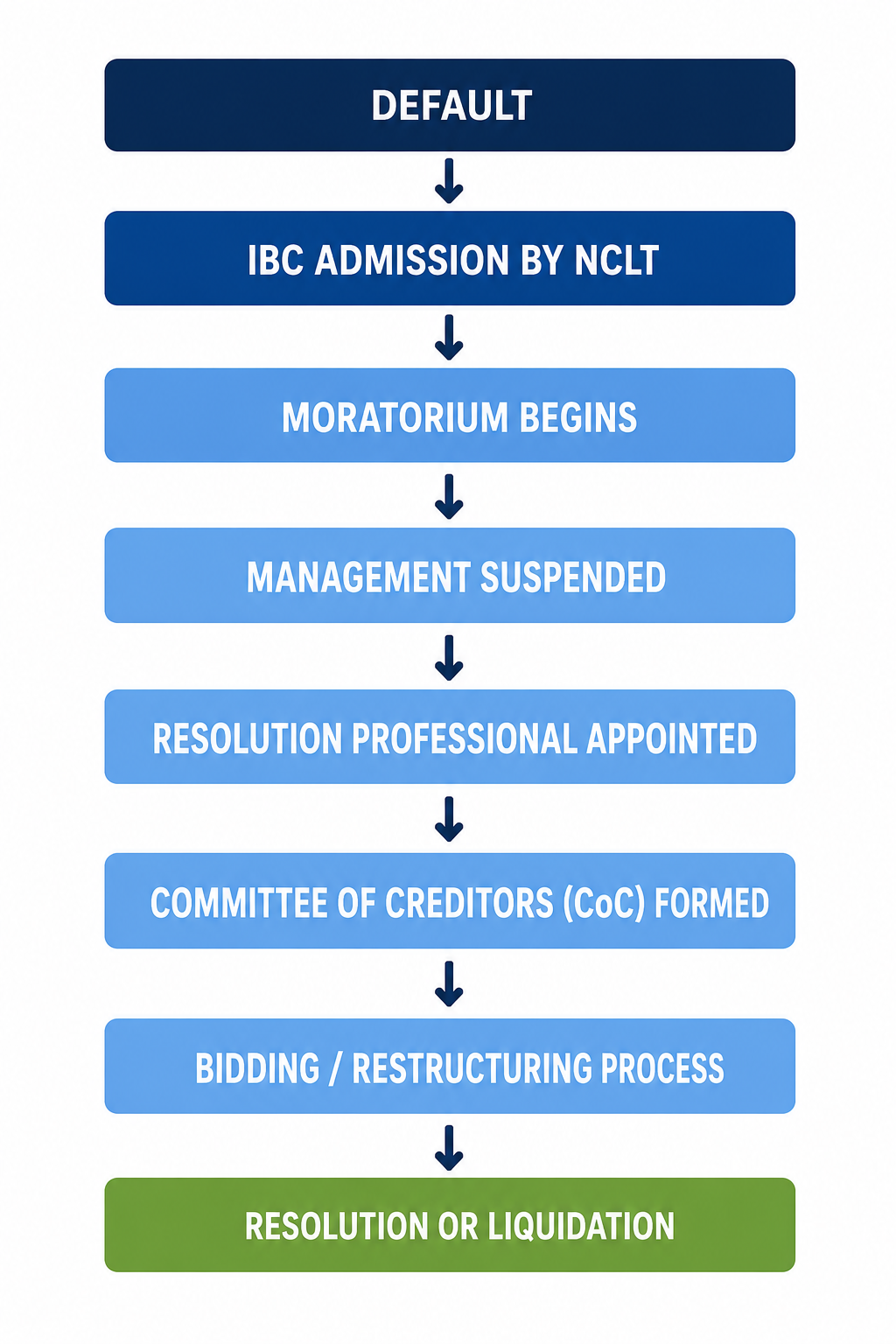
The process usually begins when a financial creditor initiates insolvency proceedings before the National Company Law Tribunal (NCLT).
Once admitted:
Why the Moratorium Matters in Infrastructure Insolvency
The moratorium under the IBC freezes:
- Enforcement actions
- Litigation proceedings
- Asset transfers
- Independent recovery attempts
For ordinary companies, this mainly preserves value. For infrastructure assets, it prevents operational collapse.
Without the moratorium:
- Concession agreements may terminate
- Public services may be disrupted
- Interconnected infrastructure systems may fail
This is especially critical in sectors such as airports, power, ports and telecom.
Infrastructure Insolvency Is Not Just a Legal Process — It Is an Operational Crisis
The biggest challenge in infrastructure restructuring is usually not legal enforcement. It is operational continuity.
During Insolvency, Projects Still Need to Operate
- Supply electricity
- Maintain telecom connectivity
- Handle passenger traffic
- Preserve regulatory compliance
- Retain EPC and O&M contractors
As a result, lenders and resolution professionals often spend more time stabilising operations than litigating claims.
The Hidden Complexity: Concession Agreements and Regulatory Dependencies
Most infrastructure assets are tied to government concessions, licences or sector-specific approvals. That means insolvency resolution frequently requires coordination with:
- Sectoral regulators
- Government authorities
- Concessioning agencies
- Public sector counterparties
For example:
| Sector | Key Regulatory Dependency |
| Airports | Airport concession transfer approvals |
| Roads & Highways | NHAI substitution rights |
| Power Projects | PPA continuity and tariff approvals |
| Telecom | Spectrum and licensing compliance |
| Renewable Energy | Grid connectivity and DISCOM payments |
This is why PPP project insolvency in India remains significantly more complicated than standard corporate insolvency.
The Committee of Creditors (CoC): The Real Decision-Making Power
Once insolvency begins, financial creditors collectively control the restructuring process through the Committee of Creditors (CoC). The CoC decides:
- Whether the project should be sold, restructured or liquidated
- Who can acquire the asset
- How recoveries are distributed
Most major decisions require 66% voting approval.
In consortium-financed infrastructure projects, inter-creditor coordination becomes one of the most decisive factors in successful resolution.
Distressed Infrastructure Investing Is Booming in India
One of the biggest post-IBC shifts has been the rise of distressed infrastructure investing in India. Global infrastructure funds, sovereign wealth funds, private equity firms and private credit investors increasingly view stressed projects as acquisition opportunities rather than failed assets.
The most active sectors include:
- Renewable energy
- Roads and HAM assets
- Telecom infrastructure
- Logistics parks
- Airports
- Data centres
The reason is simple: many distressed assets remain operationally valuable despite financial stress.
Why Investors Prefer Buying Infrastructure Assets Through the IBC
A major attraction is the “clean slate” principle. Successful bidders under the IBC generally acquire assets free from many historical liabilities and legacy claims, subject to the approved resolution plan.
For investors, this creates:
- Cleaner title structures
- Lower litigation exposure
- Improved bankability of acquired assets
This principle has significantly accelerated distressed renewable energy acquisitions and infrastructure platform consolidation in India.
Renewable Energy Insolvency: The Next Major Wave
Unlike thermal assets, renewable projects often remain attractive because they generate relatively stable long-term cashflows. However, they also carry sector-specific risks:
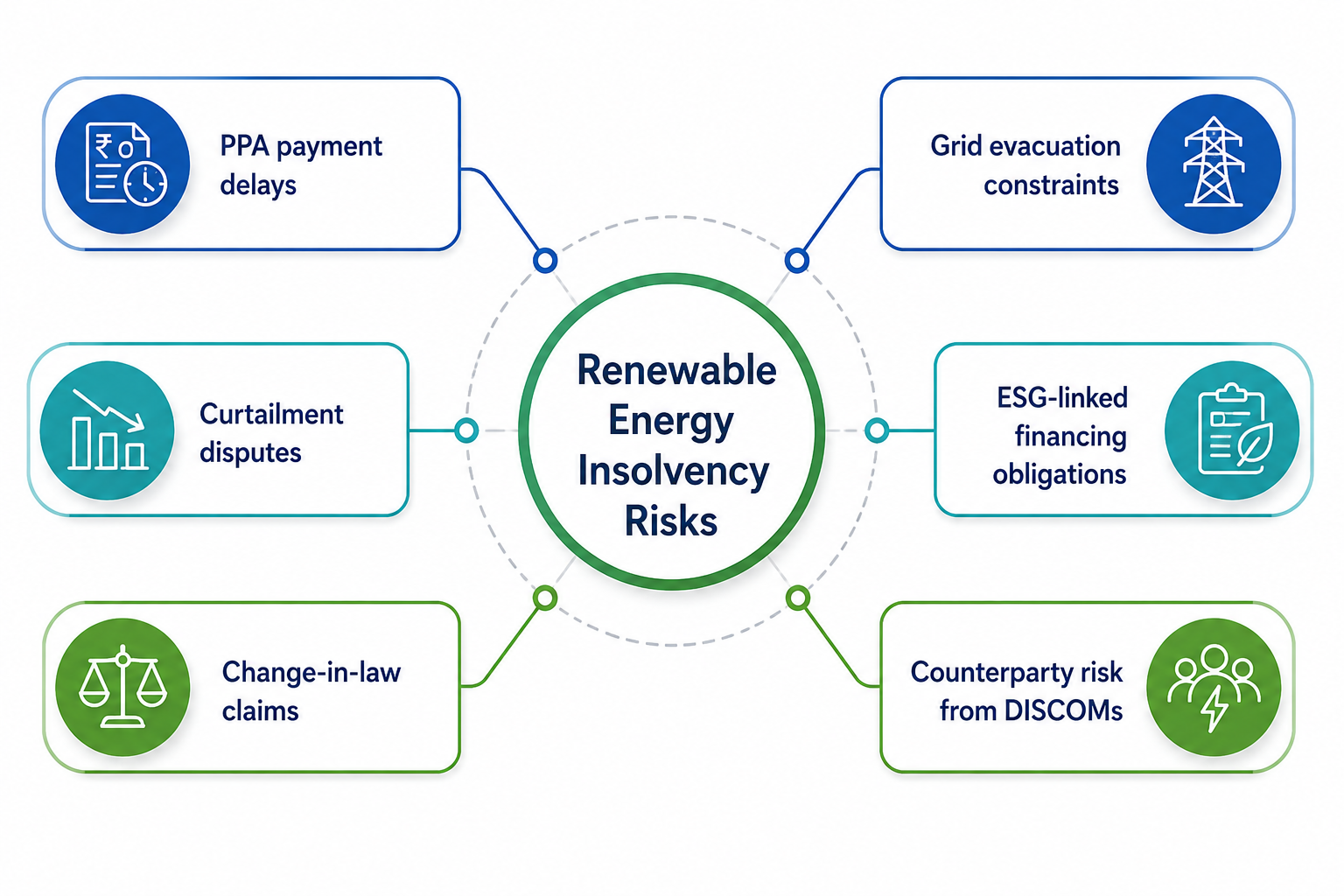
As India accelerates its energy transition, renewable energy restructuring and distressed green infrastructure acquisitions are expected to rise significantly.
Data Centres and Digital Infrastructure: A New Category of Distress
India’s digital infrastructure boom has created another emerging restructuring segment: data centres and technology-linked infrastructure assets.
These insolvencies are structurally different from traditional infrastructure because they involve:
- Rapid technology obsolescence
- Cybersecurity exposure
- High energy dependence
- Continuous capex requirements
Unlike roads or power plants, digital infrastructure assets require constant operational upgrades simply to retain enterprise customers.
Why Liquidation Rarely Works for Infrastructure Projects
Liquidation is usually the least preferred outcome in infrastructure insolvency. Breaking apart an infrastructure project often destroys value because:
- Concessions may terminate
- Operations may shut down
- Regulatory approvals may lapse
- Buyers prefer operating platforms over fragmented assets
Accordingly, stakeholders usually pursue:
- Sponsor replacement
- Refinancing
- Restructuring
- Platform-level acquisitions
2026 IBC Amendments: What Infrastructure Lenders Must Watch
The Insolvency and Bankruptcy (Amendment) Act, 2026 introduces important implications for infrastructure financing and secured lending.
Key changes include:
| Amendment | Impact |
| Mandatory notice timelines for secured creditors | Delayed action may result in loss of enforcement rights |
| 66% lender approval for commonly charged assets | Strengthens collective enforcement discipline |
| Greater procedural oversight in liquidation enforcement | Reduces fragmented recoveries |
These changes are especially relevant in multi-lender project finance structures and syndicated infrastructure loans.
Arbitration and Insolvency: The Collision of Two Legal Systems
Infrastructure insolvencies frequently overlap with:
- Arbitration proceedings
- Concession disputes
- EPC claims
- Regulatory litigation
This creates procedural complexity because insolvency may pause certain proceedings while allowing others to continue independently.
For distressed infrastructure assets, legal strategy increasingly requires simultaneous management of:
- Insolvency law
- Arbitration law
- Public procurement rules
- Sector-specific regulation
ESG Is Becoming Central to Distressed Infrastructure Valuation
Environmental and governance risks are now materially influencing distressed asset pricing. Investors evaluating infrastructure acquisitions increasingly examine:
- Environmental liabilities
- Carbon transition risks
- Labour compliance exposure
- Governance failures
- Sustainability-linked financing obligations
In many transactions, ESG diligence now directly affects both valuation and financing availability.
The Future of Infrastructure Insolvency in India
India’s infrastructure restructuring ecosystem is rapidly institutionalising. The next phase of growth is likely to be driven by:
- Private credit expansion
- Sovereign capital participation
- Cross-border infrastructure acquisitions
- Renewable energy consolidation
- Digital infrastructure restructuring
The market is also witnessing growing sophistication in:
- Pre-insolvency restructuring strategies
- Special situation investments
- Stressed infrastructure platforms
- Hybrid financing models
Conclusion
Infrastructure insolvency in India is no longer simply about recovering bad loans. It has evolved into a high-stakes restructuring ecosystem that sits at the intersection of project finance, public policy, distressed investing and national infrastructure development.
The Insolvency and Bankruptcy Code has fundamentally transformed how distressed infrastructure assets are preserved, transferred and revived. Yet infrastructure insolvency remains uniquely complex because every resolution involves operational continuity, regulatory approvals, public interest obligations and multi-stakeholder coordination.
For lenders, developers, private credit funds and strategic investors, successful infrastructure restructuring now depends as much on operational strategy and regulatory navigation as it does on legal enforcement.
As India continues building one of the world’s largest infrastructure economies, the efficiency with which distressed projects are resolved will play a defining role in sustaining long-term investor confidence, capital inflows and infrastructure growth.
Last Updated on 15 May, 2026

By entering the email address you agree to our Privacy Policy.