
Project Finance Due Diligence in India (2026): What Lenders, Investors and Infrastructure Developers Must Really Watch

India’s infrastructure financing market is entering a far more disciplined and sophisticated phase. What was once a documentation-heavy exercise focused largely on land title and financial viability has evolved into a multidimensional risk assessment involving regulatory oversight, ESG compliance, technology resilience, insolvency preparedness, cybersecurity exposure and cross-border structuring.
This shift is being driven by several structural developments:
- The RBI’s tighter framework for project finance monitoring and provisioning;
- Rising participation by sovereign funds, pension funds and global infrastructure investors;
- Increased scrutiny around ESG and sustainability-linked financing;
- Technology-heavy infrastructure assets such as data centres, battery storage and green hydrogen projects; and
- Lessons learned from India’s earlier infrastructure stress cycles.
In 2026, lenders are no longer funding merely “projects.” They are financing long-duration risk ecosystems. For banks, NBFCs, infrastructure debt funds, private equity investors and multilateral institutions, robust project finance due diligence has now become one of the most important determinants of bankability, valuation stability and recovery protection.
Table of Contents
- Why Project Finance Due Diligence Has Become Far More Intensive
- The RBI Project Finance Directions 2025: Why Due Diligence Standards Have Tightened
- Legal Due Diligence Remains the Core of Infrastructure Financing
- Land Due Diligence Continues to Be the Biggest Infrastructure Risk in India
- Regulatory Due Diligence Has Become Increasingly Sector-Specific
- ESG Due Diligence Is No Longer Optional
- What ESG Diligence Typically Covers
- Contractual Due Diligence Often Determines Revenue Stability
- Technology Due Diligence Is Becoming a Major Financing Issue
- What Technology Diligence Now Covers
- Revenue Due Diligence Has Become More Conservative
- Insolvency and Enforcement Analysis Is Now Built Into Due Diligence
- Modern Diligence Now Examines
- Cross-Border Infrastructure Financing Requires Multi-Layered FEMA Review
- Common FEMA and FDI Review Areas
- Insurance Review Is Now Part of Core Credit Analysis
- Sector-Specific Due Diligence Trends Defining 2026
- The Future of Project Finance Due Diligence in India
- Conclusion
Why Project Finance Due Diligence Has Become Far More Intensive
Infrastructure projects inherently involve:
- Long gestation periods;
- Large upfront capital commitments;
- Regulatory dependency;
- Public authority interfaces;
- Multi-party contractual structures; and
- Long-term revenue assumptions.
A single weakness whether in land acquisition, environmental approvals, concession protections or technology integration can materially impair:
- Financial close timelines;
- Debt servicing capability;
- Project cashflows;
- Security enforceability; and
- Investor exit opportunities.
Unlike traditional corporate lending, project finance depends almost entirely on the future performance of the underlying asset. Consequently, lenders today evaluate not only whether a project is viable, but whether it can survive stress, delay, regulatory disruption and restructuring scenarios.
The RBI Project Finance Directions 2025: Why Due Diligence Standards Have Tightened
The RBI’s revised project finance framework has materially changed how banks and financial institutions approach infrastructure lending.
The focus has shifted toward:
| Earlier Approach | 2026 Lending Approach |
| Financial closure focused | Lifecycle risk focused |
| Reliance on sponsor comfort | Independent project validation |
| Static due diligence | Continuous monitoring |
| Documentation-heavy review | Milestone-linked risk analysis |
| Limited operational oversight | Real-time implementation monitoring |
Lenders are now expected to conduct significantly deeper assessment of:
- Construction readiness;
- Implementation timelines;
- Contingency planning;
- Cost overruns;
- Regulatory dependency; and
- Delay-related provisioning risks.
Legal Due Diligence Remains the Core of Infrastructure Financing
Legal diligence continues to form the foundation of project finance transactions. However, the scope has become far broader than conventional corporate verification.
Modern infrastructure legal due diligence now typically covers:
| Core Legal Review Area | Key Focus |
| Corporate diligence | Corporate authority, promoter structure, litigation history |
| Land diligence | Title, acquisition, zoning, encumbrances |
| Regulatory review | Licences, permits, sector approvals |
| Contract review | EPC, concession, PPA, O&M and offtake agreements |
| Security analysis | Charge creation, enforceability, assignment rights |
| Insolvency preparedness | Distress scenarios and restructuring flexibility |
For institutional investors, legal diligence is now closely linked to long-term operational resilience rather than merely transaction completion.
Land Due Diligence Continues to Be the Biggest Infrastructure Risk in India
Despite improvements in digitisation and land record management, land-related disputes remain one of the largest causes of project delay and litigation in India. Lenders therefore treat land diligence as a critical bankability issue.
What Lenders Typically Examine
- Chain of title and ownership continuity;
- Existing encumbrances and third-party rights;
- Land use and zoning compliance;
- Acquisition status;
- Government approvals and conversion permissions;
- Easement and access rights; and
- Ongoing litigation or acquisition disputes.
Sector-Specific Land Risks
| Sector | Typical Land Risk |
| Renewable energy | Fragmented ownership and agricultural conversion |
| Logistics parks | Industrial zoning and connectivity approvals |
| Airports | Large-scale acquisition and rehabilitation exposure |
| Data centres | Utility access and infrastructure dependency |
| Urban infrastructure | Municipal approvals and rehabilitation obligations |
Even commercially viable projects may become unfinanceable where land aggregation or title integrity remains uncertain.
Regulatory Due Diligence Has Become Increasingly Sector-Specific
Infrastructure assets today operate within highly specialised regulatory ecosystems.
Accordingly, lenders now require deep sectoral regulatory assessment rather than generic compliance review.
Key Areas of Regulatory Assessment
- Concession validity;
- Licence tenure;
- Tariff approvals;
- Environmental permissions;
- Utility access rights;
- Government support agreements;
- Change-in-law protections; and
- Sector regulator compliance.
Why This Matters
Regulatory non-compliance can trigger:
- Delay in commissioning;
- Revenue interruption;
- Penalties and sanctions;
- Concession termination; or
- Financing default events.
Projects in sectors such as airports, telecom, power transmission, mining and urban mobility typically involve especially high regulatory complexity.
ESG Due Diligence Is No Longer Optional
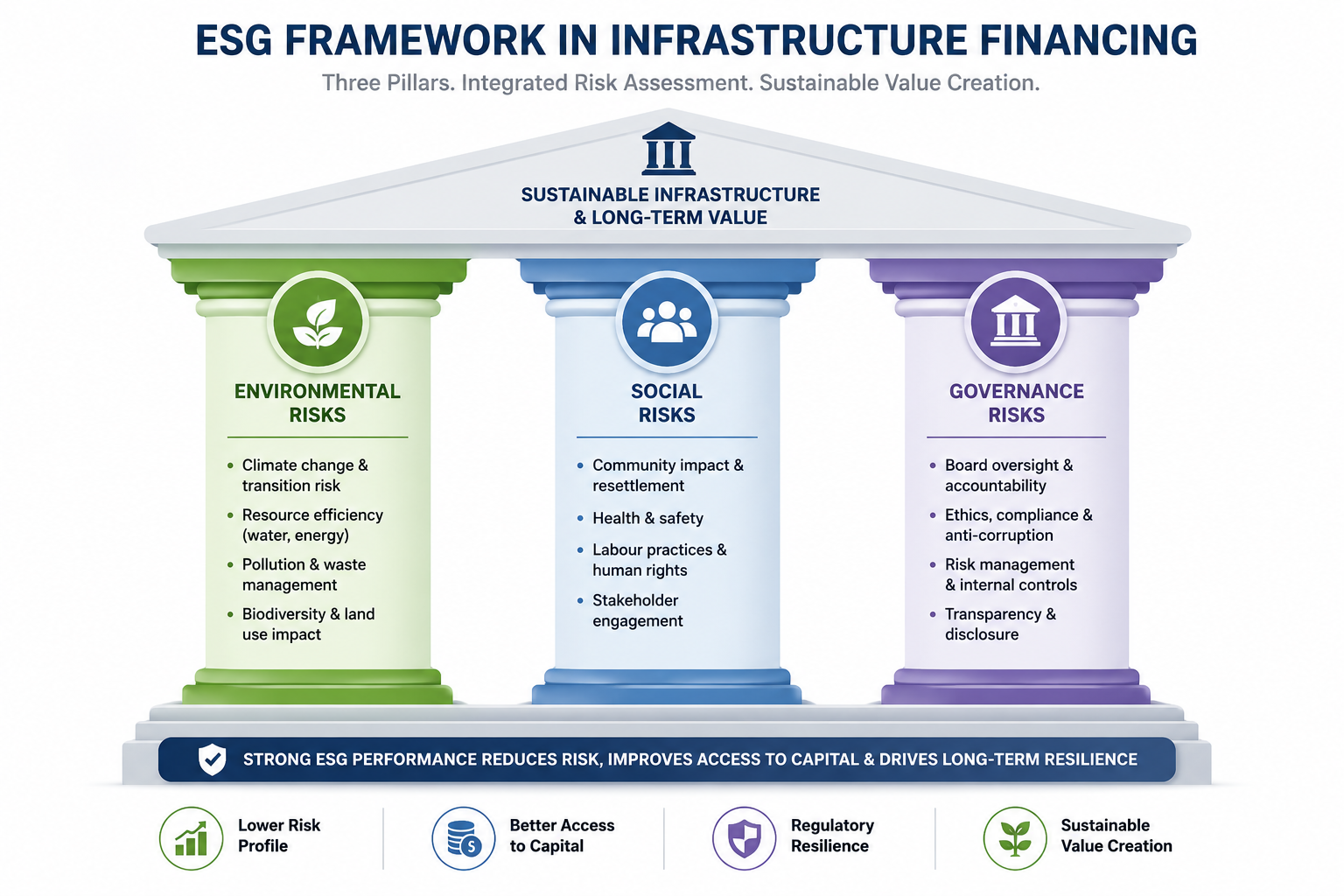
Environmental, Social and Governance (ESG) review has become central to modern infrastructure financing. International lenders, sovereign funds and institutional investors increasingly integrate ESG metrics directly into financing and valuation decisions.
What ESG Diligence Typically Covers
| ESG Area | Key Evaluation Metrics |
| Environmental | Emissions, waste management, water usage, climate exposure |
| Social | Labour standards, rehabilitation impact, community disputes |
| Governance | Board controls, anti-corruption systems, compliance mechanisms |
Projects with weak ESG alignment increasingly face:
- Higher financing costs;
- Reduced institutional participation;
- Reputational risk;
- Regulatory scrutiny; and
- Litigation exposure.
This is particularly relevant for:
- Renewable energy projects;
- Battery energy storage systems (BESS);
- Green hydrogen facilities;
- Urban infrastructure; and
- Large industrial infrastructure platforms.
Contractual Due Diligence Often Determines Revenue Stability
Infrastructure assets depend heavily on long-term contracts for revenue visibility and operational continuity. Accordingly, lenders scrutinise project agreements in extraordinary detail.
Contracts Commonly Reviewed
- EPC contracts;
- Power Purchase Agreements (PPAs);
- Concession agreements;
- O&M agreements;
- Fuel supply arrangements;
- Technology licensing agreements; and
- Offtake contracts.
Critical Contractual Risks
| Risk Area | Why It Matters |
| Termination rights | Impacts lender recovery |
| Force majeure clauses | Determines operational resilience |
| Delay liquidated damages | Affects construction risk allocation |
| Change-in-law protections | Protects long-term revenue stability |
| Payment security | Ensures cashflow certainty |
| Counterparty credit quality | Determines enforceability and collection risk |
Weak contractual frameworks often become the single largest cause of infrastructure stress during downturns.
Technology Due Diligence Is Becoming a Major Financing Issue
Traditional infrastructure financing focused primarily on physical asset quality. In 2026, technology resilience has become equally important. This is especially true for:
- Data centres;
- Battery storage systems;
- Smart infrastructure;
- Renewable integration systems; and
- Green hydrogen projects.
What Technology Diligence Now Covers
- Equipment reliability;
- Cybersecurity architecture;
- Technology obsolescence risk;
- Manufacturer stability;
- Software resilience;
- Operational integration capability; and
- Long-term maintenance support.
Technology-intensive infrastructure assets now require integrated legal, technical and operational diligence.
Revenue Due Diligence Has Become More Conservative
Following earlier infrastructure distress cycles, lenders now apply far more conservative assumptions while evaluating project cashflows.
Key Financial Review Areas
- Revenue projections;
- Demand forecasting;
- Tariff assumptions;
- Stress testing;
- Counterparty risk;
- Sensitivity analysis; and
- Debt servicing resilience.
Sector-Wise Revenue Concerns
| Sector | Primary Revenue Risk |
| Toll roads | Traffic projection volatility |
| Renewable energy | PPA enforceability and curtailment |
| Data centres | Customer concentration |
| Green hydrogen | Offtake uncertainty |
| Airports | Passenger traffic fluctuations |
Projects with optimistic assumptions but weak downside protection increasingly struggle to achieve financing closure.
Insolvency and Enforcement Analysis Is Now Built Into Due Diligence
Since the implementation of the Insolvency and Bankruptcy Code, 2016, lenders have become significantly more focused on enforcement preparedness and restructuring flexibility.
Modern Diligence Now Examines
- Security enforceability;
- Inter-creditor structures;
- Distress scenarios;
- Sponsor financial strength;
- Step-in rights;
- Concession transferability; and
- Restructuring pathways.
Infrastructure projects are long-duration assets vulnerable to:
- Policy shifts;
- Economic cycles;
- Regulatory disruption; and
- Commodity price volatility.
As a result, lenders increasingly structure transactions with pre-designed distress management mechanisms.
Cross-Border Infrastructure Financing Requires Multi-Layered FEMA Review
Foreign investment into Indian infrastructure continues to grow across:
- Renewable energy;
- Logistics;
- Digital infrastructure;
- Warehousing;
- Urban mobility; and
- Energy transition assets.
However, cross-border financing structures require careful regulatory coordination.
Common FEMA and FDI Review Areas
| Review Area | Typical Concern |
| ECB compliance | Borrowing eligibility and end-use restrictions |
| Security creation | Overseas lender security limitations |
| Pricing guidelines | Equity and transfer compliance |
| Repatriation structures | Cashflow movement restrictions |
| Tax treaty analysis | Withholding and capital gains optimisation |
Cross-border infrastructure transactions increasingly require integrated advice across finance, tax, regulatory and disputes teams.
Insurance Review Is Now Part of Core Credit Analysis
Insurance structures are no longer treated as secondary documentation. Lenders increasingly evaluate whether insurance coverage adequately protects long-term asset stability.
Key Insurance Areas Reviewed
- Construction all-risk coverage;
- Business interruption insurance;
- Political risk insurance;
- Cybersecurity insurance;
- Environmental liability coverage; and
- Operational risk protection.
For technology-heavy assets such as data centres and battery storage systems, insurance adequacy directly influences lender risk appetite.
Sector-Specific Due Diligence Trends Defining 2026
Renewable Energy Projects
Key focus areas include:
- Curtailment risk;
- Grid connectivity;
- Land aggregation;
- PPA enforceability; and
- ESG compliance.
Data Centre Financing
Key diligence concerns include:
- Reliable power supply;
- Cybersecurity resilience;
- Sustainability obligations;
- Customer concentration risk; and
- Technology scalability.
Green Hydrogen Projects
Lenders increasingly focus on:
- Technology maturity;
- Renewable integration;
- Water sourcing rights;
- Export infrastructure; and
- Long-term offtake arrangements.
Battery Energy Storage Systems (BESS)
Major diligence concerns include:
- Technology degradation;
- Warranty structures;
- Revenue model stability; and
- Lifecycle economics.
The Future of Project Finance Due Diligence in India
Infrastructure diligence is expected to become increasingly:
- AI-assisted;
- Real-time monitored;
- ESG-driven;
- Data-intensive; and
- Operationally integrated.
Future financing frameworks are likely to involve:
| Emerging Trend | Expected Impact |
| AI-based monitoring | Faster risk detection |
| Real-time compliance tracking | Continuous lender oversight |
| Climate analytics | Better resilience assessment |
| Digital twin infrastructure monitoring | Predictive maintenance and risk analysis |
| ESG-linked financing covenants | Performance-based pricing |
The era of static due diligence reports is gradually ending. Infrastructure finance is moving toward continuous lifecycle risk supervision.
Conclusion
Project finance due diligence in India has evolved from a traditional legal verification exercise into a sophisticated multidisciplinary risk management framework.
In 2026, successful infrastructure financing depends not only on project economics, but also on:
- Regulatory resilience;
- ESG preparedness;
- Technology reliability;
- Enforcement readiness;
- Cross-border compliance; and
- Long-term operational sustainability.
As India’s infrastructure ecosystem becomes increasingly global, technology-driven and institutionally financed, comprehensive due diligence will remain one of the defining factors shaping successful infrastructure investment outcomes.
Last Updated on 19 May, 2026

By entering the email address you agree to our Privacy Policy.