
Food Safety Enforcement and Due Process: Bombay High Court Examines the Limits of Immediate FSSAI Licence Suspension
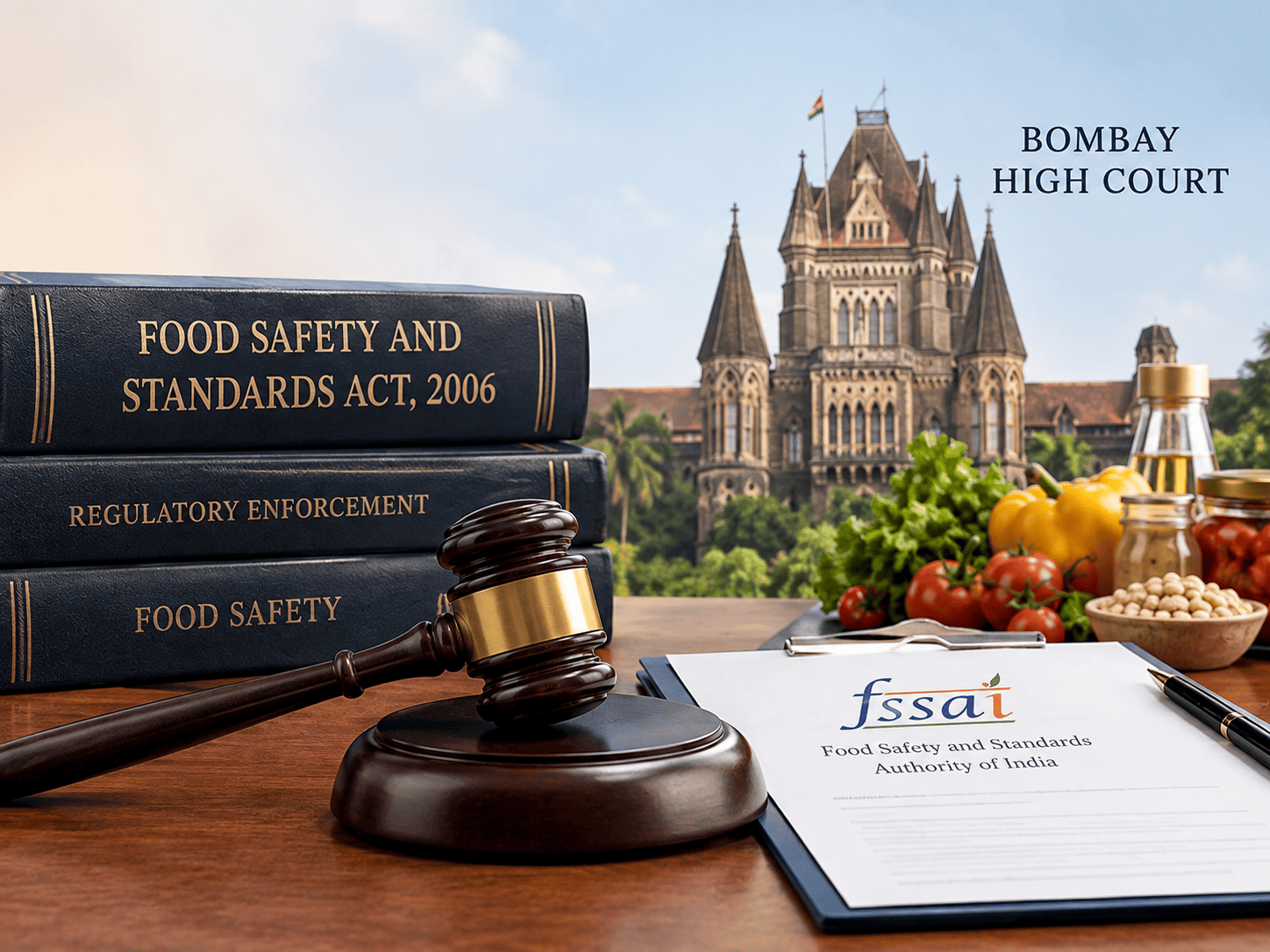
Bombay High Court’s recent proceedings highlight the importance of proportionality, reasoned decision-making and impartial enforcement under the Food Safety and Standards Act, 2006
Introduction
The recent enforcement drive undertaken by the Food and Drug Administration (“FDA”) across Maharashtra has brought renewed attention to the balance between food safety regulation and procedural fairness. Several restaurants, hotels and other food establishments have faced inspections, suspension orders and directions to cease food business activities following alleged deficiencies relating to hygiene, sanitation, food storage and food handling.
While the protection of public health is undoubtedly a compelling regulatory objective, the manner in which statutory powers are exercised raises important questions concerning the scope of regulatory discretion, the safeguards prescribed under the Food Safety and Standards Act, 2006 (“FSS Act”) and the constitutional principles governing administrative action.
These issues came into sharp focus before the Bombay High Court in Sanjay Baburao Nirbhavne v. State of Maharashtra & Ors., Writ Petition No. 8429 of 2026. The proceedings concerned the immediate suspension of a food business licence following a surprise inspection. While the Court ultimately quashed the suspension after subsequent inspections demonstrated substantial rectification of the deficiencies, it expressly left open the larger question of whether an improvement notice is an indispensable pre-condition to the exercise of the exceptional power of immediate suspension under Section 32 of the FSS Act.
Subsequent proceedings on 31 July 2026 also brought into focus the requirement of impartiality in regulatory enforcement, particularly in the context of inspections of private establishments vis-à-vis government-operated canteens and eateries.
Regulatory Framework Under the Food Safety and Standards Act, 2006
The FSS Act was enacted to consolidate the laws relating to food and to establish a systematic framework for regulating food safety standards in India. The legislation confers substantial powers upon food safety authorities to inspect establishments, collect samples, investigate violations and take enforcement action. At the same time, the statutory scheme contemplates procedural safeguards governing suspension and cancellation of food business licences.
Section 26 imposes obligations upon Food Business Operators (“FBOs”) to ensure that food manufactured, processed, stored, distributed or sold by them complies with the requirements of the FSS Act and the regulations made thereunder. Section 31 requires food businesses to obtain the requisite licence or registration, thereby providing the statutory basis for regulatory supervision.
Section 32 assumes particular significance in the context of enforcement. The provision contemplates the issuance of an Improvement Notice where a Designated Officer is satisfied that an FBO has failed to comply with the provisions of the Act, the Rules or the conditions of its licence. The FBO is ordinarily afforded an opportunity to rectify the identified deficiencies within the prescribed period, failing which further action, including suspension or cancellation of the licence, may follow.
Section 38 further empowers Food Safety Officers to inspect establishments, collect samples, seize food articles and conduct investigations. However, such powers are intended to facilitate compliance and evidence gathering rather than permit arbitrary closure of businesses. The enforcement architecture of the Act thus envisages regulated and proportionate intervention rather than immediate business disruption in every case.
The statutory scheme, however, contains an important exception. The proviso to Section 32(3) permits the Designated Officer to suspend a licence forthwith in the interest of public health, for reasons to be recorded in writing. Regulation 2.1.8 of the Food Safety and Standards (Licensing and Registration of Food Businesses) Regulations, 2011 similarly provides for the ordinary suspension mechanism following non-compliance with an Improvement Notice, while recognising the power to take immediate action in circumstances warranting such intervention.
Section 38 further empowers Food Safety Officers to inspect food establishments, collect samples, seize food articles and conduct investigations. These powers are central to the enforcement architecture of the FSS Act. However, their exercise remains subject to the statutory framework and the general principles governing administrative action.
Thus, the FSS Act seeks to balance two competing imperatives: prompt intervention where public health is at risk, and structured corrective enforcement where deficiencies can appropriately be remedied through compliance measures.
The Maharashtra Enforcement Drive and the Challenge Before the Bombay High Court
The enforcement drive in Maharashtra resulted in inspections of several food establishments, with reports identifying deficiencies relating to hygiene, sanitation, storage practices, pest control and food handling. The legal controversy intensified when establishments challenged suspension orders directing them to cease food business activities. One such challenge was brought by Sanjay Baburao Nirbhavne, Senior Manager of M/s. Lotus Pond Hotel Pvt. Ltd., which operated the Park INN by Radisson establishment.
On 2 July 2026, the establishment was subjected to a surprise inspection. The inspection identified several deficiencies and recorded a compliance score of 61%, with 65 out of 108 marks. On 3 July 2026, the Designated Officer invoked the proviso to Section 32(3) of the FSS Act read with Regulation 2.1.8(iv) and suspended the food licence with immediate effect, directing the establishment to cease food business activities.
The petitioner challenged the suspension before the Bombay High Court, contending, inter alia, that the exceptional power of immediate suspension had been exercised without adequate reasons demonstrating an exigency affecting public health and without following the ordinary mechanism of an Improvement Notice.
The State, on the other hand, maintained that the inspection had disclosed serious deficiencies in hygiene, sanitation, food storage and food handling and that the immediate suspension was justified in the interest of public health and consumer safety.
Bombay High Court’s Intervention and Subsequent Inspections
The proceedings before the Bombay High Court in the matter of Sanjay Baburao Nirbhavne V/s The State of Maharashtra WP 8249 of 2026 marked an important judicial examination of food safety enforcement powers. While considering challenges to closure and suspension orders, the Court reportedly questioned whether immediate punitive action was justified in every case of alleged non-compliance.
The Court appeared particularly concerned with the issue of proportionality. The doctrine of proportionality requires that administrative action bear a reasonable relationship to the objective sought to be achieved. In the regulatory context, this means that enforcement action should correspond to the severity and nature of the violation identified.
The Court’s observations suggested that minor hygiene deficiencies, capable of immediate correction, may not automatically warrant complete shutdown of a business establishment. Such action not only affects the business owner but also employees, suppliers and consumers. Consequently, closure orders issued without examining whether less intrusive alternatives were available could potentially fail the test of proportionality.
In directing inspections of government canteens and public facilities as well, the Court underscored another important principle, namely that regulatory standards must apply uniformly irrespective of whether the regulated entity is public or private.
Constitutional Foundations of Fair Enforcement
The issues emerging from the recent raids extend beyond the Food Safety Act and enter the constitutional domain. Article 14 of the Constitution guarantees equality before law and protection against arbitrary state action. Enforcement decisions that are inconsistent, selective or disproportionate may attract constitutional scrutiny under this provision.
The landmark judgment in Maneka Gandhi v. Union of India (1978) 1 SCC 248 transformed Indian administrative law by holding that any state action affecting rights must be fair, just and reasonable. The decision established that statutory powers cannot be exercised arbitrarily merely because the statute confers discretion.
Applying the principles of Maneka Gandhi to food safety regulation, authorities undoubtedly possess power to inspect, suspend and penalise. However, such powers must be exercised in a manner that is reasonable, transparent and procedurally fair. Any action resulting in closure of a business without adequate adherence to statutory safeguards may be vulnerable to legal challenge.
Supreme Court on Proportionality and Administrative Action
The doctrine of proportionality was authoritatively recognised by the Supreme Court in Om Kumar v. Union of India (2001) 2 SCC 386. The Court held that administrative measures must not impose excessive or disproportionate burdens having regard to the objective sought to be achieved.
The relevance of Om Kumar in the present context is substantial. Food safety authorities undoubtedly have a legitimate objective in protecting public health. However, where a violation involves a remediable hygiene lapse rather than the sale of unsafe or adulterated food causing harm, the question arises whether immediate closure constitutes an excessive response.
The proportionality principle requires regulators to ask whether a less restrictive measure such as an improvement notice, corrective direction or temporary remedial order could adequately address the concern. If the answer is affirmative, complete closure may become difficult to justify.
Equality Before Law and Impartial Regulatory Enforcement
Perhaps the most significant outcome of the Bombay High Court proceedings has been the emphasis on equal application of food safety laws. Regulatory legitimacy depends not merely upon strict enforcement but also upon uniform enforcement.
If private restaurants are subjected to rigorous inspections and closure orders while similar deficiencies in government-operated kitchens, public institutions or official canteens escape scrutiny, concerns regarding arbitrariness inevitably arise. Article 14 requires that similarly situated entities be treated alike.
The High Court’s insistence on extending inspections to public facilities signals judicial recognition that food safety regulation cannot operate selectively. Public confidence in regulatory systems is strengthened when standards are applied consistently across all establishments.
Conclusion
The recent FSSAI and FDA enforcement drive in Maharashtra marks a critical moment in the evolution of food safety regulation in India. While regulators possess both statutory authority and public responsibility to ensure compliance with food safety norms, their powers are not unlimited. The Food Safety and Standards Act, 2006 itself contemplates a structured compliance framework built around improvement notices, opportunities for rectification and proportionate penalties.
The emerging judicial response of the Bombay High Court reinforces a broader constitutional principle: enforcement cannot come at the cost of due process. As the Supreme Court’s decisions in Maneka Gandhi, Om Kumar demonstrate, administrative action must always remain fair, proportionate and non-arbitrary.
The larger lesson from the recent raids is therefore twofold. Food businesses must maintain the highest standards of hygiene and compliance. Equally, regulators must ensure that enforcement actions are legally sustainable, procedurally fair and uniformly applied. In a constitutional democracy governed by the rule of law, public health and due process are not competing objectives but complementary principles that must advance together.
Last Updated on 7 September, 2026

By entering the email address you agree to our Privacy Policy.