
Renewable Energy Project Finance in India: Legal Framework for Solar, Wind and Green Hydrogen Projects
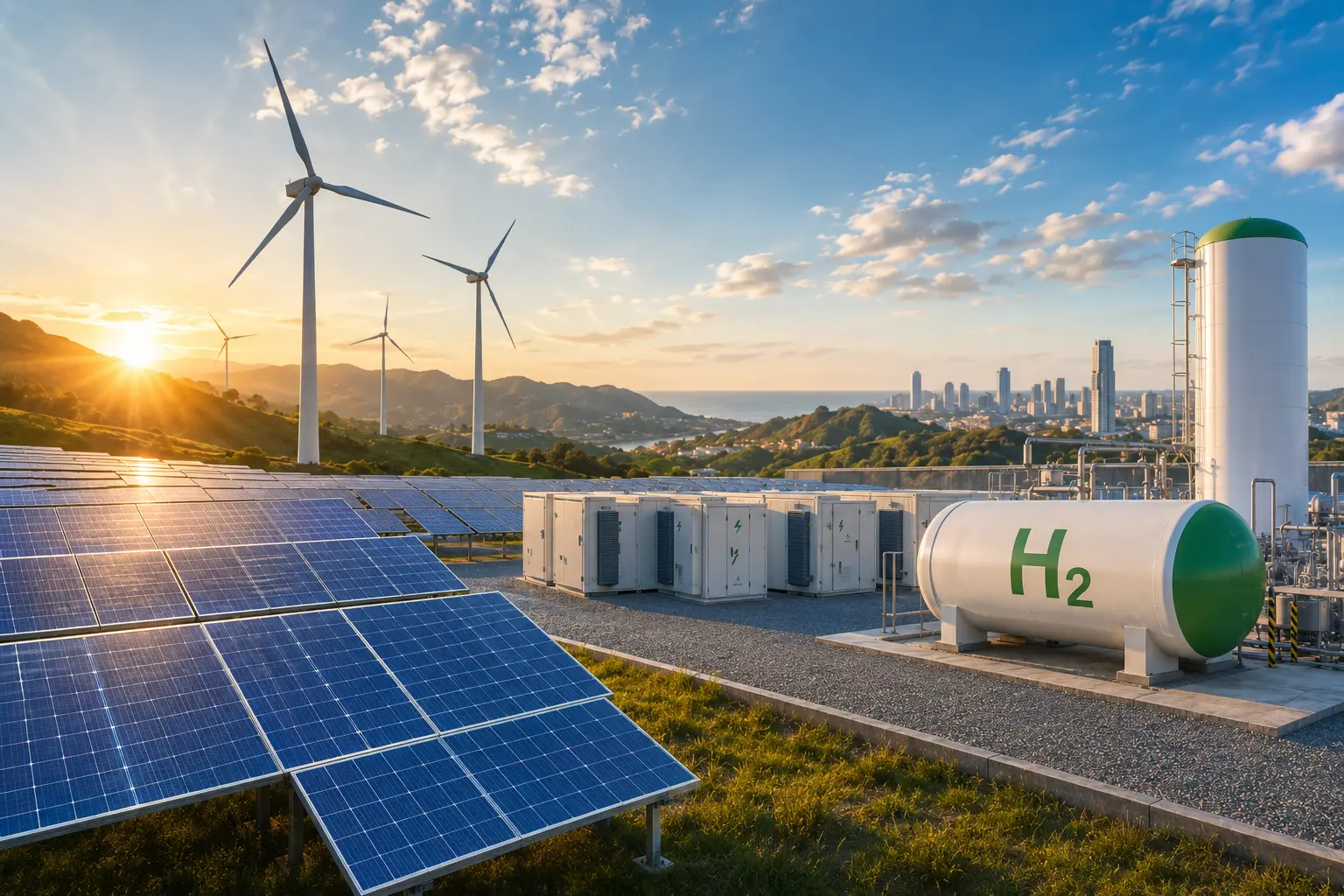
India’s renewable energy sector has emerged as one of the largest and most dynamic infrastructure investment markets globally. With ambitious decarbonisation goals, rising energy demand, increasing institutional capital participation and strong policy support, renewable energy project finance has become central to India’s infrastructure growth story.
Over the past decade, India has evolved from a market driven primarily by utility-scale solar deployment into a diversified clean energy ecosystem involving:
- Wind energy;
- Hybrid renewable projects;
- Round-the-clock renewable supply;
- Battery energy storage systems (“BESS”);
- Pumped hydro storage;
- Green hydrogen infrastructure; and
- Emerging energy transition technologies.
This evolution has also transformed the financing landscape.
Renewable energy transactions in India today involve complex legal and regulatory considerations relating to:
- Land acquisition;
- Grid connectivity;
- Power purchase arrangements;
- Environmental approvals;
- Security creation;
- Exchange control compliance;
- Insolvency risk; and
- ESG-linked financing frameworks.
This article examines the legal and financing framework governing renewable energy projects in India and analyses the key regulatory considerations for solar, wind and green hydrogen investments in 2026.
India’s Renewable Energy Growth Story
Government initiatives supporting:
- Energy transition;
- Net-zero commitments;
- Domestic manufacturing;
- Grid modernisation; and
- Green infrastructure
have significantly accelerated project development across the sector. The renewable energy market is increasingly attracting:
- Sovereign wealth funds;
- Pension funds;
- Infrastructure investment trusts (“InvITs”);
- Private equity investors;
- Multilateral institutions; and
- Offshore lenders.
The sector’s attractiveness is driven by:
- Long-term revenue visibility;
- Government-backed procurement frameworks;
- ESG alignment;
- Stable operational cashflows; and
- Increasing institutionalisation of renewable assets.
The Regulatory Framework Governing Renewable Energy Projects
Renewable energy projects in India are governed by a combination of:
- Central laws;
- State-specific electricity regulations;
- Environmental laws;
- Land laws;
- Exchange control regulations; and
- Financing regulations.
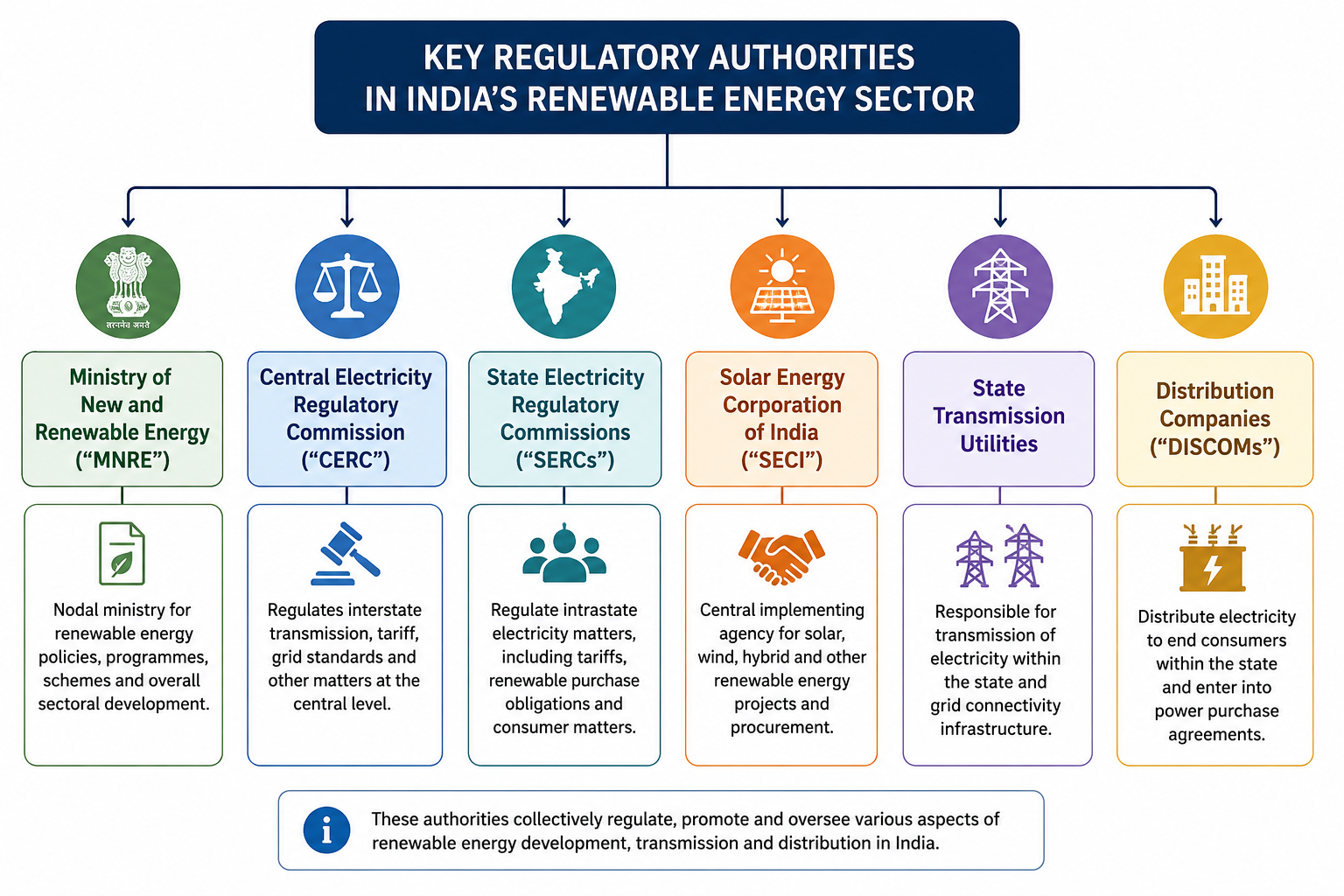
The legal framework varies depending on t project type, state location, power sale structure, and connectivity model.
Solar Energy Projects: Legal and Financing Considerations
Solar power continues to dominate India’s renewable energy market. Utility-scale solar projects generally involve:
- Special purpose vehicles (“SPVs”);
- Long-term power purchase agreements (“PPAs”);
- EPC contracts;
- Transmission agreements; and
- Multi-layered financing structures.
Land Acquisition Challenges
Land acquisition remains one of the most important legal considerations for solar projects. Key issues include:
- Agricultural land conversion;
- Title verification;
- Zoning restrictions;
- Fragmented ownership structures; and
- State-specific land laws.
Lenders typically require:
- Comprehensive title due diligence;
- Encumbrance verification;
- Land use approvals; and
- Litigation searches.
Defective title remains one of the most common causes of project delays.
Transmission Connectivity and Grid Access
Grid connectivity is critical for project viability. Renewable projects require:
- Transmission approvals;
- Connectivity agreements;
- Grid evacuation arrangements; and
- Open access approvals (where applicable).
Transmission delays continue to present material implementation risks.
Project financing documents increasingly include long-stop dates, connectivity-related conditions precedent, and delay-related risk allocation mechanisms.
Power Purchase Agreements (“PPAs”)
The bankability of renewable projects is heavily dependent on PPA quality. Key lender considerations include:
- Tariff certainty;
- Counterparty creditworthiness;
- Payment security mechanisms;
- Change-in-law protections;
- Curtailment provisions; and
- Termination compensation rights.
State-owned DISCOM payment delays continue to remain a key financing concern.
As a result, central procurement agencies such as SECI are often viewed more favourably by lenders and institutional investors.
Wind Energy Projects: Distinct Regulatory and Operational Risks
Wind projects involve:
- Greater dependence on site-specific wind assessments;
- Larger land aggregation requirements;
- Complex transmission arrangements; and
- More variable generation profiles.
Land and Right-of-Way Issues
Wind projects frequently involve:
- Large geographical spread;
- Multiple land parcels; and
- Right-of-way arrangements.
This creates additional due diligence complexity. Transmission infrastructure for wind projects also often requires:
- Easement rights;
- Access rights; and
- Environmental clearances.
Generation Variability and Financing
Wind generation profiles are inherently variable. Lenders therefore focus heavily on:
- Wind resource assessment;
- Independent generation studies;
- Historical weather data; and
- Conservative revenue projections.
Insurance structures also play a particularly important role in wind financing transactions.
Hybrid Renewable Energy Projects: The New Financing Frontier
India’s renewable sector is increasingly moving toward hybrid energy structures integrating solar, wind, and battery storage systems. These projects are particularly attractive because they:
- Improve generation stability;
- Reduce intermittency risk; and
- Support round-the-clock supply obligations.
Increased Financing Complexity
Hybrid projects involve significantly more complex financing structures because they require:
- Multiple technology integrations;
- Coordinated implementation timelines;
- Shared infrastructure frameworks; and
- Complex operational interfaces.
Financing documentation must carefully address:
- Component-specific delays;
- Shared security arrangements;
- Technology performance guarantees; and
- Operational risk allocation.
RBI Project Finance Directions 2025
The RBI (Project Finance) Directions, 2025 are expected to materially influence hybrid renewable financing structures. Lenders are now required to:
- Closely monitor implementation milestones;
- Link disbursements to project progress; and
- Undertake enhanced technical oversight.
Hybrid projects therefore require significantly greater implementation monitoring and lender coordination.
Battery Energy Storage Systems (“BESS”)
Battery storage is emerging as a core infrastructure segment within India’s renewable ecosystem. The inclusion of BESS under the Harmonised Infrastructure List has improved financing access.
Key Financing Risks
Battery projects present unique lender concerns relating to:
- Technology degradation;
- Supply chain dependence;
- Warranty enforceability;
- Replacement costs; and
- Revenue certainty.
Lenders increasingly require:
- Performance guarantees;
- Technology reserve mechanisms;
- Long-term service arrangements; and
- Enhanced insurance coverage.
Regulatory Evolution
Issues relating to market participation, ancillary services, capacity payments, and storage monetisation are still developing. This regulatory uncertainty affects financing structures and risk pricing.
Green Hydrogen: India’s Next Renewable Infrastructure Opportunity
Green hydrogen is rapidly emerging as one of India’s most strategically important energy transition sectors. The National Green Hydrogen Mission has accelerated policy support for:
- Electrolyser manufacturing;
- Renewable-linked hydrogen production;
- Export infrastructure; and
- Industrial decarbonisation.
Financing Green Hydrogen Projects
Green hydrogen projects involve multiple layers of complexity because they integrate:
- Renewable power infrastructure;
- Water sourcing;
- Electrolyser technology;
- Storage systems; and
- Transportation infrastructure.
Project finance structures for green hydrogen remain relatively nascent.
Key Legal and Regulatory Issues
Lenders and investors must evaluate:
- Water rights and allocation;
- Renewable power sourcing obligations;
- Carbon credit monetisation;
- Export licensing;
- Technology risk allocation;
- Offtake arrangements; and
- ESG compliance obligations.
Long-term bankability will depend heavily on government incentives, demand certainty, and international trade frameworks.
Foreign Investment in Renewable Energy Projects
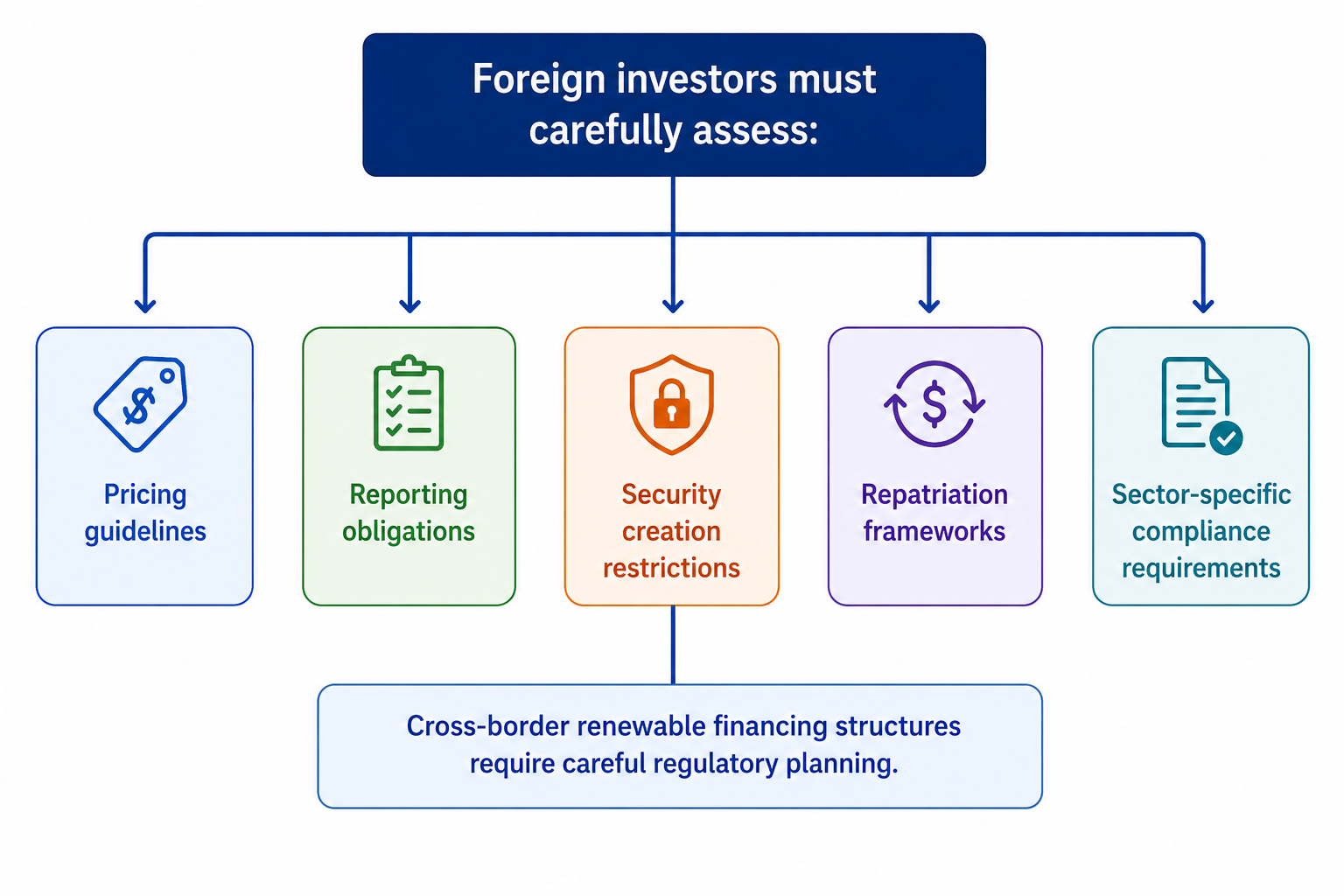
India’s renewable energy sector remains one of the most open infrastructure sectors for foreign investment. Foreign participation is generally permitted under the automatic route subject to FEMA compliance. Foreign investors commonly participate through:
- Direct equity investments;
- Infrastructure funds;
- External Commercial Borrowings (“ECBs”);
- Offshore bond structures; and
- InvIT investments.
FEMA and Exchange Control Considerations
Security Creation in Renewable Energy Financing
Renewable energy projects typically involve comprehensive security packages. Common security structures include:
- Mortgage over project land;
- Hypothecation of plant and equipment;
- Assignment of PPAs;
- Charge over project accounts;
- Assignment of insurance proceeds; and
- Pledge of shares.
CERSAI and Security Perfection
Security perfection through Registrar of Companies (“RoC”) filings and CERSAI registration has become critically important. Improperly perfected security may materially affect:
- Enforcement rights;
- Insolvency recoveries; and
- Priority claims.
Insolvency and Renewable Energy Projects
The Insolvency and Bankruptcy Code, 2016 (“IBC”) continues to significantly influence renewable energy financing. Lenders increasingly assess:
- PPA survivability during insolvency;
- Counterparty payment behaviour;
- Change-in-law disputes; and
- Regulatory litigation exposure.
The “clean slate” principle under the IBC has also improved investor appetite for distressed renewable asset acquisitions.
Distressed renewable platforms are increasingly attracting:
- Infrastructure funds;
- Sovereign investors; and
- Special situations capital.
ESG and Sustainability-Linked Financing
Renewable energy financing is closely tied to ESG-focused investment strategies. Institutional lenders increasingly require:
- Environmental compliance monitoring;
- Governance oversight;
- Sustainability reporting;
- Supply chain due diligence; and
- Climate disclosure frameworks.
Projects with strong ESG alignment often benefit from lower financing costs, wider lender participation, and improved refinancing access.
GIFT City and Offshore Renewable Financing
India’s IFSC at GIFT City is becoming increasingly relevant for renewable energy financing. Renewable developers are increasingly exploring:
- Offshore bond issuances;
- Green bonds;
- Sustainability-linked instruments; and
- Structured financing platforms through GIFT City.
The IFSC framework provides:
- Tax efficiencies;
- Regulatory flexibility; and
- Enhanced international investor access.
Common Risks in Renewable Energy Project Finance
Despite strong growth potential, renewable energy projects continue to face multiple risks, including:
- Land acquisition delays;
- Regulatory uncertainty;
- Transmission bottlenecks;
- Counterparty payment delays;
- Technology risks;
- Environmental litigation;
- Currency fluctuation exposure; and
- Policy changes.
Comprehensive due diligence and careful contractual structuring remain essential.
Conclusion
The market is evolving rapidly from traditional utility-scale solar and wind projects toward:
- Hybrid renewable systems;
- Battery storage;
- Green hydrogen;
- Sustainable infrastructure platforms; and
- Technology-integrated energy ecosystems.
At the same time, financing structures are becoming increasingly complex and compliance-intensive. Successful renewable energy project financing in India now requires careful navigation of:
- Regulatory frameworks;
- Land and transmission issues;
- Security perfection;
- ESG obligations;
- Insolvency risks; and
- Cross-border financing regulations.
As India accelerates its energy transition ambitions, renewable infrastructure is expected to remain one of the most attractive sectors for global capital participation.
Last Updated on 11 May, 2026

By entering the email address you agree to our Privacy Policy.