
Can a Resolution Applicant Withdraw or Renegotiate After CoC Approval? Supreme Court Clarifies
Introduction
The Insolvency and Bankruptcy Code, 2016 (“IBC” or “Code”) seeks to provide for a time-bound resolution of corporate insolvency, maximisation of the value of assets and balancing the interests of stakeholders. A crucial component of this framework is the Committee of Creditors (“CoC”), which evaluates and approves resolution plans in accordance with its commercial wisdom.
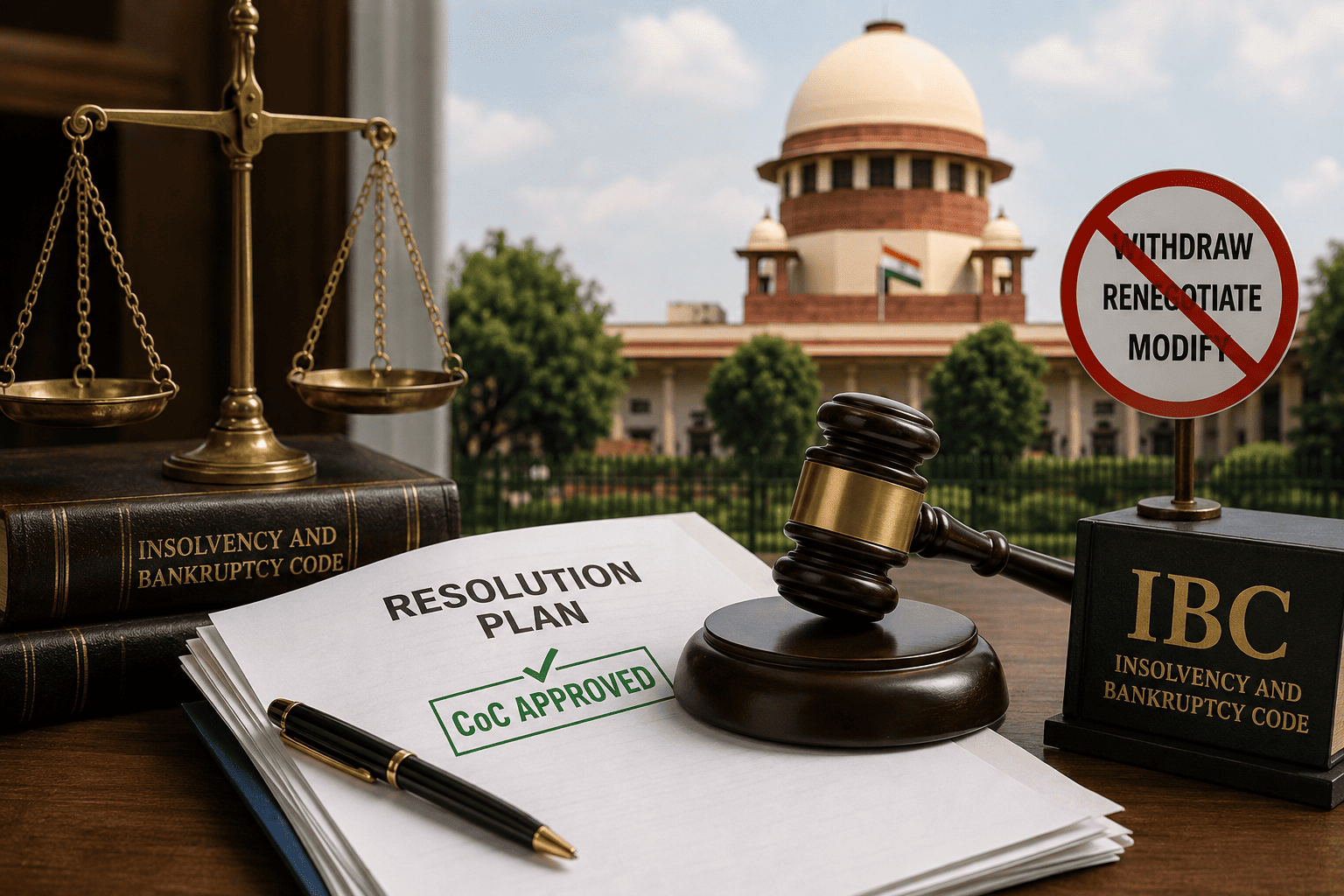
This raises an important practical question: Can a Successful Resolution Applicant (“SRA”) seek to renegotiate, modify or withdraw from a resolution plan after its approval by the CoC by objecting to conditions contained in the Letter of Intent (“LoI”)?
In Sanjay Dave v. Andhra Bank Ltd. & Ors., 2026 INSC 580, decided on 27 May 2026, the Supreme Court of India considered whether an SRA could refuse to proceed with a CoC-approved resolution plan by characterising certain terms of the LoI as “conditionalities”. The Supreme Court held that where the terms objected to by the SRA were already within its knowledge and had been discussed and expressly agreed to during the CoC meetings, the SRA could not subsequently rely on those terms as a basis to renege from the CoC-approved resolution plan.
The judgment also considered the forfeiture of the Earnest Money Deposit (“EMD”) and the subsequent decision of the CoC to liquidate the corporate debtor under Section 33(2) of the IBC.
Factual Background of Sanjay Dave v. Andhra Bank Ltd.
The dispute arose from the Corporate Insolvency Resolution Process (“CIRP”) of M/s. Oracle Home Textiles Limited, which was admitted into CIRP on 9 August 2018. A Request for Resolution Plan (“RFRP”) was issued by the Resolution Professional (“RP”) on 6 February 2019. With the permission of the National Company Law Tribunal (“NCLT”), the appellant, Sanjay Dave, who was a promoter/director of the corporate debtor, submitted a resolution plan.
On 10 May 2021, the appellant was informed that his resolution plan had been approved by the CoC with a voting share of 99.90%. At that stage, applications filed by prospective resolution applicants seeking permission to submit competing resolution plans were pending before the NCLT.
On 23 May 2021, the RP issued an LoI to the appellant. The LoI stated, inter alia, that the approval of the resolution plan was subject to the outcome of the pending proceedings before the NCLT. The appellant subsequently characterised the LoI as conditional and sought issuance of an unconditional LoI.
A second LoI was issued on 23 June 2021 on substantially the same terms. The appellant also objected to a provision under which the risk and cost associated with applications and litigation filed by staff, employees and workers were to be borne by the SRA. A third LoI was subsequently issued on 23 July 2021, again requiring the appellant to furnish the performance guarantee within the stipulated period. The appellant did not accept the LoIs or furnish the required performance guarantee. On 2 August 2021, the RP informed him that his EMD of ₹1 crore had been forfeited under the terms of the RFRP.
The CIRP period subsequently came to an end on 21 February 2023. In the absence of a valid resolution plan, the CoC, on 5 June 2023, approved liquidation of the corporate debtor with a voting share of 99.61%. The NCLT approved the liquidation, and the NCLAT dismissed the appellant’s appeals. The matter thereafter reached the Supreme Court under Section 62 of the IBC.
The Supreme Court’s Reasoning
The Supreme Court rejected the appellant’s contention that the terms contained in the LoI rendered it conditional in a manner that entitled him to withdraw from the CoC-approved resolution plan.
The Court observed that the stipulation making the LoI subject to the outcome of pending proceedings before the NCLT did not, in the circumstances of the case, provide a basis for the appellant to renege from the plan. The Court noted that the pending proceedings were already known to the appellant and had been discussed during the CoC meetings.
The Court also examined the minutes of the CoC meetings and found that the appellant had not merely acquiesced to the relevant conditions but had expressly agreed to them. In particular, the minutes demonstrated that the appellant had agreed that the risk and cost associated with staff and workers’ litigation would be borne by the resolution applicant. The Supreme Court therefore held that the appellant could not subsequently characterise these matters as new or impermissible conditionalities to avoid proceeding with the resolution plan.
No Scope for Further Negotiation After CoC Approval
The Supreme Court relied extensively on its earlier judgment in Ebix Singapore Private Limited v. Committee of Creditors of Educomp Solutions Limited & Anr., (2022) 2 SCC 401.
In Ebix Singapore, the Court had held that the negotiations between the resolution applicant and the CoC come to an end after the CoC approves the resolution plan. The resolution plan is binding and irrevocable as between the CoC and the successful resolution applicant, while the remaining stage is consideration of the plan by the Adjudicating Authority within its limited statutory jurisdiction.
The Supreme Court in Sanjay Dave reiterated that once the CoC has approved a resolution plan, an SRA cannot seek to reopen negotiations by raising objections to terms that were already known, discussed and accepted during the CIRP. Allowing such further negotiations or unilateral modifications would introduce an additional and unregulated stage into the insolvency process and undermine the time-bound framework of the IBC.
It is important, however, to distinguish this position from the statutory binding effect under Section 31(1) of the IBC. Section 31 provides that once the Adjudicating Authority approves a resolution plan that satisfies the requirements of Section 30(2), the plan becomes binding on the corporate debtor and the specified stakeholders.
Thus, Sanjay Dave reinforces the binding nature of a CoC-approved plan as between the CoC and the SRA, while Section 31 governs the statutory binding effect of a resolution plan following approval by the Adjudicating Authority.
Forfeiture of EMD and the Doctrine of Approbate and Reprobate
The Supreme Court also applied the principle of approbate and reprobate. Relying on Nagubai Ammal v. B. Shama Rao1, Rajasthan State Industrial Development & Investment Corporation v. Diamond & Gem Development Corporation Limited and Chairman2, State Bank of India v. M.J. James3, the Court held that a party cannot accept or expressly agree to a position and subsequently seek to challenge the same position for its own benefit.
The Court found that the appellant had expressly agreed to the relevant terms during the CoC deliberations. His subsequent attempt to rely on those terms as “conditionalities” to avoid proceeding with the plan was therefore characterised by the Court as an indirect attempt to renege from the plan. On the EMD, the Court relied upon Clause 1.9.4 of the RFRP, which permitted forfeiture where the successful applicant failed to submit the performance guarantee within the stipulated period or otherwise failed to comply with the resolution plan process or the resolution plan. The Court consequently found no illegality in the forfeiture of the ₹1 crore EMD.
CoC’s Decision to Liquidate the Corporate Debtor
The Supreme Court also upheld the subsequent liquidation process. Section 33(2) of the IBC permits the CoC, at any time during the CIRP and before confirmation of a resolution plan, to decide to liquidate the corporate debtor by a vote of at least 66% of the voting share. The Explanation to Section 33(2) further clarifies that the CoC may take such a decision at any time after its constitution and before confirmation of the resolution plan.
In the present case, the appellant’s failure to proceed with the resolution plan resulted in the absence of a valid resolution plan within the CIRP period. The CoC thereafter exercised its commercial wisdom to approve liquidation with a voting share of 99.61%. The Supreme Court found no basis to interfere with that decision.
Why Is the Judgment Important?
The judgment has several important implications for insolvency practice in India.
First, it reinforces finality after CoC approval. An SRA cannot use objections to terms that were already known, discussed and accepted during the CIRP as a means of reopening negotiations after CoC approval.
Second, it emphasises the importance of CoC meeting records. The minutes of CoC meetings can be critical in determining whether a resolution applicant was aware of, objected to or expressly accepted a particular term.
Third, it highlights the risks associated with non-performance by an SRA. Depending on the terms of the RFRP and the resolution process, failure to comply with obligations such as furnishing a performance guarantee may result in forfeiture of the EMD.
Fourth, the judgment protects the time-bound architecture of the IBC. Permitting an SRA to reopen negotiations after CoC approval could introduce an additional stage of negotiations, delay implementation and adversely affect the value of the corporate debtor. The Supreme Court reiterated that the IBC does not permit such open-ended renegotiation at the instance of the successful resolution applicant.
Conclusion
The Supreme Court’s decision in Sanjay Dave v. Andhra Bank Ltd. reinforces the principle that an SRA cannot seek to undermine a CoC-approved resolution plan by subsequently characterising previously known and accepted terms as impermissible conditionalities. The judgment is particularly significant because the Court examined not merely the language of the LoI but also the contemporaneous record of the CoC meetings. The appellant’s express acceptance of the relevant conditions was central to the Court’s conclusion that he could not subsequently approbate and reprobate.
For resolution applicants, the judgment underscores the importance of raising objections to material terms during the CIRP and before the CoC approves the resolution plan. For creditors and resolution professionals, it reinforces the importance of maintaining clear and accurate records of discussions and decisions during CoC meetings.
The decision therefore strengthens certainty in the resolution process and makes clear that, once a resolution plan has been approved by the CoC, an SRA cannot use subsequent objections to previously accepted terms as a mechanism to reopen negotiations or withdraw from the plan.
- Nagubai Ammal vs. B Shama Rao [1956] SCR 451 (SC) 9.15. ↩︎
- Rajasthan State Industrial Development & Investment Corp vs. Diamond & Gem Development Corp Ltd (2013) 5 SCC 470 (SC) [15]-[16]. ↩︎
- Chairman, State Bank of India vs. MJ James (2022) 2 SCC 301 (SC) [39]. ↩︎
Frequently Asked Questions
1. Can a Successful Resolution Applicant withdraw after CoC approval?
2. What did the Supreme Court decide in Sanjay Dave v. Andhra Bank Ltd.?
3. Can an SRA renegotiate terms after the CoC approves a resolution plan?
4. Was the forfeiture of the EMD upheld by the Supreme Court?
Last Updated on 12 August, 2026

By entering the email address you agree to our Privacy Policy.