
Legal Framework Governing FCL and LCL Shipments in India: Risks, Liabilities, Insurance, and Delay
Introduction
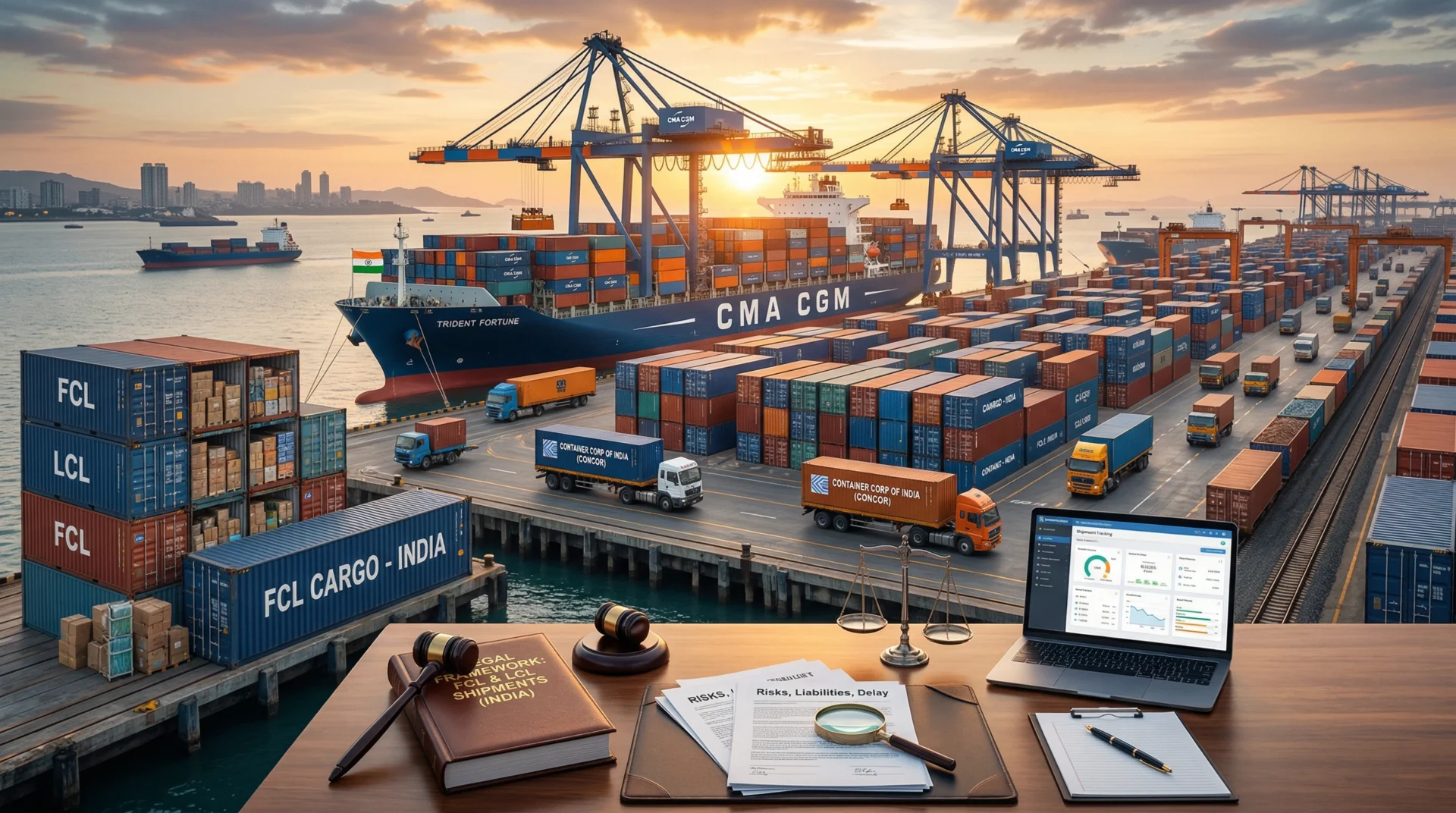
The rapid expansion of global trade has made containerized shipping the backbone of international commerce. Within this system, shipments are typically categorized as Full Container Load (FCL) or Less than Container Load (LCL), depending on whether a single consignor uses an entire container or shares space with other shippers. While commercially driven, this distinction carries significant legal implications in terms of risk allocation, liability, insurance, and delays. In India, the legal framework governing such shipments is not codified in a single statute but is derived from a combination of statutory provisions, international conventions, and contractual arrangements.
Statutory and Contractual Legal Framework
At the heart of this framework lies the Indian Contract Act, 1872, which governs the contractual relationship between parties, including shippers, carriers, and freight forwarders. Maritime carriage is specifically regulated by the Carriage of Goods by Sea Act, 1925, which incorporates principles of the Hague Rules and sets out the rights, obligations, and immunities of carriers. Additionally, the Bills of Lading Act, 1856 confers legal status upon bills of lading as documents of title, while the Merchant Shipping Act, 1958 governs broader aspects of shipping and maritime operations.
Together, these laws form a hybrid legal regime where statutory obligations are supplemented and often modified by contractual terms contained in bills of lading, sea waybills, and multimodal transport documents.
Distinction Between FCL and LCL Shipments
The distinction between FCL and LCL shipments becomes particularly relevant in determining control and responsibility. In an FCL shipment, the consignor typically undertakes the responsibility of stuffing the container, sealing it, and ensuring proper packing. Consequently, liability for damage arising from poor packing or improper stowage often rests with the shipper.
By contrast, LCL shipments involve consolidation by a freight forwarder or Non-Vessel Operating Common Carrier (NVOCC), who combines multiple consignments into a single container. This introduces an additional contractual layer and complicates liability, as multiple cargo interests and handling stages are involved.
Nature of Risks in Containerized Shipping
The risks associated with FCL and LCL shipments are multifaceted.
Physical risks include damage caused by inadequate packaging, exposure to moisture or temperature variations, and contamination particularly in LCL shipments where goods from different shippers are stored together. Legal risks arise from misdeclaration of cargo, inaccurate documentation, or failure to comply with customs requirements. Operational risks, such as port congestion, transshipment delays, and logistical inefficiencies, further increase the vulnerability of cargo during transit.
Liability of Carriers and Intermediaries
Liability is primarily governed by the Carriage of Goods by Sea Act, 1925, which imposes a duty on carriers to exercise due diligence in ensuring seaworthiness of the vessel and proper handling of cargo. However, this liability is subject to several defenses, including acts of God, perils of the sea, fire not attributable to the carrier, and acts or omissions of the shipper.
The Act also provides limitation of liability, typically capped at £100 per package or unit unless a higher value is declared. In FCL shipments, carriers frequently rely on clauses such as “shipper’s load, stow, and count” to avoid liability for improper packing. In LCL shipments, freight forwarders or NVOCCs may assume carrier-like liability under house bills of lading, resulting in complex, multi-party disputes when damage occurs.
Insurance and Risk Mitigation
Insurance plays a critical role in managing shipping risks. Marine cargo insurance, governed by Institute Cargo Clauses (A, B, or C), offers varying levels of protection.
In FCL shipments, there is a risk of underinsurance if the full value of the container’s contents is not declared. In LCL shipments, risks are heightened due to potential theft, pilferage, and cross-contamination. It is therefore essential for cargo owners to obtain comprehensive “all-risk” coverage and ensure that policies explicitly account for consolidation risks.
Indian courts have generally upheld the principle of subrogation, allowing insurers to recover losses from carriers after compensating the insured party.
Delay and Consequential Loss
Delay is a significant commercial concern but remains legally difficult to enforce. Under Indian law, claims for delay are generally not sustainable unless expressly provided for in the contract of carriage.
Most bills of lading include clauses excluding liability for delay and consequential losses such as loss of market or profits. Indian courts have traditionally upheld such clauses, requiring clear proof of negligence before awarding damages. As a result, parties often bear the financial consequences of delays unless specific contractual protections are negotiated.
Comparative Allocation of Risk: FCL vs LCL
The allocation of risk differs significantly between FCL and LCL shipments. FCL offers greater control and clearer liability lines but places a higher burden on the shipper for packing and compliance. LCL, while cost-effective, involves multiple stakeholders and increases the complexity of claims, making it more susceptible to disputes and losses.
Conclusion
The legal regime governing FCL and LCL shipments in India reflects a balance between statutory obligations and contractual freedom. While statutes establish baseline responsibilities and limitations, the practical allocation of risk is largely determined by contractual terms and insurance coverage.
For businesses engaged in international trade, this underscores the importance of careful contract drafting, appropriate insurance coverage, and informed logistical choices. A proactive legal strategy is essential to effectively manage the risks inherent in containerized shipping and to minimize exposure to liability and loss.
Contributed By – Amiy Kumar
Last Updated on 14 April, 2026

By entering the email address you agree to our Privacy Policy.