
Design Registration vs Copyright in India: Industrial Design Protection Explained
Introduction
Can a business protect the shape of a product, a distinctive product configuration or an ornamental pattern through copyright, or must it obtain industrial design registration? In India, the answer depends on the nature of the work, its intended application and the extent to which it has been commercially reproduced.
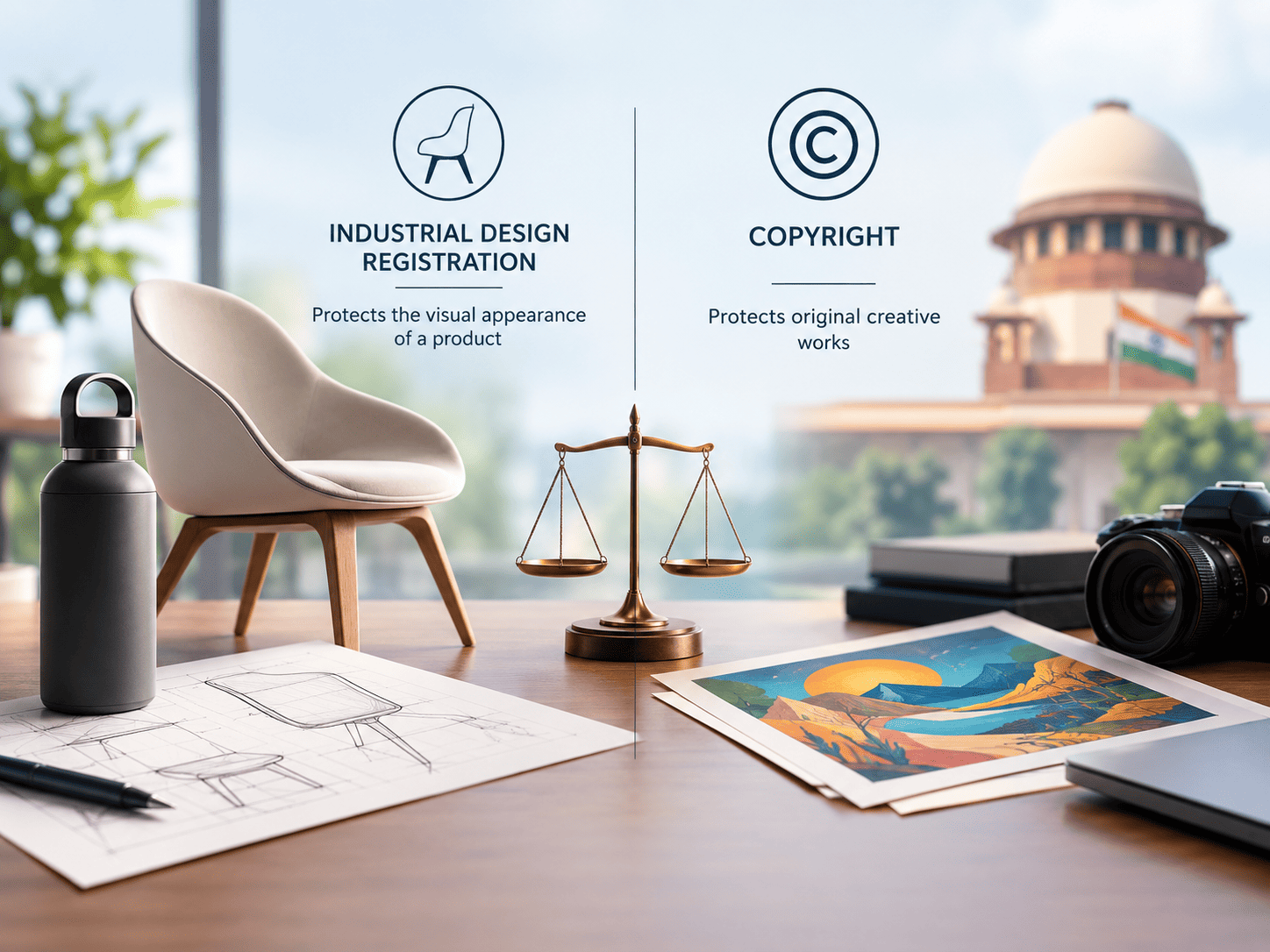
Copyright protection under the Copyright Act, 1957 generally arises automatically when an original artistic work is created. Design registration under the Designs Act, 2000, by contrast, provides statutory protection for qualifying visual features applied to an article, subject to registration and the Act’s requirements. Although the two forms of intellectual property protection may appear to overlap, they serve different purposes and are subject to different conditions, terms and limitations.
Section 15 of the Copyright Act, 1957 is central to this distinction. It provides that copyright does not subsist under the Copyright Act in a design registered under the Designs Act. It also provides that copyright in a design capable of registration, but not registered, ceases once an article to which the design has been applied has been reproduced more than fifty times by an industrial process by the copyright owner or a person acting under the owner’s licence.
The distinction has significant commercial implications for manufacturers, product designers, consumer goods businesses, furniture companies, fashion and textile businesses, and other enterprises that invest in product appearance. A business that relies exclusively on copyright may discover that its protection is limited when the work is used for industrial production. Equally, a business that discloses a design before filing an application may encounter difficulties in obtaining registration.
The Supreme Court’s decision in LNG Express India Private Limited v. Inox India Limited & Ors., decided on 15 April 2025, provides important guidance on distinguishing artistic works from designs governed by the Designs Act. This article examines the legal framework governing design registration versus copyright protection in India, the fifty-article threshold under Section 15(2), the requirements of novelty and originality, the risks of prior publication, and the practical steps businesses should consider when protecting product designs.
Design Registration vs Copyright Protection: Understanding the Difference
The first step in choosing the appropriate intellectual property protection is to identify what the business seeks to protect.
Copyright protects original works falling within the categories recognised under the Copyright Act, including artistic works such as drawings, illustrations and certain other visual works. It does not require registration as a general condition for protection. However, the application of an artistic work to a commercially manufactured article may bring Section 15 into operation if the relevant statutory conditions are satisfied.
Industrial design registration protects qualifying features of shape, configuration, pattern, ornament or composition of lines or colours applied to an article, whether in two or three dimensions or both, which in the finished article appeal to and are judged solely by the eye. The design must satisfy the requirements of the Designs Act, 2000, and must not fall within its exclusions.
The distinction is therefore not simply between an unregistered right and a registered right. It concerns the nature of the subject matter, its relationship with an article, and the statutory conditions governing protection.
For example, an original illustration created for a publication may qualify for copyright protection as an artistic work. If a business develops a distinctive ornamental configuration for a consumer product and intends to reproduce that configuration industrially, design registration may be the more appropriate form of protection for the product’s appearance. The underlying drawing and the design applied to the article must nevertheless be assessed separately where necessary.
The following comparison sets out the principal differences.
| Basis of comparison | Copyright protection | Industrial design registration |
|---|---|---|
| Governing legislation | Copyright Act, 1957 | Designs Act, 2000 |
| Subject matter | Original artistic works and other works recognised under the Act | Qualifying visual features applied to an article |
| Registration | Generally not required for copyright to arise | Registration is required for protection under the Designs Act |
| Core requirement | Originality and subsistence of copyright in the relevant work | New or original design, statutory eligibility and compliance with registration requirements |
| Prior disclosure | Copyright does not generally depend on filing before publication, although other statutory limitations may apply | Prior publication or disclosure can prevent registration |
| Duration | For many original artistic works, the author’s lifetime plus sixty years, subject to statutory rules and exceptions | Initially ten years from registration, extendable by five years |
| Industrial reproduction | Section 15(2) may cause copyright in a qualifying unregistered design to cease after more than fifty reproductions by an industrial process | Protection is governed by the registration, statutory term and applicable provisions of the Designs Act |
The table is a general guide. Whether a particular work qualifies for either form of protection, and whether copyright continues to subsist in it, requires a fact-specific assessment.
Section 15 of the Copyright Act: The Fifty-Article Rule
Section 15 of the Copyright Act, 1957 addresses the relationship between copyright and designs registered, or capable of registration, under the Designs Act, 2000.
Section 15(1) provides that copyright does not subsist under the Copyright Act in a design registered under the Designs Act. Section 15(2) deals with a design capable of registration that has not been registered. In that situation, copyright in the design ceases as soon as any article to which it has been applied has been reproduced more than fifty times by an industrial process by the copyright owner or, with the owner’s licence, by another person.
The threshold is therefore more than fifty reproductions, rather than fifty or more. The provision does not mean that copyright in every drawing associated with a manufactured product automatically ceases once production exceeds fifty units. It is necessary to determine whether the relevant work or design falls within the scope of the provision and whether the statutory conditions have been met.
The provision reflects the legislative distinction between copyright protection for artistic works and the specific statutory regime governing industrial designs. Without this limitation, a proprietor could potentially rely on the longer duration of copyright to obtain protection for an industrially exploited design beyond the period contemplated by the Designs Act.
For businesses, the consequences can be significant. A product may be manufactured and sold at commercial scale while the business assumes that the underlying drawings or visual features remain protected indefinitely under copyright. If the relevant design is capable of registration and the statutory threshold has been crossed without registration, that assumption may be legally unsustainable.
The issue is particularly important where product development involves multiple forms of intellectual property. Copyright in an original drawing, copyright in other accompanying material, and design rights in the appearance of a finished article should not be treated as interchangeable. Each must be assessed according to its subject matter and the applicable statutory provisions.
The Supreme Court’s 2025 Decision: LNG Express India v. Inox India
In its decision dated 15 April 2025 in LNG Express India Private Limited v. Inox India Limited & Ors., the Supreme Court considered the distinction between artistic works protected by copyright and designs falling within the scope of the Designs Act, 2000.
The dispute arose from allegations concerning proprietary engineering drawings used in the development of equipment for the storage and transportation of liquefied natural gas. The litigation raised questions about whether the drawings attracted copyright protection or were subject to the limitations under Section 15(2) because of their relationship with industrially manufactured articles.
The Court examined the statutory framework and the factors relevant to distinguishing artistic works from designs. Its analysis involved a two-pronged approach: first, determining whether the work was a pure artistic work or a design derived from an artistic work and intended for industrial application; and second, considering functional utility in determining whether the subject matter fell within the design regime rather than qualifying as a purely artistic work.
This approach highlights the importance of examining the nature and intended application of the work instead of assuming that every original drawing used in manufacturing is necessarily entitled to unrestricted copyright protection. At the same time, the distinction cannot be resolved merely by observing that a drawing relates to a commercial product. The statutory definition of a design, including its visual characteristics and exclusions, remains relevant.
Importantly, the Supreme Court did not finally decide the underlying copyright infringement claim on its merits. Its ruling addressed the legal framework and the issues requiring examination in the proceedings; the dispute required further adjudication rather than a conclusive determination that the engineering drawings either did or did not enjoy copyright protection.
The decision is consequently relevant to businesses that develop product drawings, technical illustrations, computer-aided design (CAD) files and other materials used in manufacturing. It highlights the need to identify the precise subject matter for which protection is claimed and to evaluate whether copyright, design registration or potentially distinct forms of protection are available.
Novelty and Originality Under the Designs Act, 2000
Even where a business identifies design registration as the appropriate form of protection, registration is not automatic. The proposed design must satisfy the eligibility requirements under the Designs Act, 2000.
Section 4 prohibits the registration of a design that is not new or original, has been disclosed to the public anywhere in India or in any other country by publication in tangible form, by use or in any other way before the filing date or applicable priority date, is not significantly distinguishable from known designs or combinations of known designs, or comprises scandalous or obscene matter.
Novelty and originality are therefore central considerations when seeking industrial design protection in India. A design that has already been disclosed to the public may face objections during examination or a challenge to its validity after registration.
The assessment is not limited to whether the proprietor has previously used the design in India. Disclosure outside India may also be relevant. For example, a product displayed at an overseas exhibition, featured in an accessible international catalogue or made available through an online product listing before the relevant filing date may raise questions about whether the design remains registrable in India.
The statutory assessment must nevertheless be conducted in the context of the particular design, the nature and timing of the alleged disclosure, and the applicable legal principles. Not every reference to a product or every appearance of a related article will necessarily establish prior publication of the design in question.
Businesses should therefore undertake an appropriate prior-art and disclosure assessment before filing. This can help identify potentially conflicting designs and reduce the risk of investing in an application that may subsequently be refused or challenged.
Prior Publication: Why Filing Before Product Launch Matters
One of the principal risks in industrial design protection is the disclosure of a design before an application is filed. Unlike copyright, which generally arises without a registration application, design registration requires businesses to consider the timing of filing as part of product development. A company may inadvertently disclose a design while conducting market research, sharing prototypes with prospective customers, attending trade fairs, issuing press releases, launching a crowdfunding campaign or publishing product photographs online.
Section 4 of the Designs Act makes prior public disclosure relevant to registrability. The question is not simply whether a competitor has copied the design, but whether the design satisfies the statutory requirements for registration as of the relevant date.
Indian courts have considered the nature and sufficiency of prior publication in design disputes. The assessment depends on whether the earlier material sufficiently discloses the design so that it can be identified and compared with the design subsequently claimed. A sufficiently clear image, drawing or catalogue entry may be relevant, depending on the facts.
The Designs Act does recognise limited statutory situations in which certain disclosures may be protected. Section 16 addresses specified disclosures in circumstances involving good faith and certain confidential dealings. Section 21 provides for particular disclosures connected with exhibitions to which the statutory provision applies, subject to its requirements. These provisions are limited exceptions and should not be treated as a general grace period for launching a product before filing.
Businesses should therefore avoid assuming that their own disclosure is harmless simply because it occurred before a competitor entered the market. A product may be commercially successful and genuinely original in the ordinary sense, yet encounter difficulties in obtaining design registration because of the timing or nature of an earlier disclosure.
The practical approach is to involve the legal team before external disclosure. Where a design is intended to be commercially exploited, filing should ordinarily be considered before the product is exhibited, marketed or otherwise made publicly available.
Can a Design Be Protected by Copyright After Industrial Production Begins?
The answer depends on the nature of the work and the applicable statutory provisions. Copyright may subsist in an original artistic work independently of the protection available for the appearance of a finished product. For instance, a drawing may qualify as an artistic work in its own right. However, where the same work is used as the basis for an industrial design, it is necessary to distinguish copyright in the drawing from the legal protection claimed in the design applied to the article.
Section 15 must be considered where the relevant design is registered or capable of registration under the Designs Act. In particular, Section 15(2) may cause copyright in an unregistered, registrable design to cease after the statutory threshold of more than fifty industrial reproductions is reached.
This does not justify a blanket conclusion that all copyright in every technical drawing or CAD file associated with a product disappears after fifty units have been manufactured. The character of the work, its relationship with the design, the intended industrial application and the statutory definition of a registrable design must all be examined.
The distinction is commercially important. A business may have copyright in original artwork, technical documentation or other materials while also seeking design registration for the appearance of a product. The existence and scope of each right must be evaluated separately, including whether the relevant statutory limitations apply.
For this reason, intellectual property audits should identify not only the products a business manufactures but also the specific assets it seeks to protect. These may include drawings, illustrations, surface patterns, product configurations, packaging features and other visual elements. The appropriate protection will depend on the characteristics and intended use of each asset.
Is India Introducing a Grace Period for Design Disclosure?
The possibility of a grace period for certain disclosures is relevant to businesses assessing their design protection strategy. However, a proposed legislative change must be distinguished from the law currently in force.
On 29 January 2026, the Department for Promotion of Industry and Internal Trade (DPIIT) released a concept note proposing amendments to the Designs Act, 2000. The proposals seek to modernise India’s design protection framework and align it more closely with international practices.
The concept note is a proposal for legislative reform; it should not be treated, by itself, as an amendment that has already taken effect. Businesses should verify the status of any proposed grace-period provision and the final statutory wording before relying on it.
Until a relevant amendment comes into force, businesses should plan their filings on the basis of the applicable law rather than assume that a general twelve-month grace period is available for their own pre-filing disclosures.
The prudent approach remains to identify registrable designs early, assess novelty before disclosure and file within the appropriate timeframe. A business that waits for a proposed reform to become law without verifying its status may expose a valuable design to avoidable registration risks.
Practical Steps for Businesses to Protect Industrial Designs in India
Businesses can reduce the risk of losing design protection by integrating intellectual property review into product development and launch procedures.
Identify protectable product features early: Determine which elements of a product’s appearance may qualify for design registration and which underlying materials may separately qualify for copyright protection.
Conduct a novelty and prior-disclosure assessment: Review existing designs, publicly available catalogues, online listings, exhibition materials and other relevant disclosures before filing an application.
File before public disclosure: Consider design registration before product launches, press announcements, trade fairs, public demonstrations and online listings. Confidentiality arrangements may be appropriate when sharing designs with vendors, manufacturers, investors or prospective customers.
Monitor industrial reproduction: Where a design has not been registered, assess the implications of Section 15(2) before commercial production exceeds fifty reproductions by an industrial process. The statutory consequences depend on whether the relevant work qualifies as a design capable of registration and whether the other legal conditions are satisfied.
Maintain records of creation and disclosure: Preserve dated drawings, design files, development records, confidentiality agreements, filing documents and evidence of when and how the design was first disclosed. These materials may be relevant to questions of ownership, originality, prior publication and the scope of available protection.
Review intellectual property rights separately: Do not assume that copyright in an underlying artistic work automatically provides equivalent protection for the appearance of a manufactured article. Equally, do not assume that design registration necessarily resolves every copyright issue relating to associated drawings or other original works.
These steps can help businesses make informed decisions about design registration, copyright protection and the management of intellectual property throughout the product lifecycle.
Conclusion
Design registration and copyright protection in India are distinct legal regimes that may intersect when original artistic works are applied to industrially manufactured products. Section 15 of the Copyright Act, 1957 limits reliance on copyright for designs registered, or capable of registration, under the Designs Act, 2000. In particular, the fifty-article rule under Section 15(2) can have significant consequences where a registrable design is commercially reproduced without registration.
The Supreme Court’s decision in LNG Express India Private Limited v. Inox India Limited & Ors. reinforces the importance of distinguishing artistic works from designs by examining the nature and intended application of the work. Meanwhile, the novelty and prior-publication requirements under the Designs Act make filing strategy an important consideration for businesses developing new products.
For manufacturers, designers and product-led businesses, the central lesson is that intellectual property protection should be considered before commercial launch, rather than only after a competing product appears. Early identification of protectable designs, appropriate filing, careful disclosure management and a separate assessment of associated copyright can help businesses preserve the legal protection available for their creative and commercial investments.
Last Updated on 15 October, 2026

By entering the email address you agree to our Privacy Policy.