
When Designs Are Stolen: Understanding Remedies for Design Piracy Under Section 22 of the Designs Act, 2000
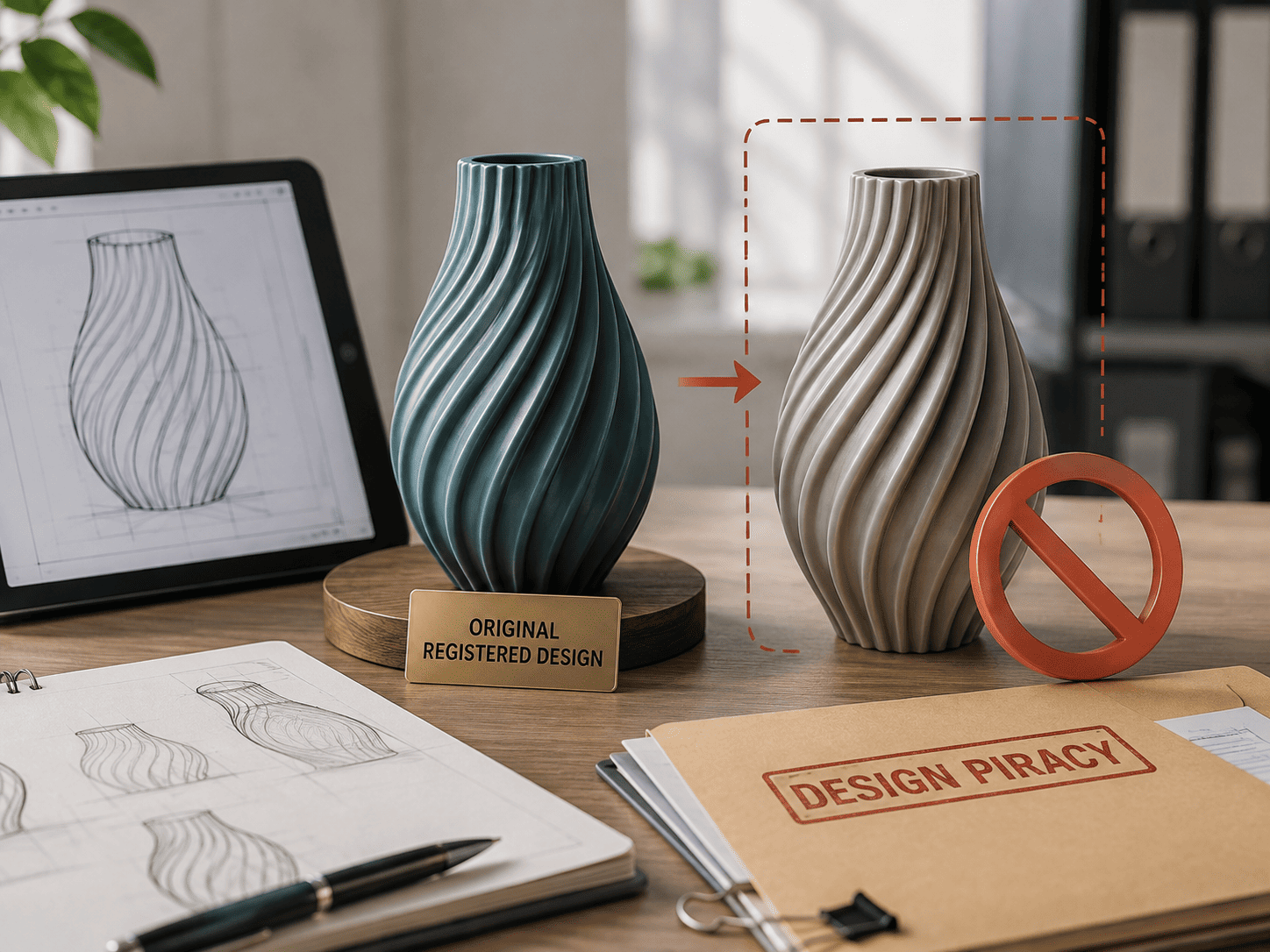
A registered design can be one of the most valuable intellectual property assets of a business. It may be the shape of a bottle, the pattern on a fabric, the configuration of a furniture piece, or the ornamentation of a consumer product that makes it recognisable in a crowded market. When a competitor copies that design and commercialises an identical or deceptively similar product, the resulting harm may extend beyond lost sales to the erosion of the exclusivity associated with the design.
Indian law provides specific remedies against such unauthorised use. The Designs Act, 2000 (“Designs Act”) replaced the Designs Act, 1911 and provides the statutory framework for registration and protection of designs in India. Section 22 of the Designs Act deals with piracy of registered designs and specifies the acts that constitute piracy as well as the remedies available to a registered proprietor.
This article explains what constitutes design piracy under Section 22, the remedies available to a registered proprietor, the defences that may be raised by an alleged infringer, and the practical steps businesses should consider when their registered design is copied.
What a Registered Design Actually Protects
Before considering the remedies for design piracy, it is important to understand what is protected. Under Section 2(d) of the Designs Act, a “design” refers to features of shape, configuration, pattern, ornament or composition of lines or colours applied to an article, whether in two-dimensional or three-dimensional form, or in both forms, by an industrial process or means, which in the finished article appeal to and are judged solely by the eye.
The definition excludes, among other things, any mode or principle of construction or operation, mechanical devices, and features that are essentially functional. It also excludes certain matters falling within the scope of trade marks and artistic works under the applicable intellectual property laws. Once a design is registered, the registered proprietor obtains copyright in the design under Section 11. The initial period of protection is ten years from the date of registration, which may be extended for a further period of five years upon application and payment of the prescribed fee. The maximum period of statutory design protection is therefore fifteen years.
This limited period of protection is significant because design law grants a statutory monopoly over the registered design for a defined period; it does not create an unlimited right over the underlying product or concept.
What Constitutes Design Piracy Under Section 22?
Section 22(1) of the Designs Act identifies the acts that are prohibited during the period in which copyright in a registered design subsists. Without the licence or written consent of the registered proprietor, a person cannot:
- apply or cause to be applied the registered design, or a fraudulent or obvious imitation of it, to an article in the class of articles in which the design is registered, for the purpose of sale;
- import, for the purposes of sale, an article belonging to the registered class of articles bearing the design or a fraudulent or obvious imitation of it; or
- knowingly publish, expose, or cause to be published or exposed for sale an article to which the registered design or a fraudulent or obvious imitation has been applied without the proprietor’s consent.
Accordingly, design piracy in India is not limited to manufacturing a copied product. Depending on the circumstances, importing, publishing or exposing an infringing article for sale may also attract liability under Section 22.
The comparison between the registered design and the allegedly infringing article is generally concerned with the overall visual impression created by the designs. Courts have considered whether the alleged copy amounts to a fraudulent or obvious imitation rather than treating every minor difference as sufficient to avoid liability.
At the same time, registration does not confer a monopoly over features that are purely functional or over designs that do not satisfy the statutory requirements of registrability. The validity of the registration may therefore become an important issue in a design piracy dispute.
Design Registration Is Central to a Section 22 Claim
Unlike copyright protection in an original artistic work, which generally arises upon creation, protection under the Designs Act is based on registration. Section 22 specifically protects a registered design during the subsistence of copyright in that design. Consequently, a proprietor seeking relief for design piracy under Section 22 must establish the relevant registration and the subsistence of the statutory right.
An unregistered design cannot ordinarily be enforced as a registered design under Section 22. Depending on the facts, however, other intellectual property or common-law remedies may potentially be relevant for example, where aspects of the product function as a trade mark, trade dress or source identifier and the requirements of a passing-off action are independently satisfied.
Remedies for Design Piracy Under Section 22(2)
Section 22(2) provides two principal statutory routes for a registered proprietor whose design has been pirated.
1. Statutory Compensation Under Section 22(2)(a)
Under Section 22(2)(a), a person who contravenes Section 22 is liable, for every contravention, to pay the registered proprietor a sum not exceeding ₹25,000, recoverable as a contract debt. However, the statute imposes an overall ceiling: the total amount recoverable in respect of any one design under Section 22(2)(a) cannot exceed ₹50,000.
This route may be relevant where the proprietor seeks the statutory monetary remedy contemplated by the provision, particularly where the scale of the dispute does not justify a broader claim for damages. The ₹25,000 amount is a statutory maximum, rather than an automatic entitlement in every case.
2. Suit for Damages and Injunction Under Section 22(2)(b)
The second route is to institute a suit seeking damages for the contravention and an injunction against repetition of the infringement. Unlike the statutory compensation route under Section 22(2)(a), this remedy is not subject to the ₹50,000 statutory ceiling. The amount of damages, if awarded, will depend on the evidence and the principles applicable to assessment of damages.
An injunction can be particularly important in design piracy disputes because continued manufacture, sale, import or distribution of an infringing product may cause continuing commercial harm. Depending on the facts and the stage of proceedings, a proprietor may seek interim relief to restrain the alleged infringer while the suit is pending, followed by appropriate final relief after adjudication.
The choice between the two statutory remedies is important. Section 22(2) contemplates an election between the statutory compensation route and a suit for damages and injunction in respect of the relevant contravention.
Which Court Can Hear a Design Piracy Suit?
Section 22(2) expressly provides that no suit or other proceeding for relief under that subsection may be instituted in a court below the court of a District Judge. Accordingly, a design piracy action under Section 22 must be instituted before a court having the requisite jurisdiction and not below the level contemplated by the Designs Act. Jurisdictional questions may become more complicated where the defendant challenges the validity of the registered design.
What Happens If the Defendant Challenges the Validity of the Design?
One of the distinctive features of design litigation is the statutory defence provided by Section 22(3). In a suit or other proceeding for relief under Section 22(2), every ground on which the registration of a design may be cancelled under Section 19 is available as a ground of defence. The grounds under Section 19 include, among others, that:
- the design had previously been registered in India;
- it had been published in India or elsewhere before registration;
- it was not new or original;
- it was not registrable under the Designs Act; or
- it did not fall within the statutory definition of a “design”.
This means that registration does not make the proprietor’s rights immune from challenge. An alleged infringer may defend a Section 22 action by questioning the validity of the registration on grounds recognised by Section 19.
Section 22(4) and Transfer of Proceedings
Section 22(4) provides for transfer where a ground for cancellation under Section 19 has been raised as a defence in a proceeding under Section 22(2). The operation of this provision has been considered by the Supreme Court in S.D. Containers Indore v. M/s Mold-Tek Packaging Ltd. The decision examined the relationship between Sections 19 and 22 and the circumstances in which a design infringement suit is to be transferred when invalidity is raised as a defence.
Importantly, it would be inaccurate to state that the High Court alone has original cancellation jurisdiction under Section 19. Section 19 provides for a cancellation petition before the Controller, with an appeal against the Controller’s order to the High Court. Therefore, the interaction between cancellation proceedings, invalidity defences and Section 22(4) requires careful consideration of the particular forum, the nature of the proceedings and the applicable jurisdictional framework.
How Do Courts Assess Design Piracy?
In design infringement disputes, the court is concerned with the visual features protected by the registered design and whether the defendant’s product amounts to a fraudulent or obvious imitation. A defendant may attempt to avoid liability by pointing to differences between the two products. However, the mere existence of minor alterations does not necessarily mean that there is no piracy. The court may examine the overall visual impression produced by the designs and the features that form the subject matter of the registration.
At the same time, design law does not protect every attractive, commonplace or functional product shape. Novelty and originality are therefore important considerations, both at the registration stage and when the validity of a design is subsequently challenged. A registered proprietor should accordingly avoid assuming that registration, by itself, guarantees success in every infringement action. The scope and validity of the registered design remain central to the dispute.
Can Design Protection Coexist With Trade Mark or Passing-Off Protection?
Design rights and trade mark rights protect different legal interests. A product may, depending on the facts, involve several forms of intellectual property for example, a registered design covering certain visual features, a trade mark protecting the brand name or logo, and other elements that may potentially support a passing-off claim.
Indian courts have recognised that an action for passing off may be available in appropriate circumstances where a design or other product feature has acquired source-identifying significance and the necessary ingredients of passing off are established. The precise relationship between a design infringement claim and a passing-off claim, however, depends on the nature of the feature relied upon and the legal basis of the claim. Businesses should therefore assess their entire IP portfolio and the manner in which the allegedly infringing product is being marketed, rather than assuming that every dispute must be pursued exclusively under the Designs Act.
Common Defences to a Design Piracy Claim
An alleged infringer may raise several defences in a Section 22 proceeding. These may include:
- Prior publication: The design was published in India or elsewhere before the plaintiff’s registration.
- Lack of novelty or originality: The registered design was not new or original.
- Non-registrability: The subject matter does not qualify for protection under the Designs Act.
- Not a “design”: The subject matter does not fall within the definition under Section 2(d).
- No fraudulent or obvious imitation: The allegedly infringing product does not amount to a fraudulent or obvious imitation of the registered design.
- Scope of registration: The features relied upon by the proprietor do not fall within the scope of the registered design.
Section 22(3) is particularly significant because it expressly makes every ground available for cancellation under Section 19 available as a defence in proceedings under Section 22(2).
What Should a Business Do When Its Design Is Copied?
Registration is only the first step in protecting a valuable design. When copying is discovered, businesses should act promptly and systematically.
- First, verify the registration. Confirm the registration number, registered proprietor, relevant article/class and the status and subsistence of the design right.
- Second, preserve evidence. Screenshots of websites and online marketplaces, product listings, advertisements, catalogues, invoices, photographs, purchase records and other evidence showing the infringing product’s availability should be preserved. Dates and sources can become important in subsequent proceedings.
- Third, compare the products carefully. The comparison should focus on the features covered by the registered design rather than unrelated aspects of the products.
- Fourth, assess the infringer’s activities. Manufacturing, importing, selling, advertising, publishing or exposing the product for sale may have different legal implications under Section 22.
- Fifth, examine the validity of the registered design. Before commencing litigation, a proprietor should assess whether the design may face a challenge based on prior publication, lack of novelty or originality, or other grounds under Section 19.
- Finally, select the appropriate remedy. Depending on the circumstances, the proprietor may consider the statutory compensation route or a suit seeking damages and injunction, while also assessing whether other intellectual property rights may be implicated.
Conclusion
A registered design can provide a business with a significant competitive advantage, but that advantage depends on effective enforcement. Section 22 of the Designs Act, 2000 provides the principal statutory framework for addressing piracy of registered designs in India, including monetary relief and injunction-based remedies. At the same time, design piracy litigation is not simply a matter of establishing visual similarity. The validity and scope of the registered design, the nature of the alleged copying, the relevant article class, the defendant’s activities and the appropriate forum can all materially affect the outcome.
For businesses operating in sectors such as consumer goods, furniture, packaging, fashion, manufacturing and product design, maintaining proper design registrations and responding promptly to suspected copying can be critical to preserving the commercial value of their intellectual property.
Frequently Asked Questions
1. What is considered piracy of a registered design under Section 22?
2. Can a design owner claim both remedies under Section 22(2) at the same time?
3. Is there a cap on the compensation a design owner can recover?
4. Which court should a design piracy suit be filed in?
5. Does copying a design for personal use amount to piracy?
Last Updated on 9 September, 2026

By entering the email address you agree to our Privacy Policy.