
Force Majeure in Times of War: Navigating Contractual Risk Under Indian Law in the Context of the Iran-Israel-US Conflict
Introduction
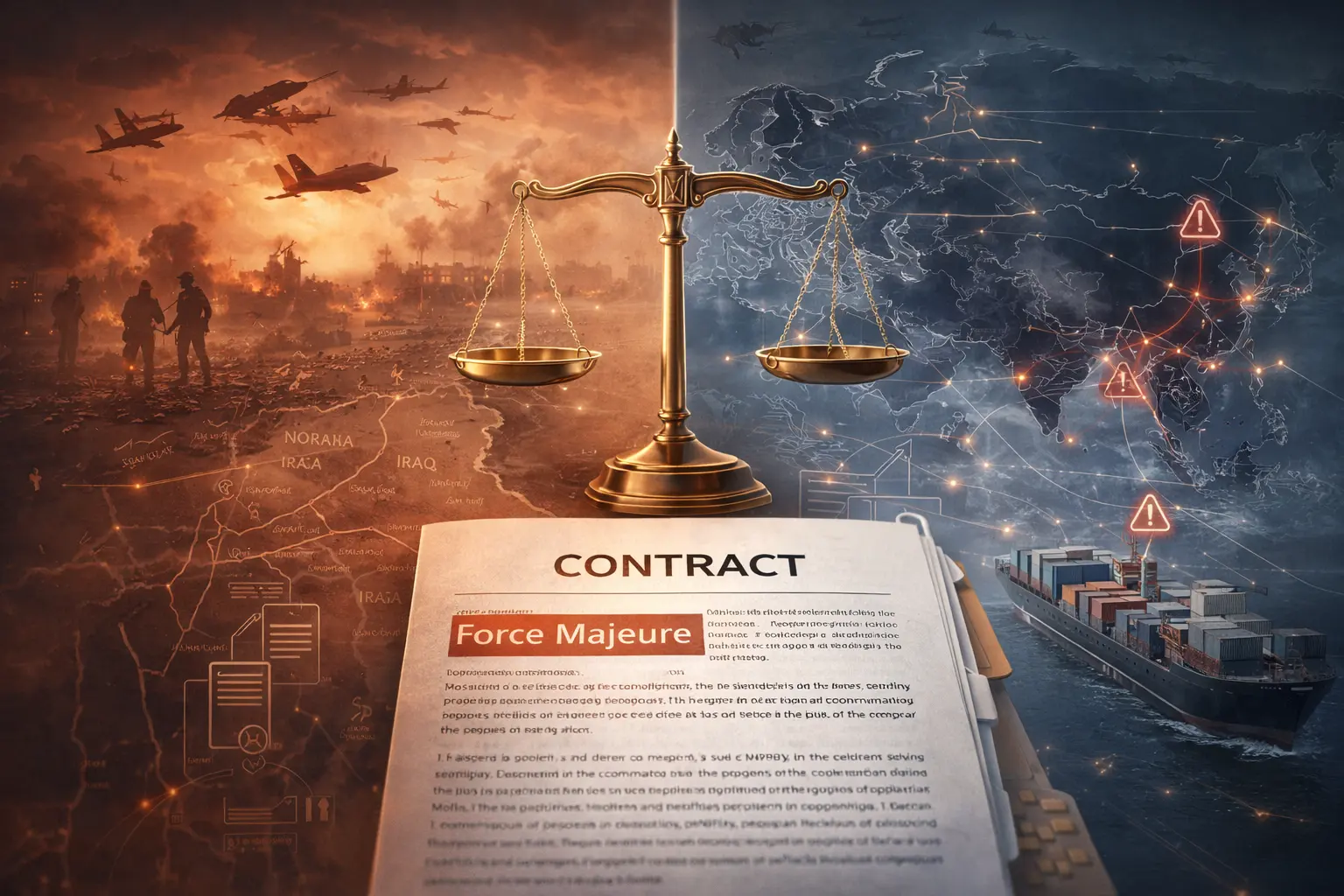
The resurgence of geopolitical conflict involving Iran, Israel, and the United States has once again foregrounded the vulnerability of international commercial arrangements to external shocks. For Indian businesses engaged in cross-border trade, energy procurement, logistics, and manufacturing, the ripple effects of such a conflict ranging from disrupted shipping routes to sanctions and supply shortages, pose significant challenges to contractual performance.
In this context, the doctrine of force majeure assumes heightened relevance. However, its invocation under Indian law is neither automatic nor expansive. It is governed by a strict legal framework that prioritises contractual intent, demands demonstrable causation, and imposes rigorous procedural obligations. This article examines the legal contours of force majeure in India, with particular emphasis on liability, performance, procedural compliance, and dispute risks in a war-driven disruption scenario.
Table of Contents
The Legal Framework: Sections 32 and 56 of the Indian Contract Act
A. Contractual Force Majeure under Section 32
Indian law does not recognise force majeure as a standalone doctrine. Instead, it is embedded within the statutory scheme of the Indian Contract Act, 1872. Where a contract expressly provides for a force majeure clause, its operation is governed by Section 32, which deals with contingent contracts. The rights and obligations of the parties are thus determined strictly by the language, scope, and conditions set out in the clause.
Courts in India have consistently upheld the primacy of contractual terms, emphasising that force majeure must be interpreted within the “four corners” of the agreement. Consequently, the inclusion or omission of terms such as “war,” “sanctions,” or “government action” becomes determinative.
B. Doctrine of Frustration under Section 56
In the absence of a force majeure clause, parties may seek recourse under Section 56, which embodies the doctrine of frustration. However, Indian courts apply this provision narrowly. A contract is rendered void only when performance becomes impossible or unlawful, and not merely difficult or commercially burdensome. The threshold for frustration is therefore significantly higher than that for invoking a contractual force majeure clause.
C. War as a Force Majeure Event: Scope and Limitations
A. Recognition of War and Allied Events
War, armed conflict, hostilities, embargoes, and sanctions are traditionally recognised as force majeure events and are often expressly included in commercial contracts. In the context of the Iran-Israel-US conflict, such events may prima facie fall within the scope of a well-drafted clause.
B. The Requirement of Direct Causation
Notwithstanding such recognition, Indian courts require a clear and proximate causal link between the force majeure event and the inability to perform contractual obligations. The mere existence of war does not suffice. The party invoking force majeure must demonstrate that the event has directly prevented performance.
Thus, disruptions such as closure of critical shipping routes, government-imposed trade restrictions, or complete unavailability of essential raw materials may satisfy this requirement. Conversely, increased costs, logistical inconvenience, or market volatility are unlikely to meet the threshold.
Liability, Performance, and the Distinction from Breach
A. Suspension of Obligations: A valid invocation of force majeure typically results in the suspension of contractual obligations for the duration of the event. The affected party is relieved from liability for non-performance during this period, provided the invocation is justified and procedurally compliant.
B. Continuity and Resumption of Performance: Importantly, force majeure does not automatically extinguish contractual obligations. Where partial performance remains possible, parties are expected to continue performing to that extent. Upon cessation of the force majeure event, performance must resume within a reasonable time.
C. Wrongful Invocation as Breach: An improper or unsupported invocation of force majeure may itself constitute a breach of contract. In such cases, the non-performing party may be exposed to damages, termination, and indemnity claims. The distinction between legitimate force majeure and breach therefore assumes critical importance.
Indemnity and Risk Allocation
The relationship between force majeure and indemnity is governed by contractual drafting. While many agreements exclude liability for failure caused by force majeure, such exclusions are not universal.
Pre-existing breaches remain actionable notwithstanding the occurrence of a force majeure event. Similarly, indemnity obligations towards third parties may survive, depending on the structure of the contract. The allocation of risk in such scenarios must therefore be assessed with reference to indemnity clauses, limitation of liability provisions, and survival clauses.
Bona Fides and the Risk of Mala Fide Invocation
Indian courts scrutinise the conduct of parties invoking force majeure to ensure that the doctrine is not used as a pretext to evade contractual obligations.
A bona fide invocation is typically characterised by a demonstrable causal nexus, prompt communication, documentary evidence, and genuine mitigation efforts. In contrast, indicators of mala fide conduct include pre-existing financial distress, selective non-performance, failure to explore alternatives, and delayed invocation.
Where a court finds that force majeure has been invoked in bad faith, it may reject the defence and award damages for breach. The requirement of good faith, though not codified, operates as an implicit standard in judicial evaluation.
Procedural Requirements: Notice, Mitigation, and Compliance
A. Notice Obligations: Force majeure clauses invariably require prompt notice to the counterparty. Such notice must typically include details of the event, its impact on performance, and the obligations affected. Many contracts also mandate periodic updates and a final notice upon cessation or termination.
Failure to comply with notice requirements may disentitle a party from relying on force majeure, even where the underlying event is valid.
B. Duty to Mitigate: The affected party is under an obligation to take reasonable steps to mitigate the impact of the force majeure event. This may include exploring alternative suppliers, routes, or modes of performance. A failure to mitigate can undermine the credibility of the claim.
C. Timeliness of Invocation: Force majeure must be invoked at the earliest reasonable opportunity. Delayed invocation raises questions regarding causation and bona fides, and may weaken the legal position of the invoking party.
Delay, Damages, and Termination
The consequences of force majeure depend on the nature and duration of the disruption. Temporary impediments typically result in extension of time without liability for damages. However, prolonged force majeure events may trigger termination rights, often after a specified period such as 30 to 90 days.
Where force majeure is validly invoked, damages for non-performance during the affected period are generally excluded. Conversely, an invalid invocation exposes the party to contractual damages, including liquidated damages where applicable.
Dispute Resolution and Jurisdictional Considerations
Disputes relating to force majeure are inherently fact-specific and frequently arise in the context of differing interpretations of causation, mitigation, and procedural compliance. Such disputes are commonly resolved through arbitration, particularly in cross-border contracts, or before Indian courts.
Jurisdiction and governing law are determined by the contract and remain unaffected by the occurrence of a force majeure event. Indian adjudicatory forums have demonstrated a consistent preference for strict interpretation and evidentiary rigour in such matters.
Conclusion
The Iran-Israel-US conflict highlights the increasing intersection between geopolitics and commercial law. While force majeure remains a vital contractual safeguard, its successful invocation under Indian law requires more than the mere occurrence of an external event. It demands precise drafting, clear causation, procedural discipline, and demonstrable good faith.
In an environment of heightened global uncertainty, businesses must move beyond boilerplate clauses and adopt a proactive approach to contractual risk management. Ultimately, force majeure is not a doctrine of convenience, but one of careful calibration, where the balance between contractual certainty and equitable relief is maintained through strict legal scrutiny.
By entering the email address you agree to our Privacy Policy.