
Asha Kiran Sharma Highlights Legal Position on Women’s Absolute Property Rights Under Hindu Law
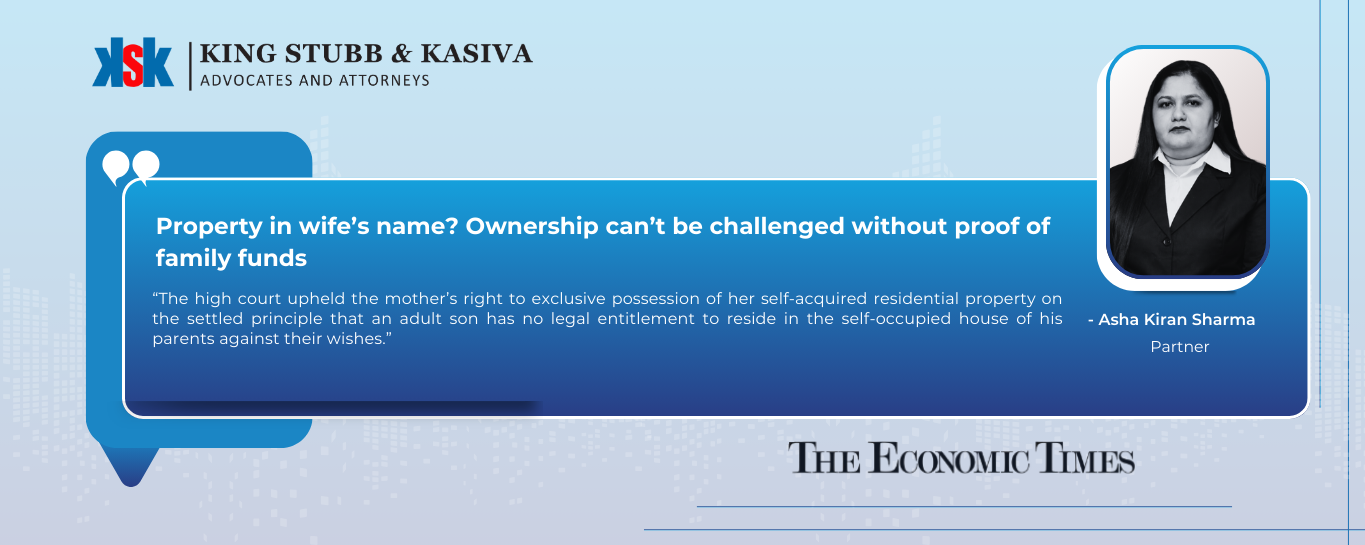
Asha Kiran Sharma provided key legal insights on the rights of women over property held in their name, following a significant High Court ruling.
In her interaction with ET Wealth Online, Sharma noted that the Court upheld the mother’s right to exclusive possession of her self-acquired residential property, reiterating the settled principle that an adult son has no legal entitlement to reside in the self-occupied house of his parents against their wishes.
Elaborating on the judgment, She stated, “The Court found that the property stood solely in the name of the mother and there was no evidence to establish that it was joint family property or that the son had contributed to its acquisition.” She further highlighted that the Court relied on established precedents to reaffirm that ownership confers an absolute right to enjoy and possess property, including the right to seek eviction of any family member whose occupation is not legally protected.
Asha emphasized the significance of Section 14 of the Hindu Succession Act, 1956, describing it as a transformative provision in Indian property law. She explained that the provision converts any property possessed by a Hindu female whether acquired before or after the enactment of the law, into her absolute property, provided she holds it in her own right and not merely as a limited owner.
According to her, courts have consistently upheld that once a property stands in the name of a woman and she is in possession, her ownership becomes absolute by operation of law. Claims by joint family members alleging that the property was acquired through joint family funds cannot override her title unless such contribution is clearly and convincingly established.
She further noted, “The importance of Section 14 lies in its role in securing economic independence and legal recognition for women, ensuring that their ownership rights are not diluted by customary or familial claims lacking evidentiary backing.”
By entering the email address you agree to our Privacy Policy.