
Aditya Bhattachrya Shares Insights on Capital Gains Tax Implications in Builder-Landowner Redevelopment Arrangements
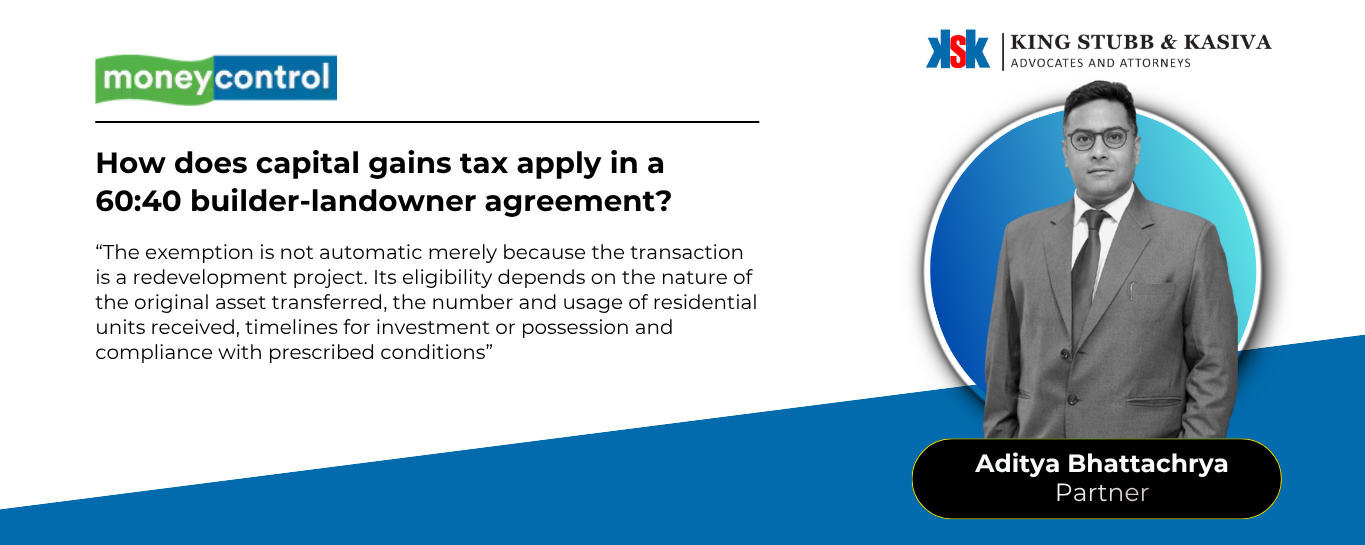
Aditya Bhattachrya was recently featured in Moneycontrol, where he provided insights on the capital gains tax implications arising from builder-landowner redevelopment agreements, a topic of increasing relevance in India’s evolving real estate landscape.
The article explores how capital gains tax is computed under a typical 60:40 redevelopment arrangement and examines the exemptions that may be available to landowners under the Income-tax Act, 1961.
Commenting on the availability of tax exemptions, Aditya noted that exemptions under Sections 54EC and 54F may be available where prescribed conditions are satisfied, particularly in cases where residential units are received as part of the redevelopment arrangement. However, he emphasized that such benefits are not automatic and depend on compliance with the specific statutory requirements.
Providing practical insight into the taxation framework, Aditya explained: “For instance, if the landowner’s 40 percent share has a stamp duty value of ₹1.20 crore and the builder pays ₹20 lakh in cash, the sale consideration is ₹1.40 crore. With an acquisition cost of ₹50 lakh, the taxable capital gain is ₹90 lakh.”
He further clarified the timing of taxation under the special provisions governing joint development arrangements:
“In the example cited, the resultant LTCG of ₹90 lakh becomes taxable in the year of issuance of the completion certificate, even if the landowner has not yet sold the flats received under the arrangement.”
His observations highlight the importance of understanding both the computation mechanism and the timing of taxation under redevelopment structures, particularly for landowners evaluating the financial and tax implications of entering into joint development agreements.
As redevelopment and urban renewal projects continue to grow across India, careful tax planning and structuring remain critical to ensuring compliance and optimising available exemptions under the law.
Last Updated on 4 June, 2026

By entering the email address you agree to our Privacy Policy.