
Hitendra Hiremath Shares Insights on Enforcement of Eviction Orders and Protection of Property Rights
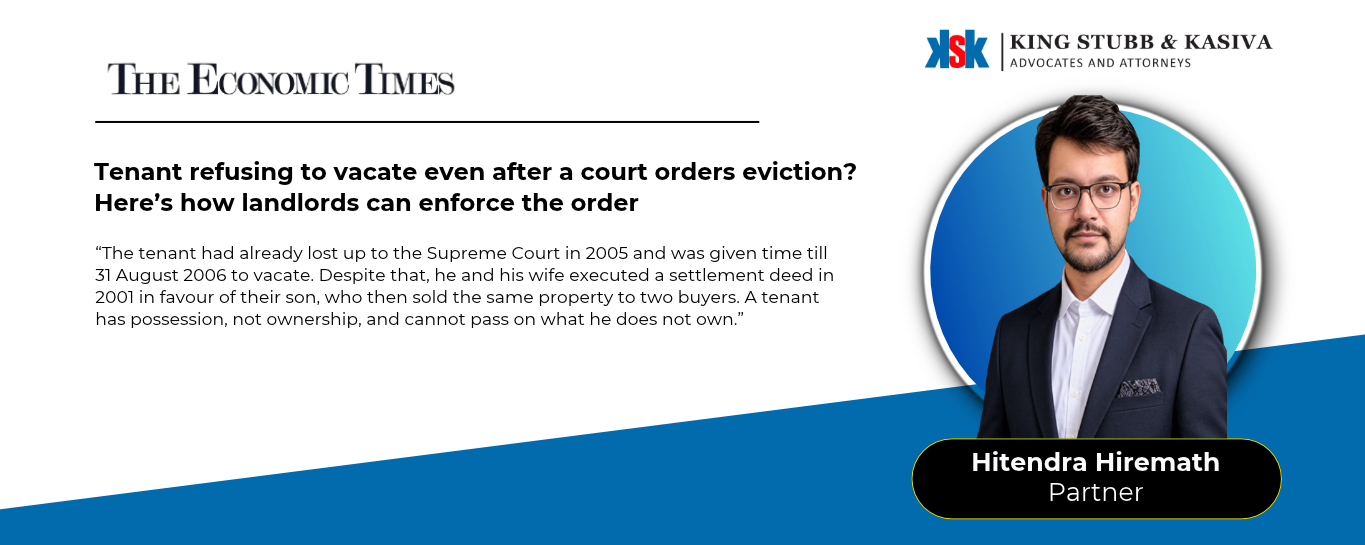
KSK Partner Hitendra Hiremath was featured in The Economic Times Wealth Online in an article examining the legal remedies available to landlords when tenants refuse to vacate a property despite a court-ordered eviction.
Commenting on a Madras High Court judgment involving a prolonged property dispute, Hitendra highlighted that obtaining a favourable court decree does not necessarily bring a dispute to an end. In the case, the landlord had secured an eviction decree, which was subsequently upheld by the Supreme Court in 2005. However, even in 2026, possession of the property had not been restored to the owner. The Madras High Court observed that the owner had been “made to run from pillar to post”.
Hitendra emphasised that landlords should act promptly after securing an eviction decree by filing an execution petition before the applicable deadline expires, rather than waiting for the tenant to voluntarily comply with the eviction order. Timely enforcement proceedings are essential to translating a favourable judgment into actual possession of the property.
He also highlighted the importance of monitoring property records to identify suspicious transactions at an early stage. As he observed, “Regular checks of the encumbrance certificate and the registration records can flag suspicious transactions early, while a challenge is still easy.”
Highlighting the need to pursue multiple legal and administrative remedies, Hitendra pointed out that the landlord in the case had sought cancellation of the fraudulent sale deed before the District Registrar and also initiated land-grab proceedings before the Tahsildar. The Madras High Court subsequently upheld the administrative findings in the writ proceedings.
Further emphasising the importance of proper documentation, Hiremath advised that legal heirs should be formally brought on record, powers of attorney should be clear and up to date, and orders passed in different proceedings should be systematically maintained. He noted, “Legal heirs should be formally on record, powers of attorney should be clear and current, and every order from every proceeding should be kept in one place. In this case, placing the earlier orders before the Court is what exposed the concealment.”
His insights highlight the importance of timely execution of court orders, continuous monitoring of property records and coordinated legal action in protecting ownership rights and securing possession of property.
Read the full article here: https://economictimes.indiatimes.com/wealth/legal/will/tenant-refusing-to-vacate-even-after-a-court-orders-eviction-heres-how-landlords-can-enforce-the-order/articleshow/135881721.cms
Last Updated on 17 November, 2026

By entering the email address you agree to our Privacy Policy.