
Rohitaashv Sinha Explains How Employees Can Evaluate the Right PF Contribution Under the Proposed Flexi EPF Scheme
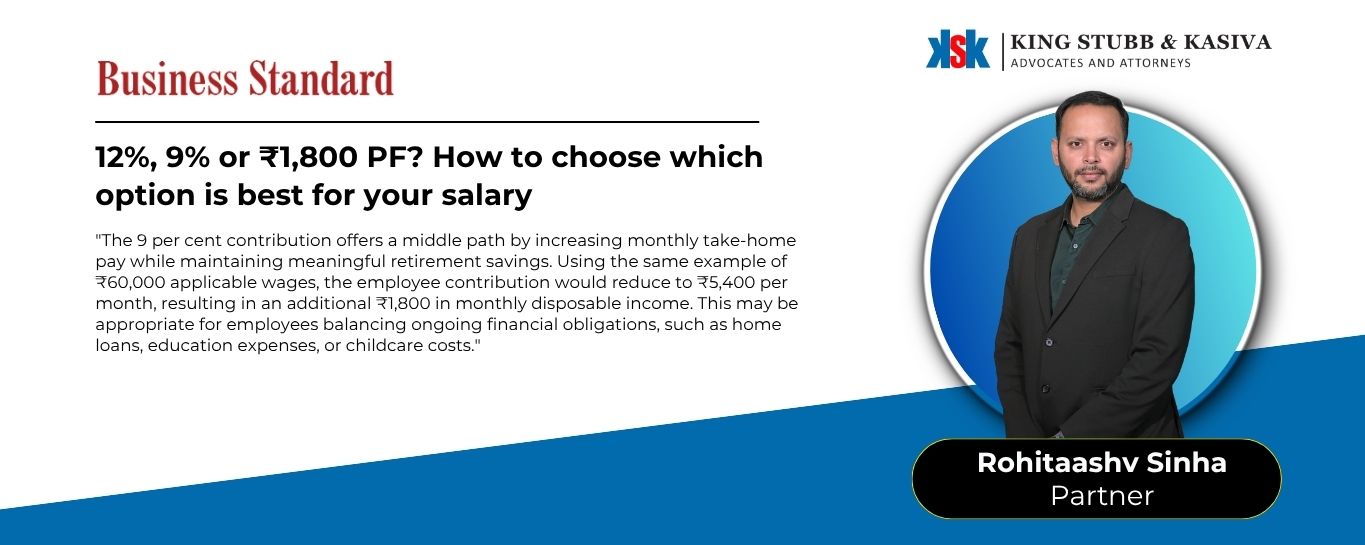
As discussions around a proposed flexi EPF contribution framework continue, employees are weighing the trade-off between higher take-home pay and long-term retirement security. In a recent interaction with Business Standard, Rohitaashv Sinha shared practical insights into how different contribution options could impact an employee’s financial future.
Commenting on the standard 12% EPF contribution, Rohitaashv noted that it remains the most beneficial option for employees focused on long-term wealth creation. He explained that employees contributing 12% of their applicable wages continue to enjoy higher retirement savings and the advantages of long-term compounding. Illustrating this with an example, he observed that an employee earning applicable wages of ₹60,000 would contribute ₹7,200 per month, accompanied by the corresponding employer contribution (subject to statutory provisions), resulting in a significantly larger retirement corpus over a 25–30-year career. According to him, this option is particularly well-suited for employees with stable financial commitments and a long investment horizon.
Addressing the proposed 9% contribution option, Rohitaashv described it as a balanced alternative for employees seeking greater monthly liquidity without completely compromising retirement savings. Using the same salary example, he explained that the employee’s contribution would reduce to ₹5,400 per month, increasing monthly disposable income by ₹1,800. He noted that this option may be appropriate for individuals managing financial obligations such as home loan repayments, children’s education expenses, or childcare costs while still maintaining meaningful retirement savings.
On the proposed fixed contribution option of ₹1,800 per month, Rohitaashv cautioned that although it maximises immediate cash flow, it can significantly diminish long-term retirement accumulation, particularly for higher-income employees. He observed that this option may be suitable for employees nearing retirement, individuals facing temporary financial constraints, or those who have already built diversified retirement investments. However, he advised younger employees to carefully assess the long-term opportunity cost of lower PF contributions, as reducing contributions today could mean foregoing the substantial benefits of compounding over several decades.
Rohitaashv also clarified an important aspect of the proposed flexi EPF framework that employees often misunderstand. He explained that where an eligible employee opts for a reduced contribution rate, such as 9% or a fixed contribution option where permitted, the employer’s statutory EPF contribution is correspondingly reduced under the applicable scheme. Consequently, employers are not required to separately contribute the difference between the standard 12% contribution and the reduced amount, as the flexi scheme itself lowers the statutory contribution obligation.
Further, he cautioned employees against assuming that opting for a lower PF contribution would automatically result in a proportionately higher take-home salary. Since the proposed flexi contribution mechanism reduces the employer’s statutory PF obligation as well, employers would only be required to contribute the reduced amount where such an option is exercised. Employees should therefore evaluate the broader financial implications of their decision rather than viewing lower contributions solely as an increase in monthly income.
Through these observations, Rohitaashv highlights that selecting the appropriate PF contribution is ultimately a personal financial decision that should be guided by an employee’s age, financial responsibilities, investment horizon, and long-term retirement goals.
Read the full article here: https://www.business-standard.com/finance/personal-finance/12-9-or-1-800-pf-how-to-choose-which-option-is-best-for-your-salary-126071400142_1.html
Last Updated on 27 July, 2026

By entering the email address you agree to our Privacy Policy.