
Shrusti Shah Highlights Goa’s Matrimonial Property Framework as National UCC Debate Brings Unique Civil Law Regime into Focus
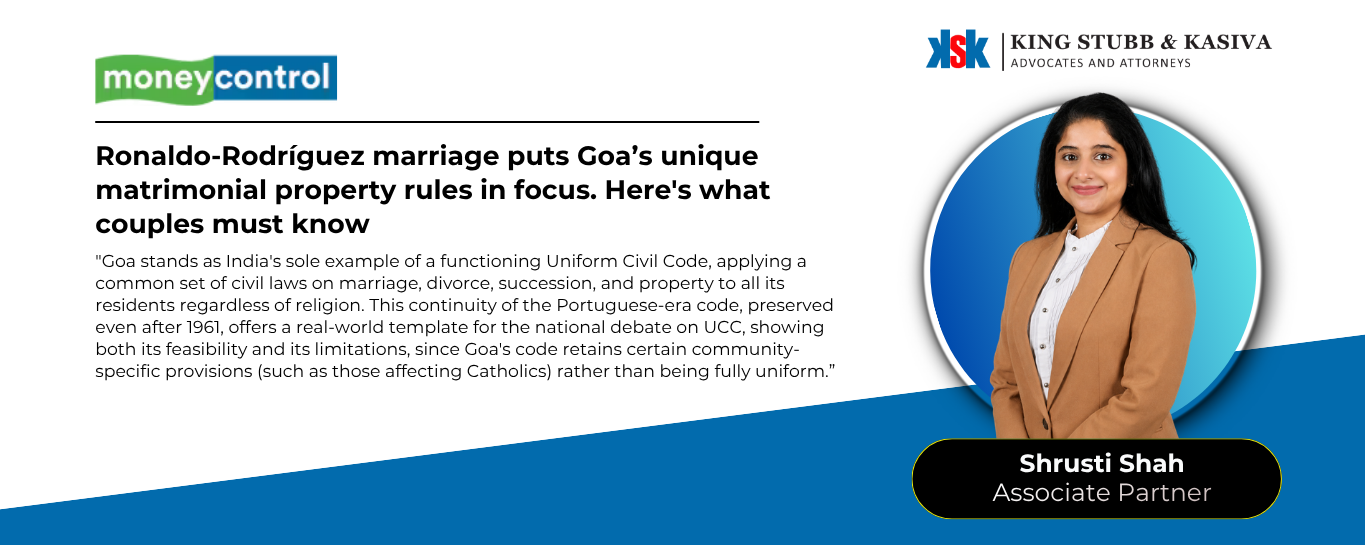
The recent marriage of global football icon Cristiano Ronaldo and Georgina Rodríguez has renewed attention on Goa’s distinctive matrimonial property regime and its relevance to couples with significant or independently acquired assets. Commenting on the issue in a recent Moneycontrol article, Shrusti Shah highlighted Goa’s unique position within India’s civil law landscape.
Goa’s Unique Position as India’s Only Functioning UCC
Shah noted that Goa remains India’s sole example of a functioning Uniform Civil Code, with a common civil law framework governing matters irrespective of religion. The framework covers key areas including:
- Marriage
- Divorce
- Succession
- Property
The framework has its origins in the Portuguese-era civil code, which continued to operate in Goa after its integration with India in 1961.
According to her, Goa’s experience offers an important real-world reference point for the national conversation on the UCC. At the same time, she pointed out that Goa’s civil code is not completely uniform in practice, as it retains certain community-specific provisions, including provisions affecting Catholics.
“Goa stands as India’s sole example of a functioning Uniform Civil Code, applying a common set of civil laws on marriage, divorce, succession, and property to all its residents regardless of religion.”
She further observed that Goa’s decades-long experience provides valuable empirical ground for examining how a common civil law framework can operate across India’s religious and cultural diversity. Goa has also frequently featured as a reference point in discussions before the Supreme Court of India and in reports and deliberations concerning the UCC.
Clarity Around Matrimonial Property and Asset Ownership
Shrusti also drew attention to the practical significance of Goa’s matrimonial property framework, particularly for couples seeking clarity around ownership, management and division of assets.
She explained that the applicable matrimonial regime and the formalities for recording or altering it must be examined under the civil law framework applicable to the parties. This becomes particularly relevant where spouses bring substantial or independently acquired wealth into a marriage.
“The significance of this framework is that it provides couples greater clarity on ownership, management and division of assets, particularly where substantial or independently acquired wealth is involved.”
Enforceability and Legal Considerations
While the framework enables couples in Goa to structure aspects of their matrimonial property arrangements, Shah cautioned that the enforceability and legal consequences of any agreement cannot be determined in isolation.
“The enforceability and legal effect of any agreement must be assessed carefully based on the parties’ status, applicable law and statutory requirements.”
Key factors that must be considered when assessing enforceability include:
- The parties’ status
- The applicable law
- Statutory requirements
Her comments highlight the importance of obtaining appropriate legal advice when structuring matrimonial property arrangements, particularly in cases involving high-value assets, cross-border wealth or parties with different legal statuses.
Broader Implications for a National Uniform Civil Code
The discussion also highlights a broader legal question: while Goa’s civil law framework demonstrates that elements of a common civil regime can operate within India’s diverse social and religious landscape, its community-specific provisions and historical evolution also illustrate the complexities involved in designing a genuinely uniform framework at the national level.
Read the full Moneycontrol article: Ronaldo–Rodríguez marriage puts Goa’s unique matrimonial property rules in focus: Here’s what couples must know
Last Updated on 19 August, 2026

By entering the email address you agree to our Privacy Policy.