
Smita Paliwal Clarifies Statutory Position on Intestate Succession Under Indian Succession Act
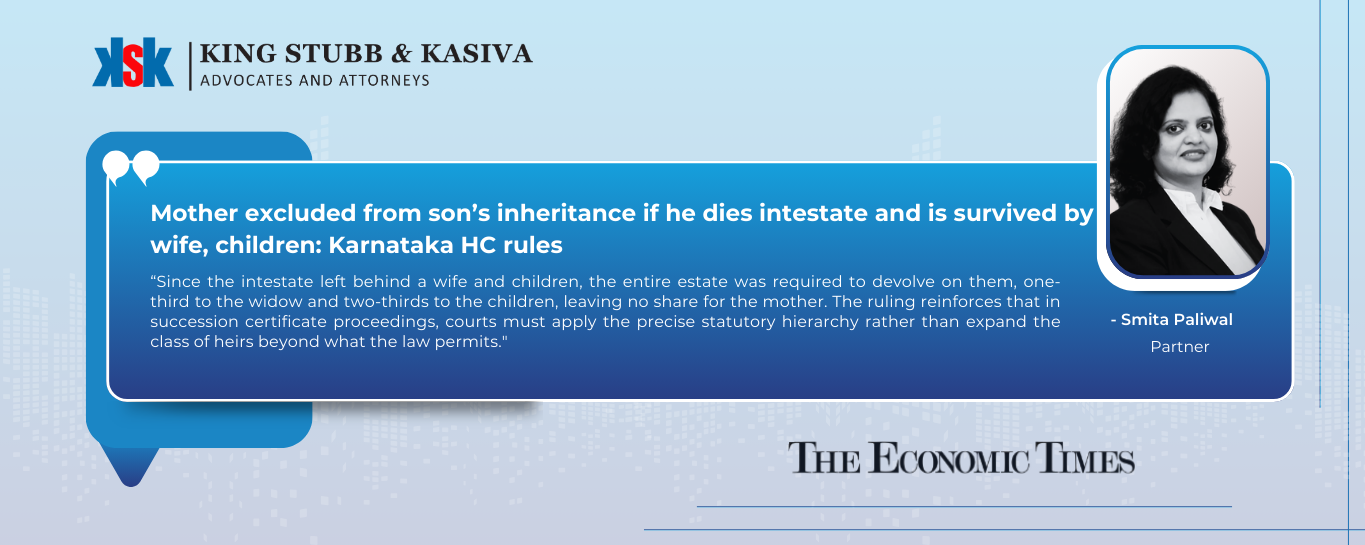
Smita Paliwal has shared her insights in a recent article published by The Economic Times (ET Wealth Online), analysing the Karnataka High Court’s ruling on intestate succession involving a Christian family.
Commenting on the judgment, Smita stated that the mother lost the case because the statutory scheme under the Indian Succession Act, 1925 clearly excludes her from inheritance when the deceased is survived by a widow and lineal descendants. She explained that Sections 32 and 33 of the Act prescribe a fixed and mandatory order of succession for Christians, under which the estate devolves first upon the spouse and children; only in their absence do parents become entitled to inherit.
Smita emphasised that the Trial Court had treated the mother as a necessary heir based on a general understanding of “legal heirs.” However, the High Court correctly clarified that succession cannot be determined on equitable considerations, sympathy, or customary assumptions. It must strictly adhere to the statutory framework.
She further elaborated, “Since the intestate left behind a wife and children, the entire estate was required to devolve on them, one-third to the widow and two-thirds to the children, leaving no share for the mother. The ruling reinforces that in succession certificate proceedings, courts must apply the precise statutory hierarchy rather than expand the class of heirs beyond what the law permits.”
By entering the email address you agree to our Privacy Policy.