
Vipin Upadhyay of King Stubb & Kasiva Highlights Key Tax Reporting Considerations for ULIPs, ESOPs and Commercial Property Income During ITR Filing
As taxpayers approach the Income Tax Return (ITR) filing deadline, Vipin Upadhyay has shared important guidance on the correct tax treatment of commonly reported income sources, including Unit Linked Insurance Plans (ULIPs), Employee Stock Ownership Plans (ESOPs), and commercial property income.
Commenting on the taxation of ULIP proceeds, Vipin noted that the taxability of such proceeds depends on whether the policy qualifies for exemption under the Income-tax Act. “While eligible ULIPs continue to enjoy tax exemption, policies that do not satisfy the prescribed conditions are taxable and must be reported under the appropriate head of income,” he said.
He further advised taxpayers to carefully review the applicable premium thresholds, the policy’s date of issuance, and insurer statements before claiming exemptions. Incorrect reporting of exempt or taxable ULIP income, he cautioned, may lead to unnecessary queries from the tax authorities.
On the taxation of Employee Stock Ownership Plans (ESOPs), Vipin explained that ESOPs are generally taxed in two distinct stages. “The first is at the time of exercise, when the difference between the fair market value of the shares and the exercise price is treated as a perquisite and taxed as salary. The second arises when the shares are subsequently sold, where any appreciation is taxed as capital gains. In the case of unlisted companies, determining the fair market value is more important, as it is based on prescribed valuation rules rather than market quotations,” he said.
He emphasised the importance of maintaining valuation reports, exercise records, and sale documents to ensure accurate reporting and minimise the risk of disputes during tax assessments. Addressing the reporting of commercial property income, Vipin observed that rental income from commercial properties is generally taxable under the head ‘Income from House Property’ where the property is let out.
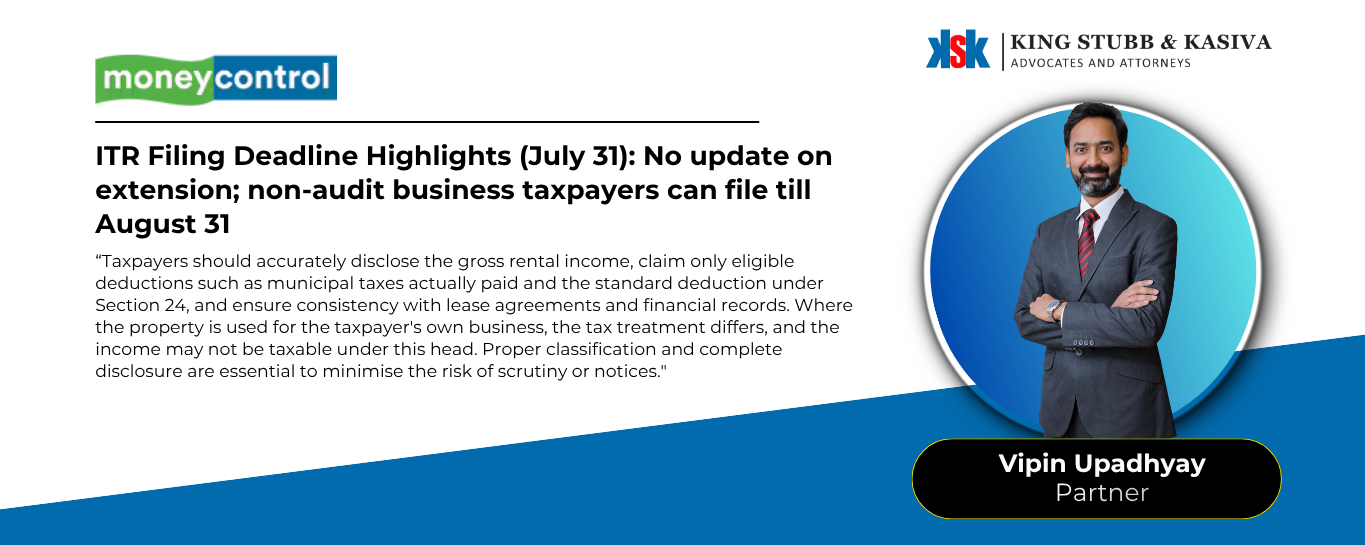
“Taxpayers should accurately disclose the gross rental income, claim only eligible deductions such as municipal taxes actually paid and the standard deduction under Section 24, and ensure consistency with lease agreements and financial records. Where the property is used for the taxpayer’s own business, the tax treatment differs, and the income may not be taxable under this head. Proper classification and complete disclosure are essential to minimise the risk of scrutiny or notices,” he added.
With the ITR filing season underway, Vipin’s insights focus on the importance of accurate classification, robust documentation, and careful disclosure of income to ensure compliance and reduce the likelihood of tax scrutiny.
Visit full article: https://www.moneycontrol.com/news/business/personal-finance/itr-filing-deadline-live-updates-itr-last-date-today-extension-news-how-to-file-july-31-liveblog-13989476.html
Last Updated on 7 August, 2026

By entering the email address you agree to our Privacy Policy.