
Sunayana Analyses Karnataka High Court Order on Ad-Interim Attachment and Its Corporate Law Implications
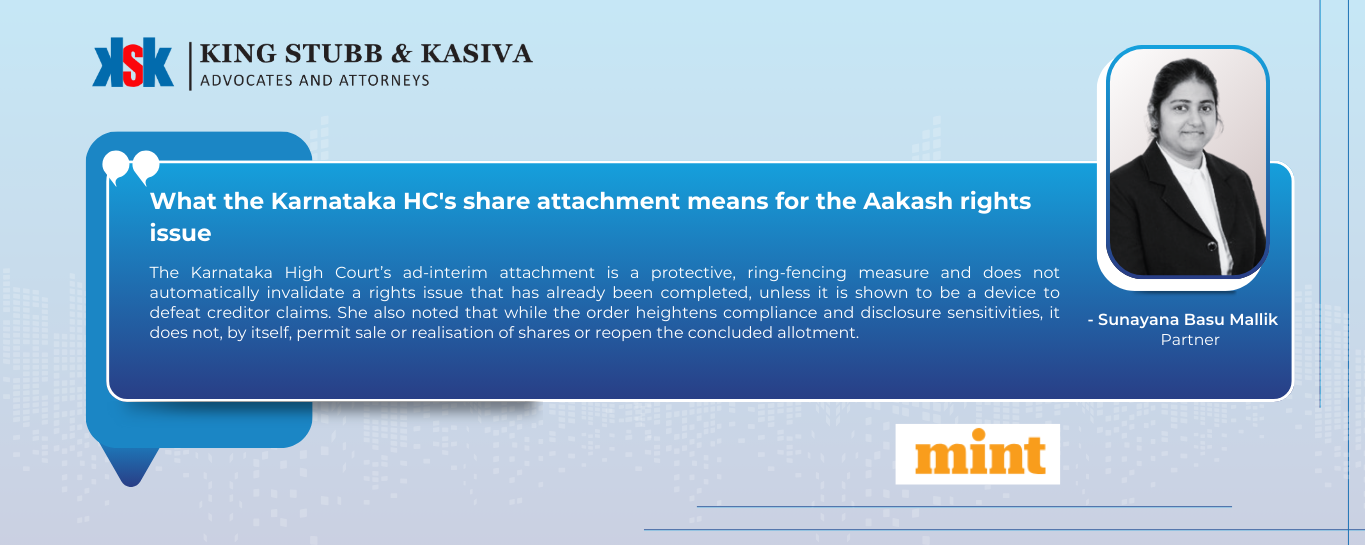
Sunayana Basu Mallik, in a recent article by the Live Mint, has provided a detailed legal perspective on the recent Karnataka High Court order granting an ad-interim attachment in relation to Byju Raveendran’s alleged beneficial interest in Aakash shares, clarifying its scope and implications under company law.
According to Sunayana, the ad-interim attachment is, at this stage, a protective measure intended to ring-fence the alleged beneficial interest in the shares. She emphasised that such an order does not automatically unsettle or invalidate a rights issue that has already concluded, unless it can be demonstrated that the allotment itself was structured as a device to defeat creditor claims.
From a company law standpoint, Sunayana explained that a completed rights issue is not rendered void merely due to the existence of a parallel attachment dispute. For the issue to be reopened or stayed, the claimant would need to establish elements such as suppression of beneficial ownership, fraud, or a deliberate circumvention of the court’s restraint. Absent such findings, the validity of the allotment remains intact.
She further noted that while the attachment order does not presently permit the sale or realisation of the shares, it significantly heightens compliance and disclosure sensitivities for the company involved. In particular, Sunayana highlighted the importance of maintaining a clear and defensible beneficial ownership trail under the Companies Act, as well as ensuring accurate and complete responses to court-directed disclosures.
Sunayana also observed that the order places the claimant in a position to seek stronger interim reliefs as the proceedings evolve, including continued attachment, asset disclosures on oath, or the appointment of a receiver pending final adjudication. However, she clarified that the order does not, by itself, alter other contested entitlements, which remain separate corporate governance and contractual issues to be tested on their own merits.
By entering the email address you agree to our Privacy Policy.