
Adnan Siddiqui Shares Insights on Ownership Rights and Inheritance in Family Property Disputes
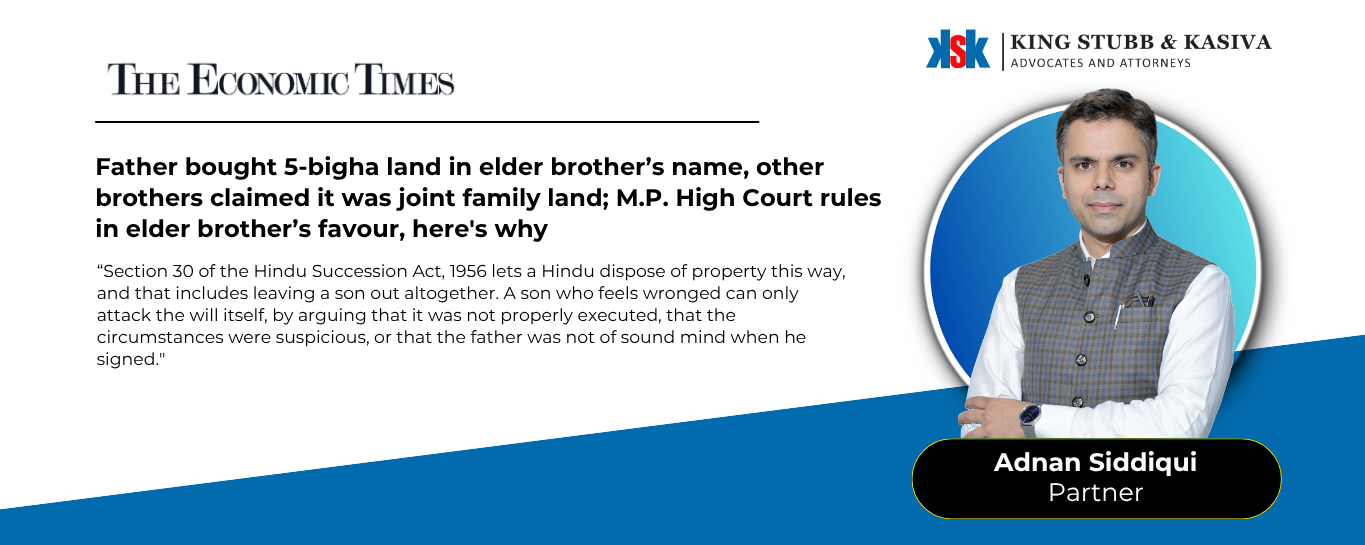
Disputes over family property often arise when land or other assets are purchased in the name of one family member but are alleged to have been acquired using funds belonging to the joint family. In an interaction with ET Wealth Online, Adnan Siddiqui shared insights on the legal principles governing ownership claims, the evidentiary value of registered sale deeds, and the inheritance rights of family members under the Hindu Succession Act, 1956.
Commenting on the Madhya Pradesh High Court’s decision in a dispute involving five bighas of agricultural land purchased in the name of the eldest brother, Siddiqui explained that a registered sale deed carries significant evidentiary value and that merely claiming that a property was purchased for the family is insufficient to establish joint family ownership. He observed that informal family arrangements, such as registering property in the eldest son’s name, carry little weight in court unless supported by documentary evidence establishing who contributed the funds and when.
Adnan further clarified that the determination of whether a property is self-acquired or ancestral depends on the source and nature of the funds used for its acquisition. As he explained, self-acquired status depends on whether the funds genuinely belonged to the individual, whether earned by them, received as a gift or inherited as separate property. However, where the property is ancestral, the legal rights of the individual’s sons would also need to be considered.
Addressing the rights of a property owner to distribute their assets, Siddiqui noted that a Hindu individual can dispose of their property through a Will under Section 30 of the Hindu Succession Act, 1956, including the decision to exclude a son from inheriting the property, subject to the nature of the property and applicable legal rights. In such circumstances, a valid Will governs the distribution of the testator’s property.
He also explained the position where a father dies intestate, that is, without leaving a Will. In such cases, Sections 8 to 10 of the Hindu Succession Act, 1956 govern the devolution of property. The property first devolves upon Class I legal heirs, who inherit simultaneously and in equal shares. These include the deceased’s widow, sons, daughters and mother, along with the children of any predeceased son or daughter, who collectively inherit the share their parent would have received. Only in the absence of Class I heirs does the property devolve upon Class II heirs, which include the deceased’s father and siblings, in accordance with the prescribed order of succession.
Adnan also highlighted that the younger brothers’ account of the transaction was based on their claim that their father, Shiv Narayan Sharma, owned six or seven bighas of agricultural land and that the income generated from this land had funded the subsequent purchase. According to their version, the sale deed was registered in Kailash’s name because he was the eldest brother. The High Court, however, did not pronounce this account false; rather, it found that the claim of joint family ownership had not been established through sufficient evidence. Siddiqui emphasised that ownership of family land or the existence of family arrangements, by themselves, do not establish that a subsequent purchase was made using joint family funds.
The discussion highlights the importance of establishing the source of funds and maintaining documentary evidence in property transactions, particularly within families, while also understanding the distinction between self-acquired and ancestral property and the succession rights that arise under applicable law.
Read the full article here: https://economictimes.indiatimes.com/wealth/legal/will/father-bought-5-bigha-land-in-elder-brothers-name-other-brothers-claimed-it-was-joint-family-land-mp-high-court-rules-in-elder-brothers-favour-heres-why/articleshow/135085784.cms
Last Updated on 2 November, 2026

By entering the email address you agree to our Privacy Policy.