
Vipin Upadhyay Highlights Importance of ITR Filing for Senior Citizens, Even Where Income Is Below the Taxable Threshold
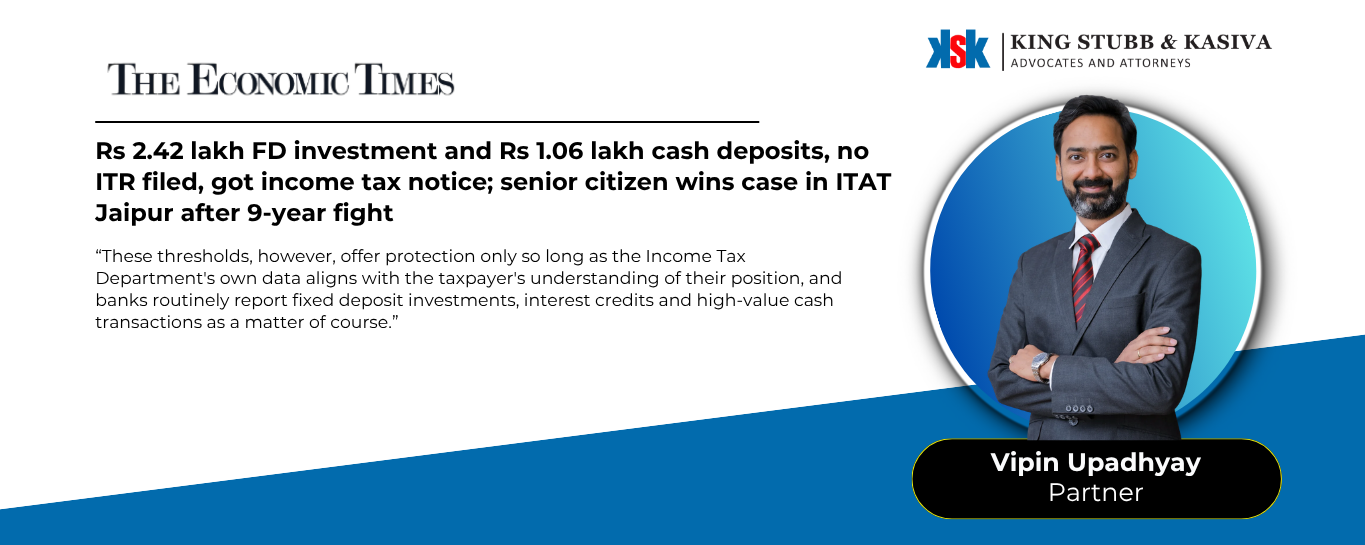
Commenting on a recent case before the Income Tax Appellate Tribunal (ITAT), Jaipur, involving a senior citizen who successfully challenged income additions relating to fixed deposits and cash deposits, Vipin Upadhyay, Partner at King Stubb & Kasiva, highlighted the importance of senior citizens maintaining a clear and contemporaneous tax record by filing their income tax returns, even where they believe that their income falls below the taxable threshold.
Vipin noted that his consistent advice to senior citizens is to file an Income Tax Return (ITR) even where there may be no tax liability. Under the new tax regime, eligible individual taxpayers can have no tax payable on total income up to ₹12 lakh due to the enhanced rebate under Section 87A of the Income-tax Act, 1961. However, where a taxpayer seeks to claim a rebate or otherwise has an obligation to furnish a return, filing the ITR remains important for establishing a formal record of their income and financial position.
According to him, the benefit of these thresholds can offer practical protection only where the taxpayer’s position is consistent with the information available with the Income Tax Department. Banks routinely report financial information, including fixed deposit investments, interest income and specified high-value cash transactions, to the tax authorities through the prescribed reporting mechanisms.
This can result in transactions being flagged where the taxpayer has not filed an ITR or where the transaction is not accompanied by an adequate explanation in the tax records. In such circumstances, even legitimate investments or deposits can potentially trigger queries or tax proceedings if the taxpayer is unable to promptly establish the source and nature of the funds.
Vipin therefore emphasised that filing an ITR on time, even where it reflects nil or low taxable income, can create a contemporaneous documentary trail and help prevent unnecessary tax disputes.
He said, “That is a particularly important safeguard for senior citizens, who are often the least equipped, years later, to locate old passbooks and fixed deposit receipts to defend transactions that a simple filing would have disclosed at the outset.”
His comments come in the context of a recent ITAT Jaipur ruling where a senior citizen was able to successfully contest income additions after producing supporting financial records, including her passbook and fixed deposit receipt. The case demonstrates how the absence of an ITR and an initial response to tax proceedings can create significant difficulties for taxpayers in subsequently explaining otherwise genuine financial transactions.
The ruling also highlights the importance of maintaining supporting documentation for bank deposits, fixed deposits, interest income and other significant financial transactions, particularly for senior citizens who may face difficulties in retrieving records several years after a transaction.
Vipin’s observations highlight a broader practical point for taxpayers: the absence of a tax liability does not necessarily mean the absence of a tax compliance trail. A timely ITR and proper preservation of supporting financial documents can provide taxpayers with contemporaneous evidence of their income and transactions and may help reduce the risk of prolonged disputes arising from mismatches between taxpayer records and information reported to the tax authorities.
Read the full article in ET Wealth Online.
Last Updated on 10 September, 2026

By entering the email address you agree to our Privacy Policy.