
Types of Intellectual Property Rights in India

Intellectual Property is a broad categorical description for the set of intangible assets owned and protected by a company or an individual so that they are not exploited or used without consent. The different types of Intellectual Property Rights in India are designed to protect the interests of the inventor of certain products of human intellect.
Recent technological developments, the value added to intellectual property and their injudicious use have taught us to identify and diligently protect intellectual property. Producing intellectual property requires heavy investment in terms of mental capability and skilled labour, making its protection important. Although intellectual property is an intangible asset, in many cases it can prove to be far more valuable than a company’s physical assets.
Table of Contents
- Types of Intellectual Property Rights in India
- Conclusion
- FAQs
- Frequently Asked Questions
- What are the four main types of Intellectual Property Rights in India?
- What is the definition of a trademark under Section 2(zb) of the Trade Marks Act, 1999?
- What does the symbol TM, SM, and ® signify on a trademark?
- What works are protected under Section 13 of the Copyright Act, 1957?
- What exclusive rights does a copyright owner enjoy in India?
- What is a patent and what does it protect?
- Related Reading
Types of Intellectual Property Rights in India
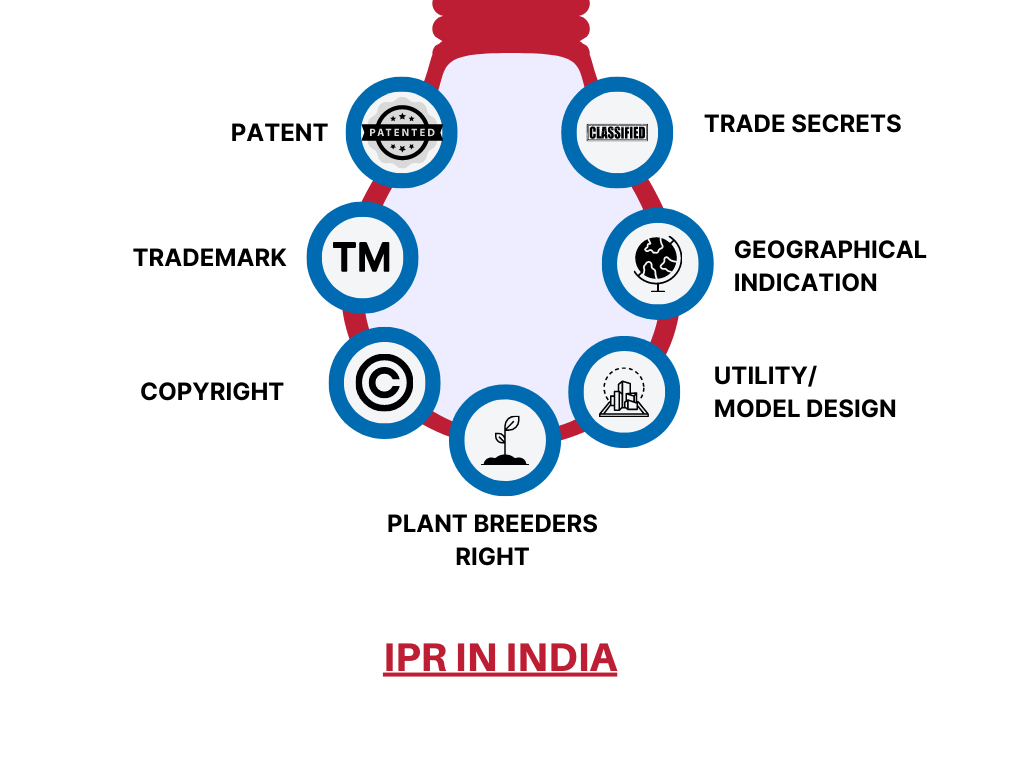
Indian law recognizes 4 (four) major types of intellectual property rights, which will be discussed in detail in this article. For any entity to secure proper protection of their intellectual property, it is advisable to work with experienced intellectual property lawyers.
- Trademarks
Trademarks are any phrases, symbols, logos, slogans, product packaging, or designs that distinguish the origin of goods or services. Section 2(zb) of the Trade Marks Act of 1999 defines a trademark to mean a mark that may be graphically represented and distinguishes one person’s goods or services from those of others, including the product’s shape, packaging, and colour combination. A trademark is often associated with a company’s brand. For example, the logo and the brand name of “Coca-Cola” are owned by the Coca-Cola Company.
Several benefits of a trademark include:
- Identification of the source of the goods and services;
- Providing legal protection to the brand;
- Guarding goods/services against counterfeiting and fraud.
While trademarking a certain word or phrase does not confer ownership of the word, it enables the owner of such a trademark the right to determine how that particular word or phrase can be used with respect to specific goods and services. The key to obtaining trademark protection is to understand how the specific categories of goods and services the mark shall cover. It is advised to avoid seeking trademarks that are merely descriptive of goods and services but are rather unique, easier to protect and more likely to qualify for trademark protection.
As soon as the trademark is applied, one can start using the same. A trademark can be used as “TM” for Goods, “SM” for Services and “®” for Registered Trademarks. These symbols enable the consumer/competitors to know that the brand proclaims the right to a particular good or service.
It is suggested for any trademark holder to actively take action against the infringers in order to protect the interests and the reputation of the company.
- Copyrights
Copyright is a person’s legal right to commercially exploit their original, tangible creative work, and it prevents others from duplicating or reproducing it without permission. Copyright preserves the expression of a concept rather than the concept itself. Section 13 of the Copyright Act, of 1957, protects original literary, dramatic, musical, and aesthetic works, as well as cinematograph films and sound recordings.
Organizations can claim ownership of a work of an employee as the Indian Law allows ownership through “work made for hire”. Copyright Act provides copyright to owners with exclusive rights to reproduce the work, prepare imitative work, distribute copies of a copyrighted work, transfer ownership or license to use the work and perform and display the work in public to name a few.
- Patents
A “patent” is an intellectual property right that protects any innovation. It is an exclusive privilege that protects the rights of the inventor and prevents unauthorized use and theft of the registered patent by third parties. A patent is a monopoly granted to the inventor on his creation for a set time, allowing him to economically use and exploit it in the market to the exclusion of others.
The term “invention” is defined as any new and useful thing, whether it be art, process, method, or manner of manufacture, the machine, apparatus, or another article, or any substance produced by a manufacturer, including any new and useful improvement of any such thing, and an alleged invention under Section 2(1)(j) of the Patents Act, 1970.
To receive a patent, one’s idea must meet the following requirements;
- The subject matter must be patentable;
- The idea must be ‘new’ and ‘useful’ and;
- The idea must be ‘non-obvious’.
While patents are the most common type of intellectual property rights that come to people’s mind when they think of IPR protection, patents can be expensive to obtain and maintain..
- Design
The term “design” is defined in Section 2(d) of the Designs Act, 2000 as only the features of shape, configuration, patterns or ornaments applied to any article by any industrial process or means, whether manual mechanical or chemical separate or combined, that appeal to and are evaluated solely by the eye in the finished article. The Designs Act, 2000 allows the registration of two-dimensional or three-dimensional characteristics of design, configuration, pattern, decoration, or line or color composition applied to any product.
Design protection guarantees one the exclusive right to use a design, including making and selling in the market, importing, exporting or using the product in which the protected design is incorporated. Third parties can also use the design provided the owner grants permission to use the same.
IPRs are critical for every business and have become the cornerstone for crucial investment decisions. Since IPRs are exclusive rights, striking a balance between the interests of innovators and the interests of society as a whole is always challenging. King Stubb & Kasiva is recognized amongst the top law firms in India, with PAN India presence offering full spectrum of legal services and has an in-house team of IPR lawyers in India to support all IPR-related matters for its clients.
The different forms of IPRs in India are governed by various legislations such as:
- The Trade Marks Act, 1999
- The Copyright Act, 1957
- The Patents Act, 1970
- The Designs Act, 2000
These different forms of IPRs are categorized in a consistent manner around the world.
Trademarks
Copyrights
Patents
Design
Conclusion
The different types of IPR in India gives freedom to individuals and organizations to seek intangible asset protection. India has ratified many conventions and treaties to provide international recognition and protection to the various forms of IPRs. Several conventions have compelled India to enact new legislation in order to safeguard products that represent India’s heritage, agricultural history, and flora. The courts in India have recognized the importance of avoiding deliberate infringement of IP rights and have begun awarding inventors large punitive damages.
This has increased the significance of IP lawyers in India as although punitive damages are rarely awarded by courts when they are, they serve as a deterrent in addition to compensating for genuine losses. As a result, Indian courts take a highly balanced approach to IPR concerns. Lastly, when we look at what are the different types of IPR, these rights can be exercised concurrently in several countries. Because these rights are associated with something fresh or distinctive, they cannot be utilized to safeguard knowledge that is already in the public domain. It is feasible to keep enhancements and changes made to well-known things.
FAQs
u003cstrongu003eWhat is the importance of intellectual property rights? u003c/strongu003e
u003cstrongu003eWhat is the difference between a patent and a copyright?u003c/strongu003e
u003cstrongu003eWhat is the Significance of Intellectual Property Protection in India?u003c/strongu003e
What is the procedure for patent registration in India?
What is IP litigation?
What is the legal framework for trade secret protection in India?
Can foreign entities apply for intellectual property rights in India?
King Stubb & Kasiva,
Advocates & Attorneys
New Delhi | Mumbai | Bangalore | Chennai | Hyderabad | Mangalore | Pune | Kochi | Kolkata
Tel: +91 11 41032969 | Email: info@ksandk.com
Frequently Asked Questions
What are the four main types of Intellectual Property Rights in India?
Indian law recognises four major types of intellectual property rights: trademarks, copyrights, patents, and designs. Trademarks are governed by the Trade Marks Act, 1999; copyrights by the Copyright Act, 1957; patents by the Patents Act; and industrial designs under separate legislation. Each category protects a distinct form of intellectual creation and grants exclusive rights to the owner against unauthorised use.
What is the definition of a trademark under Section 2(zb) of the Trade Marks Act, 1999?
Section 2(zb) of the Trade Marks Act, 1999 defines a trademark as a mark capable of being graphically represented and capable of distinguishing the goods or services of one person from those of others. The definition includes the shape of goods, packaging, and combination of colours. Phrases, symbols, logos, slogans, and designs that identify the source of goods or services qualify as trademarks.
What does the symbol TM, SM, and ® signify on a trademark?
The symbol “TM” is used for goods where a trademark application has been filed but registration is pending. “SM” is used similarly for services. The symbol “®” is reserved for trademarks that have been duly registered under the Trade Marks Act, 1999. These symbols notify consumers and competitors that the brand owner claims rights over the mark for specific goods or services.
What works are protected under Section 13 of the Copyright Act, 1957?
Section 13 of the Copyright Act, 1957 protects original literary works, dramatic works, musical works, and artistic works, along with cinematograph films and sound recordings. Copyright safeguards the expression of an idea rather than the idea itself. The Act also recognises the “work made for hire” doctrine, allowing organisations to claim ownership over works created by employees during the course of employment.
What exclusive rights does a copyright owner enjoy in India?
Under the Copyright Act, 1957, the copyright owner enjoys exclusive rights to reproduce the work, prepare derivative or imitative works, distribute copies of the copyrighted work, transfer ownership, grant licences for use of the work, and perform or display the work in public. These rights enable commercial exploitation of original creative output and prevent duplication or reproduction without permission.
What is a patent and what does it protect?
A patent is an intellectual property right that protects an innovation or invention. It grants the inventor an exclusive monopoly over the creation for a set period, preventing unauthorised use, manufacture, sale, or theft of the registered invention by third parties. Patents safeguard novel and non-obvious technical inventions, ensuring that the inventor alone holds commercial rights during the term of protection.
Related Reading
- trademark registration process in India — A practical walkthrough of registering a trademark and the costs involved.
- copyright infringement and the remedies available — How copyright owners can enforce rights under the Copyright Act.
For tailored legal advice on the issues discussed in this article, please get in touch with our intellectual property practice.
Last Updated on 30 May, 2026

By entering the email address you agree to our Privacy Policy.