
ESOP Taxation in India: Understanding the Two-Stage Taxation and Startup Tax Deferral
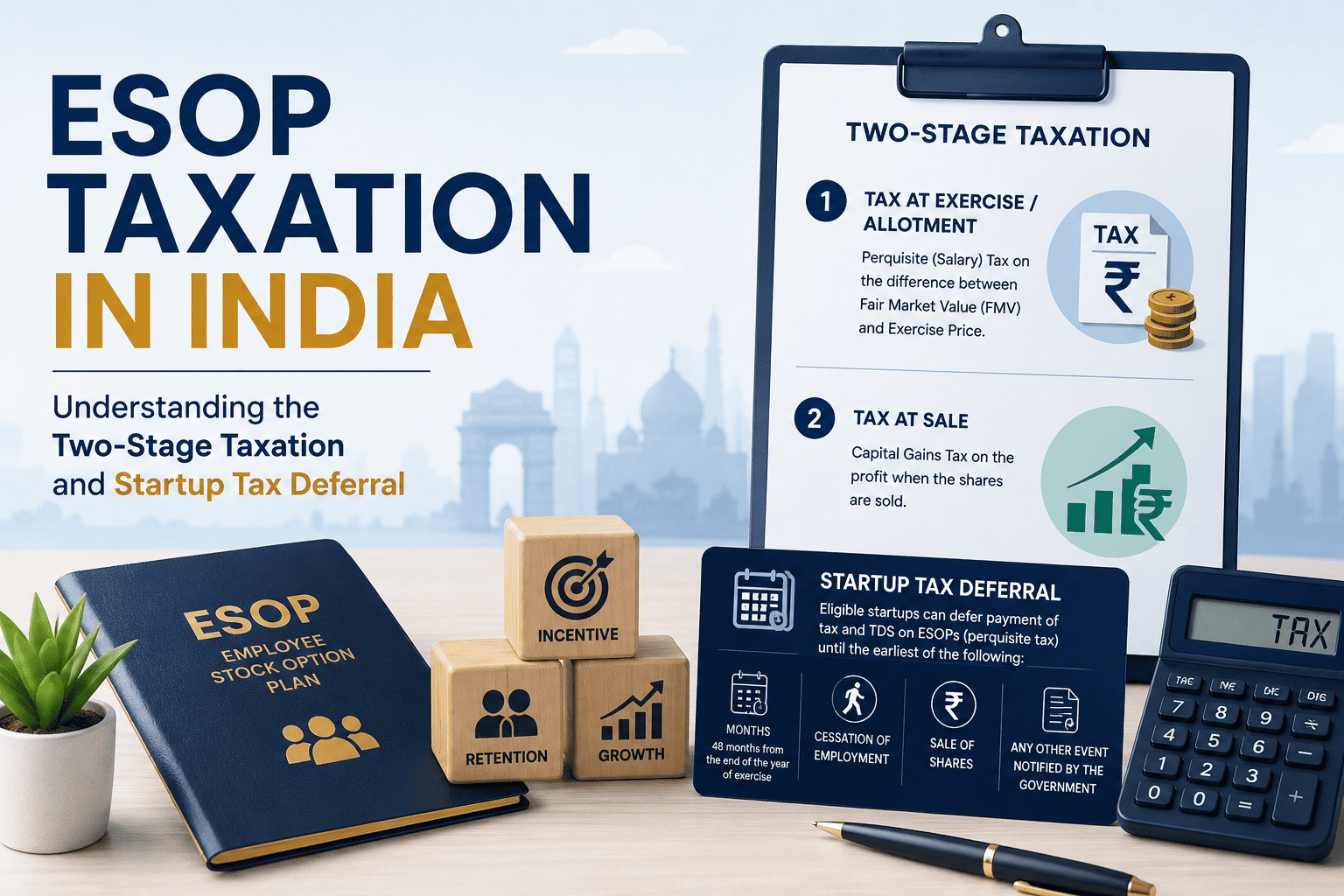
Employee Stock Option Plans (ESOPs) are an important tool for attracting and retaining talent, particularly in startups and high-growth companies. But employees often overlook a critical issue: ESOPs can create a tax liability before the underlying shares generate any cash return. This article explains the two stages of ESOP taxation in India, the special tax-deferral mechanism available to eligible startups, and the implications of the Income-tax Act, 2025.
Introduction
Employee Stock Option Plans (ESOPs) allow employees to acquire shares or specified securities of their employer, generally at a predetermined exercise price, subject to vesting and other conditions. For startups, ESOPs can help align employee incentives with long-term value creation without requiring the company to match the cash compensation that a larger established employer may offer. For employees, however, the tax treatment can be more complicated than the commercial terms of the option itself.
The central issue is that ESOP taxation generally occurs at two distinct stages:
- When the employee exercises the option and receives the shares: the benefit is generally taxed as a perquisite under the head “Salaries”; and
- When the employee subsequently sells the shares: the resulting gain or loss is generally taxed under the head “Capital Gains”.
This can create a significant liquidity issue, particularly where the shares are of an unlisted startup and cannot readily be sold after exercise. The Income-tax Act, 2025, which came into force on 1 April 2026, has retained the fundamental structure of ESOP taxation, although the statutory provisions have been reorganised and renumbered.
When is an ESOP taxed?
An ESOP generally passes through several stages: Grant → Vesting → Exercise/Allotment → Sale. The grant of an option does not ordinarily result in a taxable perquisite merely because the option has been granted. Similarly, vesting of the option, by itself, does not ordinarily trigger the ESOP perquisite tax. The principal salary-tax event occurs when the employee exercises the option and the specified securities are allotted or transferred.
Under Section 17 of the Income-tax Act, 2025, the value of specified securities or sweat equity shares allotted or transferred by the employer at no cost or at a concessional rate is included within the definition of “perquisite”. The taxable value is generally the fair market value of the security on the date the option is exercised, less the amount paid or recovered from the employee. The Income Tax Department’s current guidance similarly confirms that where an employer offers securities under an ESOP free of cost or at a concessional price, the difference between the FMV on the date of exercise and the amount paid by the employee is taxable as a perquisite.
An illustration
Suppose an employee exercises an ESOP to acquire 10,000 shares at an exercise price of ₹20 per share. If the fair market value of each share on the date of exercise is ₹120:
- FMV: ₹120 × 10,000 = ₹12 lakh
- Exercise price: ₹20 × 10,000 = ₹2 lakh
- Taxable perquisite: ₹10 lakh
The ₹10 lakh perquisite is taxable as salary income in accordance with the applicable provisions and tax rates. The employee, however, has paid only ₹2 lakh to acquire the shares and may not have received any cash from the transaction. This is the liquidity mismatch that makes ESOP taxation particularly important for employees of unlisted companies.
How is the fair market value determined?
The FMV used for ESOP taxation is not simply whatever valuation the company chooses to place on its shares. The Income-tax Rules prescribe the methodology for determining FMV. For listed securities, the applicable market-price methodology is used. For unlisted shares, valuation is generally required to be undertaken in accordance with the prescribed rules and, where applicable, by a Category I merchant banker.
“The first is at the time of exercise, when the difference between the fair market value of the shares and the exercise price is treated as a perquisite and taxed as salary. The second arises when the shares are subsequently sold, where any appreciation is taxed as capital gains. In the case of unlisted companies, determining the fair market value is more important, as it is based on prescribed valuation rules rather than market quotations.”
Vipin Upadhyay, Partner, King Stubb & Kasiva, in Moneycontrol
The Income Tax Department’s current guidance states that, for unlisted shares, the FMV for ESOP purposes is determined by a merchant banker in accordance with the prescribed rules. This makes valuation documentation an important part of ESOP administration, particularly for private companies. Companies should therefore maintain appropriate records supporting:
- the exercise date;
- exercise price;
- number of securities allotted;
- valuation methodology;
- FMV adopted;
- valuation report, where required; and
- tax deducted or paid in respect of the perquisite.
The first tax point: salary perquisite
The ESOP benefit at exercise is taxed as salary income, rather than capital gains. This distinction has several practical consequences. The perquisite is included in the employee’s taxable salary and, ordinarily, the employer is responsible for deducting tax at source in accordance with the applicable TDS provisions.
Under the Income-tax Act, 2025, Section 17 contains the substantive perquisite provision for specified securities and sweat equity shares, while the employer’s TDS obligations are dealt with under the corresponding salary-withholding provisions. The tax burden can therefore arise even though:
- the employee has not sold the shares;
- the company remains privately held;
- there is no readily available market for the shares; and
- the employee has received no cash corresponding to the value of the perquisite.
This is why ESOP tax planning is particularly important for employees of early-stage and unlisted companies.
The second tax point: sale of the shares
The second tax event arises when the employee transfers the shares. The resulting gain is generally taxable under the head “Capital Gains”. Importantly, the employee is not taxed again on the entire value that was already taxed as a salary perquisite. The Income-tax Act provides that, for specified securities or sweat equity shares covered by the ESOP provisions, the FMV that was taken into account for computing the perquisite becomes the cost of acquisition for capital gains purposes. The Income-tax Act, 2025 expressly incorporates this rule. For example:
- Exercise price: ₹20 per share
- FMV at exercise: ₹120 per share
- Perquisite taxed: ₹100 per share
- Subsequent sale price: ₹200 per share
The capital gain is generally calculated with reference to: Sale consideration – ₹120 FMV at exercise and not: Sale consideration – ₹20 exercise price. Accordingly, assuming no other adjustments, the subsequent capital gain would be ₹80 per share. This mechanism prevents the same ₹100 per-share benefit from effectively being taxed twice.
Long-term versus short-term capital gains
The tax treatment on the subsequent sale depends, among other things, on whether the shares qualify as a long-term or short-term capital asset under the applicable holding-period rules and the nature of the security. For equity shares of an Indian company, the relevant holding period is generally:
- 12 months for listed equity shares; and
- 24 months for unlisted equity shares.
The holding period for ESOP shares is generally relevant from the date the shares are acquired/allotted, rather than from the date the option was originally granted. For qualifying long-term capital gains on equity shares covered by Section 112A, the applicable tax regime and conditions must be separately examined. The ₹1.25 lakh threshold under Section 112A should not be treated as a universal exemption for all ESOP-related capital gains. The benefit is confined to qualifying long-term capital gains falling within that provision. For transactions outside Section 112A, the applicable capital gains provisions and rates must be examined separately.
The real problem: tax before liquidity
The two-stage structure can be illustrated simply. Imagine an employee of an unlisted startup exercises ESOPs when the FMV of the shares is ₹1 crore and the exercise price is ₹20 lakh. The employee may therefore have:
- paid ₹20 lakh to acquire the shares; and
- incurred a salary-tax liability on a ₹80 lakh perquisite.
But the employee may have no immediate ability to sell the shares. If the company does not permit a secondary sale and there is no liquidity event, the employee may have to fund the tax liability from personal cash or other sources. This is why the ESOP question is not merely: “How much are my options worth?” It is also: “When will I have liquidity to fund the tax liability?” For startup employees, this distinction can be critical.
Special tax deferral for eligible startups
Recognising the liquidity problem faced by employees of certain startups, the law provides a special mechanism for deferring the payment/TDS of tax on ESOP perquisites for employees of eligible startups. This is a deferral mechanism, not an exemption. Under the current framework, the eligible startup is required to deduct tax on the ESOP perquisite within the prescribed period upon the earliest occurrence of:
- expiry of 48 months from the end of the relevant assessment year in which the securities are allotted;
- the employee ceasing to be employed by the organisation; or
- the employee selling the securities.
The Income Tax Department’s current ESOP guidance confirms these three trigger events and states that the employer must deduct the tax within 14 days of the relevant event. The mechanism therefore postpones the cash-flow burden but does not eliminate the underlying tax liability.
DPIIT recognition alone is not enough
This is one of the most important practical points for founders and HR teams. DPIIT recognition does not automatically mean that the startup qualifies for every startup-related tax benefit. The Income Tax Department expressly states that a startup recognised by DPIIT does not automatically become eligible for the tax deduction under Section 80-IAC; the conditions applicable to that provision must separately be satisfied.
The same distinction is important when considering ESOP tax deferral. The relevant startup must satisfy the statutory requirements for the ESOP deferral mechanism. Accordingly, an employer should not represent to employees that simply holding a DPIIT recognition certificate automatically postpones ESOP tax. The company’s eligibility should be independently verified before the benefit is offered or communicated to employees.
Deferral is not exemption
The commercial significance of the startup relief should also be understood correctly. Suppose an employee exercises ESOPs in 2026 and qualifies for the startup deferral. The employee does not receive a permanent exemption from the perquisite tax. Instead, the tax payment is postponed until the earliest applicable trigger.
For example, if the employee continues to work for the startup and does not sell the shares, the tax obligation can still arise when the prescribed 48-month period expires. The Income Tax Department’s guidance expressly illustrates this situation: even where an employee continues with the eligible startup and retains the shares, the deferred tax obligation arises after the prescribed period. Therefore: Deferral ≠ exemption. It is a cash-flow relief mechanism.
What happens if the employee leaves?
The employee’s departure from the eligible startup is one of the events that can trigger the deferred tax obligation. This is particularly important in the context of employee exits. An employee who leaves a startup may still hold illiquid shares but nevertheless become subject to the deferred tax mechanism because cessation of employment is one of the statutory trigger events. Companies should therefore ensure that their ESOP documentation, employee communications and exit processes clearly address the potential tax consequences.
Employees should similarly consider the tax consequences before exercising options shortly before a planned resignation or career transition.
What changed with the Income-tax Act, 2025?
The Income-tax Act, 2025 came into force on 1 April 2026, replacing the Income-tax Act, 1961 for tax years governed by the new legislation. The transition represents a significant change in statutory numbering but does not fundamentally alter the ESOP taxation model. For example, the new Act continues to treat the value of specified securities or sweat equity shares allotted or transferred by an employer at a concessional price as a perquisite. Section 17 of the new Act contains the relevant provision.
Similarly, the new Act provides that the FMV taken into account for taxing the ESOP perquisite is treated as the cost of acquisition for the subsequent capital-gains computation. The practical implication for employers and employees is therefore not that ESOP taxation has been fundamentally redesigned. Rather, ESOP documentation, tax opinions and compliance materials should now use the applicable provisions of the Income-tax Act, 2025 for transactions falling within the new regime. Historical transactions and proceedings relating to earlier tax years must continue to be analysed under the applicable provisions of the Income-tax Act, 1961 and the relevant transition framework.
What should companies do?
Companies offering ESOPs should treat tax compliance as part of the overall ESOP administration process. A robust framework should include:
1. Eligibility review: Before communicating startup tax deferral to employees, verify that the company satisfies the applicable statutory requirements.
2. Valuation: Obtain and maintain the appropriate FMV determination on exercise.
3. Payroll coordination: Ensure that the perquisite is correctly reflected in payroll and that TDS is handled in accordance with the applicable rules.
4. Employee communication: Employees should be clearly informed that:
- grant is not the same as exercise;
- exercise can create a salary-tax liability;
- subsequent sale can create a capital-gains liability; and
- startup deferral, where available, postpones rather than eliminates the tax.
5. Exit planning: The company should incorporate ESOP tax considerations into employee exit processes, particularly where deferred tax is applicable.
6. Record keeping: Maintain the ESOP grant documents, exercise records, valuation reports, allotment records and TDS documentation for the relevant statutory period.
What should employees consider before exercising ESOPs?
Employees should evaluate more than the headline valuation of their ESOPs. Before exercising, they should consider:
- the exercise price;
- the current FMV;
- the resulting perquisite value;
- estimated tax liability;
- whether the shares are listed or unlisted;
- restrictions on transfer;
- the likelihood and timing of a liquidity event;
- whether the employer qualifies for startup tax deferral;
- what happens if the employee leaves the company; and
- the potential capital gains tax on a future sale.
For an employee of a private startup, exercising a large number of options can create a significant tax liability without corresponding liquidity. The decision to exercise should therefore be viewed as a tax and liquidity decision, not merely an investment decision.
The practical takeaway
The phrase “two-point taxation” is useful, but it should not be understood as double taxation of the same income. There are two separate taxable events: Exercise: FMV on exercise – exercise price → salary perquisite. Sale: Sale consideration – FMV already taxed at exercise → capital gain. The second computation uses the FMV already taken into account for the perquisite, thereby preventing the same appreciation from being taxed twice. The real problem is instead one of timing and liquidity.
An employee may have to pay tax on the value of shares before being able to monetise those shares. The special startup regime addresses this problem only partially by deferring the tax-payment/TDS obligation until the earliest of the prescribed events. It does not eliminate the tax.
Conclusion
ESOPs remain one of the most effective tools available to Indian startups and growth companies for attracting, retaining and incentivising employees. But their tax treatment requires careful planning. For employees, the critical distinction is between exercise and sale. Exercise can trigger a salary perquisite based on the FMV of the shares, even where the employee has received no cash. A later sale can trigger capital gains tax on the appreciation after the exercise date.
For eligible startups, the statutory deferral mechanism can provide valuable liquidity relief. But the benefit is limited, eligibility must be independently established, and the deferred tax ultimately becomes payable upon the occurrence of the prescribed trigger events.
The introduction of the Income-tax Act, 2025 from 1 April 2026 does not fundamentally change this two-stage architecture. Instead, it requires companies, employees and advisers to update their ESOP documentation and tax analysis to reflect the new statutory framework. For founders and HR teams, the key lesson is therefore: An ESOP is not tax-free equity compensation. The tax question begins at exercise, while the liquidity question may begin much earlier. A well-designed ESOP programme should consequently consider tax, valuation, liquidity and employee communication together, rather than treating taxation as a compliance issue to be addressed only when an employee exercises the option.
Last Updated on 14 October, 2026

By entering the email address you agree to our Privacy Policy.