
Non-Signatories to Arbitration Agreements: Supreme Court’s Decision in KKH Finvest v. Ashiesh Shukla
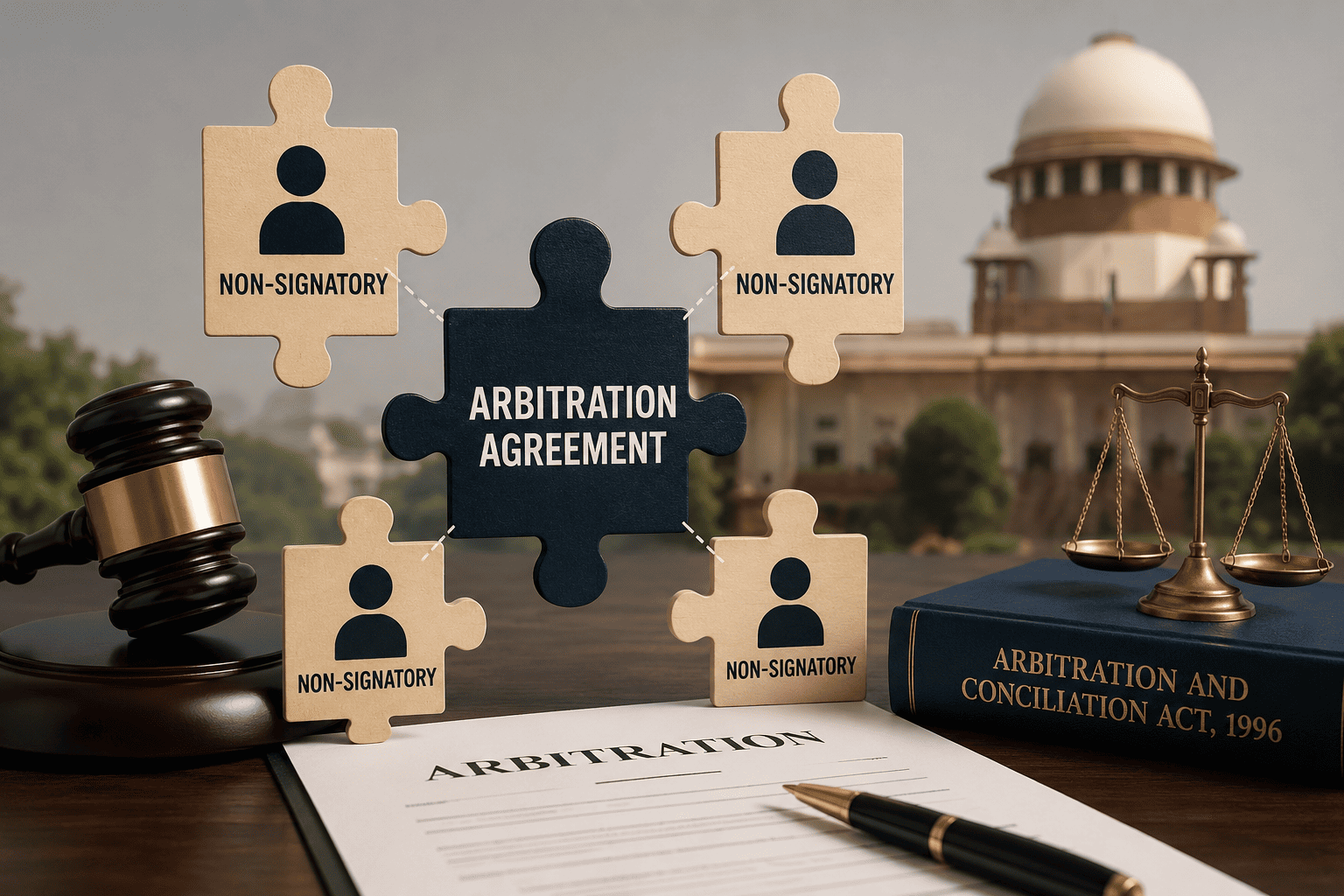
In a significant ruling on the ever-evolving contours of arbitration law, the Supreme Court in KKH Finvest Pvt. Ltd. v. Ashiesh Shukla (Civil Appeal arising out of SLP (C) No. 4222 of 2025, decided on 5th August, 2026) revisited the circumstances in which a non-signatory can be bound by an arbitration agreement. The judgment, delivered by a Bench comprising of Justice Sanjay Kumar and Justice Sanjeev Sachdeva, reinforces the principles laid down in Cox and Kings Ltd. v. SAP India Pvt. Ltd 2024) 4 SCC 1, 2023. and highlights that courts must look beyond the formal act of signing a contract when determining the true parties to an arbitration agreement.
The Dispute
The dispute arose from a Memorandum of Settlement (“MOS”) executed in May 2022 pursuant to a transaction through which KKH Finvest sought to acquire Sensorise Digital Services Private Limited and related entities. While the MoS was signed by KKH Finvest, the target entities and certain promoters, not all stakeholders were signatories to the document.
One such stakeholder was Ashiesh Shukla, a minority shareholder who held a small percentage of shares in the target company and had executed a separate Share Purchase Agreement as part of the acquisition process. When disputes emerged and arbitration was invoked, the Delhi High Court, while dealing with a petition under Section 11 of the Arbitration and Conciliation Act, 1996, held that Ashiesh Shukla could not be referred to arbitration as he had not signed the MoS containing the arbitration clause. The challenge before the Supreme Court was narrowly confined to whether this conclusion was legally sustainable.
Looking Beyond Signatures
The Supreme Court approached the issue through the lens of the “veritable party” doctrine, which has increasingly gained recognition in Indian arbitration jurisprudence. The doctrine recognises that in modern commercial transactions, rights and obligations are often distributed across a series of interconnected contracts and entities.
Consequently, the real inquiry is not merely whether a person signed the arbitration agreement, but whether the overall transaction and the conduct of the parties demonstrate an intention to be bound by it. Referring to the principles enunciated in Cox and Kings, the Court reiterated that factors such as the relationship between the parties, the commonality of the subject matter, the composite nature of the transaction, and the role played by the non-signatory in the performance of the contract are relevant considerations in determining whether a non-signatory is bound by an arbitration agreement.
Composite Transactions and Commercial Reality
A central feature of the Court’s reasoning was the finding that the acquisition structure was not a collection of isolated agreements, but a single commercial arrangement implemented through multiple documents. The Share Purchase Agreement executed by Ashiesh Shukla was not an independent transaction detached from the MoS. Rather, it was an integral component of the larger acquisition framework envisaged under the settlement. His transfer of shares formed part of the very mechanism through which the transaction was to be consummated.
The Court observed that the commercial objective of the acquisition could not be achieved without the participation of shareholders such as Shukla. His role was therefore fundamental to the implementation of the overall settlement. In these circumstances, the Court held that his involvement in the transaction provided a clear indication of an intention to participate in the obligations and benefits arising from the larger contractual framework.
The Inconsistency Addressed
An aspect that appears to have weighed significantly with the Bench was the treatment of other shareholders who were similarly placed. The Court noted that other stakeholders who had executed agreements containing substantially similar language had already been referred to arbitration. Excluding Shukla while referring similarly situated parties would, in the Court’s view, result in an artificial distinction unsupported by the commercial realities of the transaction.
Why the Judgment Matters
The decision is a step forward in the Supreme Court’s attempt to align arbitration law with commercial realities. Complex transactions today frequently involve holding companies, subsidiaries, affiliates, promoters, consultants, shareholders and investors spread across multiple agreements. Restricting arbitration only to the technical signatories of a particular document can often frustrate both dispute resolution and commercial intent.
At the same time, the judgment does not dilute the fundamental principle of consent which lies at the heart of arbitration. Instead, it recognises that consent may be manifested through participation in a composite transaction and may be inferred from conduct, contractual interdependence and the surrounding commercial framework. The Court’s analysis strikes a careful balance between maintaining party autonomy and preventing parties from strategically distancing themselves from arbitration despite having played a central role in the underlying transaction.
Conclusion
The ruling in KKH Finvest v. Ashiesh Shukla serves as a timely reminder that arbitration agreements are not always confined within the four corners of a single document. Indian courts are increasingly willing to examine the substance of commercial arrangements rather than their form. For businesses structuring acquisitions, shareholder exits and multi-party settlements, the judgment highlights an important reality: a party may find itself before an arbitral tribunal not because it signed the arbitration clause, but because its role in the transaction demonstrates that it was, in truth, a party to the bargain itself.
Frequently Asked Questions
1. What did the Supreme Court decide in KKH Finvest v. Ashiesh Shukla?
2. What is the veritable party doctrine?
3. Why did the Court treat the transaction as composite rather than separate agreements?
4. How did the treatment of other shareholders affect the ruling?
5. Does this ruling mean signing an arbitration clause no longer matters?
Last Updated on 9 September, 2026

By entering the email address you agree to our Privacy Policy.