
Will British Cars Really Become Cheaper in India? Decoding the India–UK FTA for the Automotive Industry
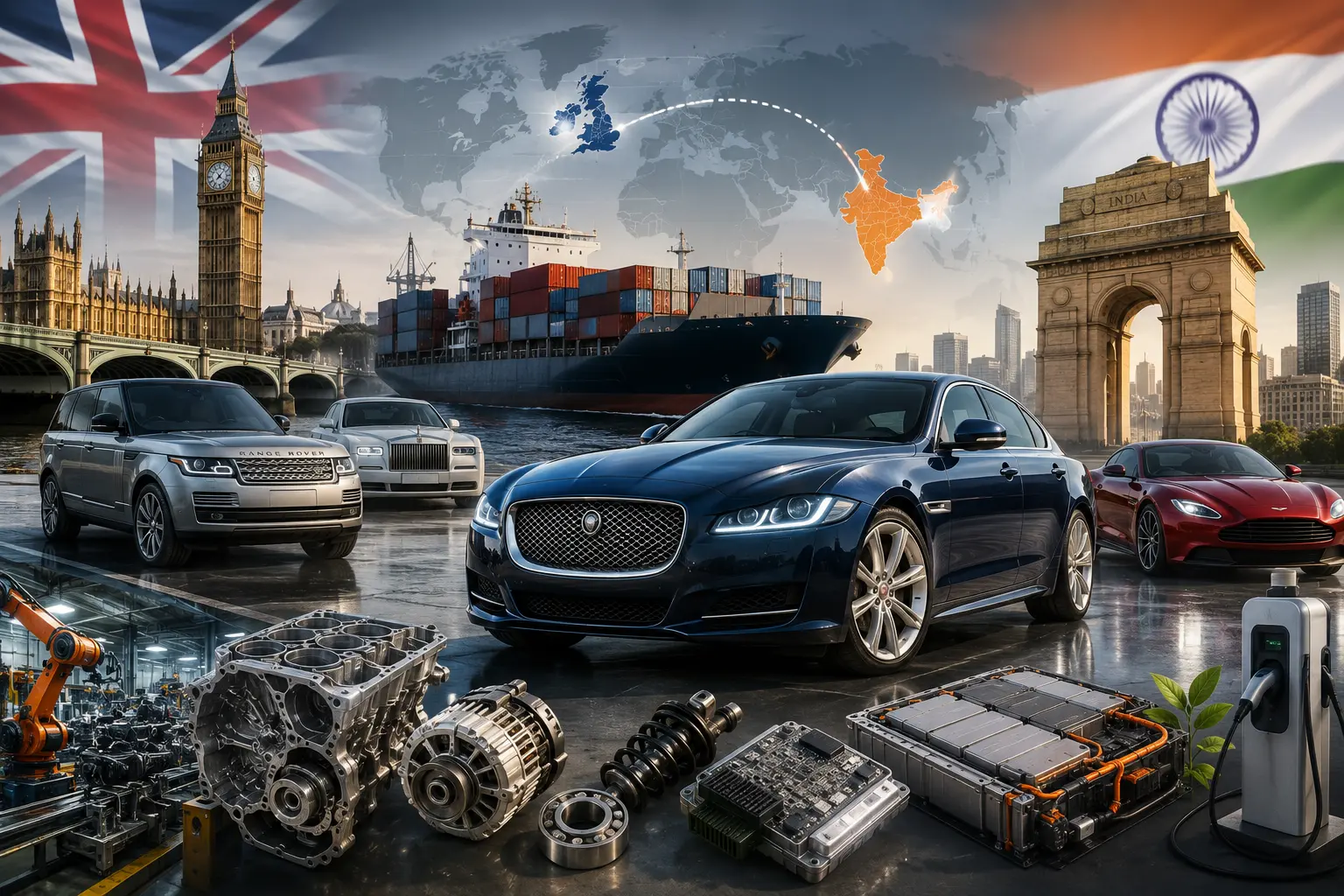
Lower Tariffs Are Only Part of the Story: What Automakers, Component Manufacturers, Dealers and Consumers Need to Know
This article is part of our India–UK CETA guidance for businesses, covering rules of origin, the contract clauses the agreement puts in play, and sector-by-sector analysis.
Introduction
Among the many announcements surrounding the India–UK Comprehensive Economic and Trade Agreement (“India–UK FTA” or “CETA”), few have generated as much public interest as the promise of cheaper British automobiles in India. Luxury brands such as Jaguar Land Rover, Aston Martin, Bentley, Rolls-Royce and McLaren have long attracted Indian consumers, but their prices have traditionally been inflated by India’s steep customs duties on imported vehicles.
The India–UK FTA marks a significant shift. For the first time, India has agreed to provide preferential tariff treatment for qualifying automobiles originating from the United Kingdom. Headlines have understandably focused on the prospect of luxury vehicles becoming more affordable. However, the legal and commercial reality is considerably more complex.
Tariff concessions under the FTA are subject to detailed conditions, including tariff-rate quotas, phased implementation schedules and strict Rules of Origin (“RoO”). Moreover, customs duty constitutes only one element of the final retail price of an imported vehicle. Logistics costs, insurance, GST, compensation cess, dealer margins, registration charges and manufacturers’ pricing strategies all continue to influence the ultimate cost borne by consumers.
More importantly, the FTA’s significance extends far beyond retail pricing. It has the potential to reshape investment decisions, component sourcing strategies, manufacturing footprints, supply chains and export opportunities for businesses operating across the automotive ecosystem.
For manufacturers, suppliers, distributors and investors, the more pertinent question is therefore not merely whether British cars will become cheaper, but how the FTA will redefine the economics of automotive trade between India and the United Kingdom.
Why Automobiles Were One of the Most Sensitive Issues in the Negotiations
The automotive sector has historically occupied a central place in India’s industrial policy. India has built one of the world’s largest automobile manufacturing ecosystems through a combination of domestic demand, export competitiveness and policies designed to encourage local production.
High customs duties on Completely Built Units (“CBUs”) have been an important policy tool, incentivising global manufacturers to establish manufacturing and assembly facilities in India instead of relying solely on imports.
The United Kingdom, on the other hand, is home to globally recognised premium automobile manufacturers and a highly sophisticated network of engineering, design and automotive component suppliers.
During the FTA negotiations, the UK sought greater access to India’s expanding premium vehicle market, while India sought to preserve its domestic manufacturing base and avoid an unrestricted influx of imported vehicles. The resulting agreement represents a carefully negotiated compromise—one that liberalises trade while retaining safeguards for India’s domestic automotive industry.
Tariff Reductions Are Significant but Not Unconditional
Public commentary has largely centred on the reduction of customs duties on UK-origin vehicles. While this is undoubtedly one of the headline outcomes of the FTA, it should not be interpreted as an automatic reduction in vehicle prices. Several legal and commercial limitations apply.
Phased Implementation and Tariff-Rate Quotas
Preferential tariffs are generally introduced through phased implementation rather than immediate elimination. Certain categories of vehicles may also be subject to tariff-rate quotas, under which only a specified volume of imports qualifies for reduced duties. Imports exceeding those quotas may continue to attract the standard Most Favoured Nation (“MFN”) tariff.
Manufacturer Pricing Discretion
Furthermore, only vehicles satisfying the FTA’s Rules of Origin can claim preferential treatment. Even where customs duties are reduced, manufacturers remain free to determine whether the savings are passed on to consumers, retained to improve margins or utilised to fund marketing and distribution.
Accordingly, lower customs duties create an opportunity for reduced prices—they do not guarantee them.
Rules of Origin: Why Every British Vehicle Will Not Qualify
Perhaps the most legally significant aspect of the FTA is its Rules of Origin framework. In modern automobile manufacturing, vehicles are assembled using components sourced from multiple jurisdictions. Engines, transmissions, semiconductors, batteries, electronic control units, infotainment systems and safety components frequently originate from different countries before final assembly.
A vehicle exported from the United Kingdom will therefore not automatically qualify for preferential tariff treatment merely because it carries a British brand or is shipped from a UK port.
What Qualifies as UK Origin?
To claim FTA benefits, exporters must demonstrate that the vehicle satisfies the prescribed origin criteria, which may include:
- Minimum regional value content
- Prescribed manufacturing or processing operations
- Tariff classification changes
- Product-specific rules applicable to automobiles and components
- Documentary requirements proving origin
Compliance Systems and Risks
Manufacturers will need robust compliance systems capable of tracing the origin of thousands of individual components across complex international supply chains. Failure to satisfy these requirements may result in denial of preferential treatment, reassessment of customs duties, recovery proceedings and potential penalties.
Implications for Global Automotive Supply Chains
The FTA may significantly influence how multinational automotive companies organise their production and sourcing operations. Manufacturers exporting to India from the United Kingdom may increasingly evaluate whether certain manufacturing processes should be undertaken within the UK to satisfy origin requirements.
Similarly, Indian component manufacturers may find new opportunities to become suppliers to UK-based vehicle manufacturers seeking to increase qualifying regional content under the FTA. This could accelerate integration between Indian suppliers and UK automotive production networks, particularly in areas such as:
- Precision engineering
- Castings and forgings
- Electrical systems
- Software and embedded electronics
- Lightweight materials
- Specialised automotive components
- Electric vehicle technologies
For Indian manufacturers already supplying global Original Equipment Manufacturers (“OEMs”), the FTA may create new export avenues into UK production facilities.
Opportunities for India’s Auto Component Industry
The Indian automotive component industry stands to benefit significantly from the agreement. India has developed substantial capabilities in manufacturing cost-efficient, high-quality automotive components for global markets.
Preferential market access into the UK may enhance the competitiveness of Indian suppliers relative to manufacturers located in countries without similar trade arrangements. Export opportunities may arise across multiple product categories, including:
- Engine and transmission components
- Braking systems
- Steering assemblies
- Suspension systems
- Electrical equipment
- Vehicle electronics
- Aluminium castings
- Forgings
- Tyres
- Aftermarket parts
- Components used in electric mobility
Indian suppliers may also benefit from increased collaboration with UK manufacturers on advanced engineering, research and product development.
Electric Vehicles Could Become a Key Beneficiary
The automotive sector is undergoing one of its most significant technological transformations, driven by electrification, digitalisation and connected mobility. The India–UK FTA may facilitate greater collaboration in emerging automotive technologies, particularly in relation to electric vehicles (“EVs”).
UK Expertise in EV Technologies
The United Kingdom possesses considerable expertise in:
- Battery technologies
- Power electronics
- Autonomous driving systems
- Vehicle software
- Lightweight materials
- Motorsport engineering
- Advanced automotive research
India’s Growing EV Ecosystem
India, meanwhile, is rapidly expanding its EV manufacturing ecosystem through government incentives, localisation initiatives and investments in battery manufacturing.
Reduced trade barriers could encourage greater cross-border collaboration involving technology licensing, joint ventures, engineering services, research partnerships and supply chain integration.
Implications for Dealers and Distributors
Automobile distributors and dealers should also assess the commercial implications of the FTA. Import strategies may evolve as manufacturers reassess whether to import fully built vehicles, expand local assembly operations or adopt hybrid distribution models.
Dealers handling premium UK brands may experience increased consumer demand if pricing becomes more competitive. However, businesses should remain cautious about making marketing representations regarding preferential pricing until manufacturers announce revised pricing structures.
Businesses involved in imports should also ensure that customs documentation accurately reflects eligibility under the FTA to avoid disputes with customs authorities.
Customs Compliance Will Become Increasingly Important
Preferential tariff regimes invariably increase regulatory scrutiny. Indian customs authorities retain the power to verify claims relating to preferential origin. Importers claiming reduced duties should therefore maintain comprehensive documentation supporting eligibility under the FTA.
Documentation and Internal Controls
Businesses should establish internal compliance mechanisms covering:
- Supplier declarations
- Origin certification
- Manufacturing records
- Regional value content calculations
- Component traceability
- Import documentation
- Record-retention policies
Customs audits are expected to become increasingly sophisticated, particularly for high-value imports such as luxury automobiles. Failure to comply may expose businesses to duty recovery, interest, penalties and prolonged customs disputes.
What Does the FTA Mean for Consumers?
For consumers, the answer is nuanced. Certain premium UK-origin vehicles may become more competitively priced over time, particularly where manufacturers choose to pass on customs savings and where imports qualify under the FTA’s origin requirements.
However, consumers should not expect dramatic overnight reductions across all British brands or vehicle models. Final pricing will continue to depend on multiple variables, including:
- Eligibility under the FTA
- Applicable tariff-rate quotas
- Exchange rate fluctuations
- Freight and insurance costs
- GST and compensation cess
- Dealer margins
- Registration charges
- Manufacturers’ commercial pricing decisions
The FTA is therefore likely to improve competitiveness rather than fundamentally transform the economics of imported luxury vehicles in the short term.
Strategic Considerations for Businesses
Automotive manufacturers, importers and suppliers should begin reviewing their business models in light of the FTA. Key considerations include:
- Evaluating whether existing supply chains satisfy the Rules of Origin
- Reassessing sourcing strategies to maximise preferential tariff benefits
- Reviewing customs compliance procedures and documentation
- Identifying opportunities for exports of Indian automotive components to the UK
- Considering manufacturing or assembly restructuring where commercially viable
- Revisiting dealership, distribution and pricing strategies
- Monitoring implementing notifications, customs procedures and operational guidelines issued by the respective governments
Early planning may enable businesses to secure a competitive advantage as the agreement is progressively implemented.
Conclusion
The India–UK FTA represents far more than a reduction in customs duties on imported luxury vehicles. It establishes a new legal and commercial framework governing automotive trade between two significant economies.
While consumers may ultimately benefit from more competitive pricing for certain UK-origin vehicles, the agreement’s greater significance lies in its ability to reshape manufacturing strategies, supply chains, technology partnerships and investment decisions across the automotive sector.
For businesses, the true opportunity will not lie merely in importing vehicles more cheaply. It will lie in strategically restructuring operations to take full advantage of preferential market access while ensuring robust compliance with the FTA’s Rules of Origin and customs requirements.
As implementation progresses, companies that proactively align their sourcing, manufacturing and compliance frameworks with the FTA will be best positioned to capitalise on the evolving India–UK automotive trade landscape.
Last Updated on 26 August, 2026

By entering the email address you agree to our Privacy Policy.