
Emergency Arbitration in India: Enforceability, Judicial Support and Key Contract-Drafting Considerations
Introduction
Emergency arbitration has emerged as an important mechanism for obtaining urgent interim relief before the constitution of the main arbitral tribunal. In India, however, its enforceability has evolved primarily through judicial interpretation rather than express statutory recognition. The Supreme Court’s decision in Amazon.com NV Investment Holdings LLC v. Future Retail Ltd. marked a significant turning point for India-seated arbitrations, while subsequent judicial developments have highlighted important limitations, particularly where the arbitration is seated outside India.
For businesses entering into joint ventures, shareholders’ agreements, investment arrangements, technology licences and other commercial contracts, the choice of arbitral institution, seat and emergency-arbitration mechanism can therefore have significant practical consequences.
This article examines the current position of emergency arbitration in India and identifies key issues that parties should consider when drafting arbitration clauses.
What Is Emergency Arbitration?
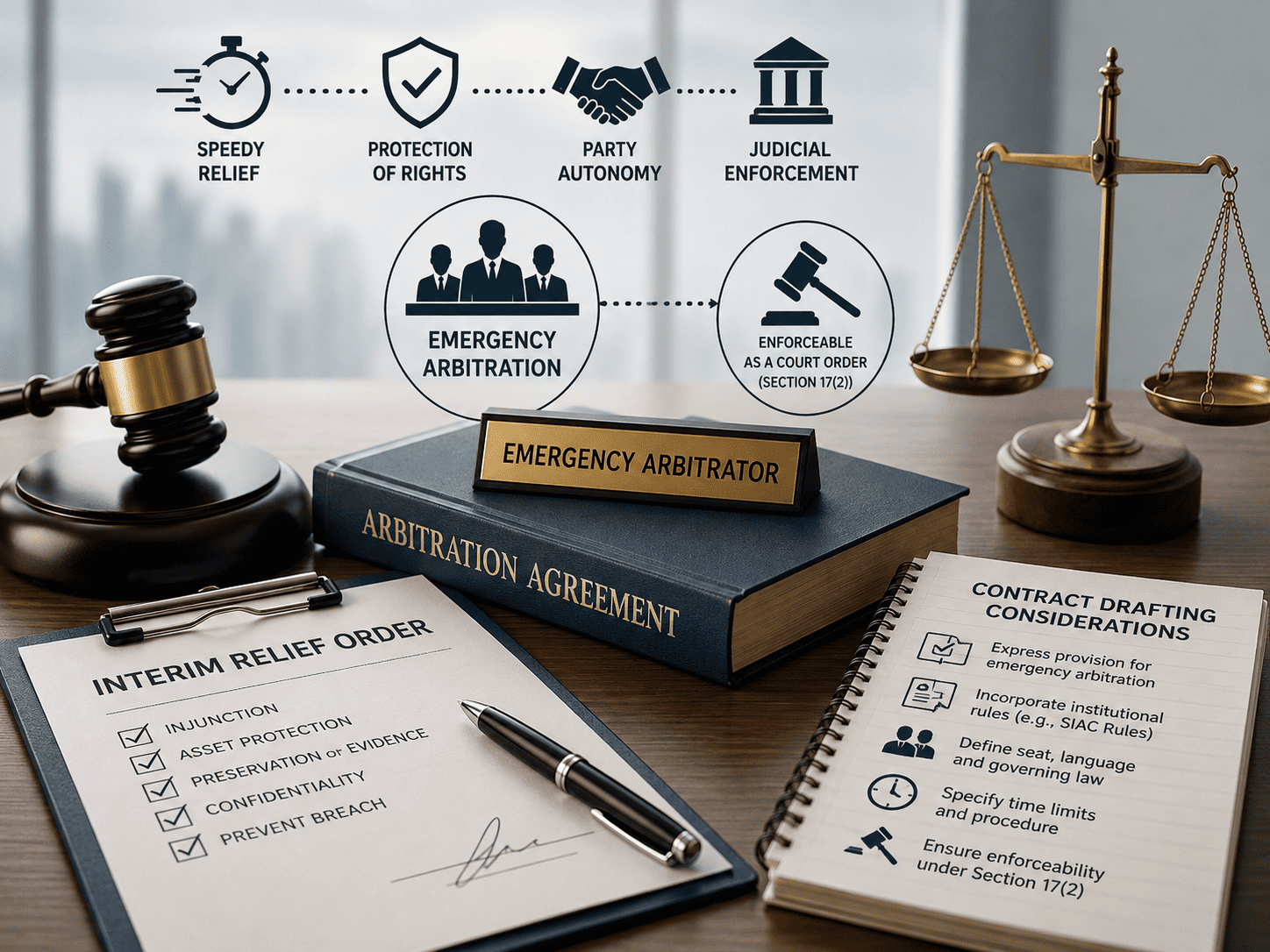
Emergency arbitration is a mechanism under which a party can seek urgent interim relief from an emergency arbitrator before the main arbitral tribunal is constituted. The purpose is straightforward: certain disputes cannot wait for the ordinary process of appointing a tribunal. For example, a party may require urgent protection where there is a risk that the counterparty may:
- transfer or dissipate assets;
- dispose of shares or other securities;
- breach confidentiality obligations;
- misuse intellectual property or confidential information;
- complete a transaction in violation of contractual restrictions; or
- take an action that could render the eventual arbitral award ineffective.
Institutional arbitration rules have responded to this commercial requirement by creating expedited procedures for the appointment of emergency arbitrators. Institutions such as the Singapore International Arbitration Centre (SIAC), International Chamber of Commerce (ICC), Mumbai Centre for International Arbitration (MCIA) and Delhi International Arbitration Centre (DIAC) provide mechanisms for emergency relief under their respective rules.
The difficulty in India historically arose because the Arbitration and Conciliation Act, 1996 (“Arbitration Act”) does not expressly define or refer to an “emergency arbitrator”. The resulting question was whether an order passed by an emergency arbitrator under institutional rules could receive the same statutory enforcement treatment as an interim order of an arbitral tribunal. The Supreme Court’s decision in Amazon.com NV Investment Holdings LLC v. Future Retail Ltd. significantly changed this position.
The Statutory Gap Under the Arbitration Act
Section 17 of the Arbitration Act empowers an arbitral tribunal to grant interim measures of protection during arbitral proceedings. Following the 2015 amendments, an order of an arbitral tribunal under Section 17 is enforceable in the same manner as if it were an order of a court. The difficulty was that the Arbitration Act did not expressly contemplate an emergency arbitrator appointed before the constitution of the arbitral tribunal. This issue had been identified even before the Supreme Court addressed it.
In its 246th Report, the Law Commission of India recommended amending Section 2(1)(d) to expressly include emergency arbitrators where the applicable institutional rules provided for such a mechanism. Parliament did not incorporate that recommendation into the 2015 amendments. Consequently, institutional rules had developed emergency arbitration mechanisms even though the parent statute did not expressly use the terminology.
From Judicial Workarounds to Amazon v. Future Retail
Before the Supreme Court’s landmark decision, Indian courts had to consider how parties could obtain protection in India following an emergency order issued under institutional rules. In HSBC PI Holdings (Mauritius) Ltd. v. Avitel Post Studioz Ltd., the Bombay High Court was approached under Section 9 after an emergency arbitrator appointed under SIAC Rules had granted interim relief. The court considered the request for interim protection under its own statutory jurisdiction rather than treating the emergency arbitrator’s order as automatically enforceable under Section 17. The Supreme Court subsequently considered the broader issue in proceedings arising from the dispute between Amazon and Future Retail.
The Amazon decision
In Amazon.com NV Investment Holdings LLC v. Future Retail Ltd., 2021 INSC 385, the Supreme Court considered whether an emergency arbitrator appointed under the SIAC Rules could be treated as an arbitral tribunal for the purposes of Section 17. The Court held that where parties have agreed to institutional arbitration rules providing for an emergency arbitrator, the emergency arbitrator is an “arbitrator for all intents and purposes” and the order made by the emergency arbitrator can be treated as an order under Section 17(1).
Consequently, such an order can be enforced under Section 17(2) in the same manner as an order of the arbitral tribunal. The Court also held that an order of the court enforcing an emergency arbitrator’s order under Section 17(2) is not appealable under Section 37. The decision was significant because the Supreme Court resolved the statutory gap through interpretation rather than waiting for Parliament to introduce an express legislative provision.
What Does Amazon Actually Establish?
The significance of Amazon should, however, be understood carefully. It does not mean that every emergency arbitrator’s order issued anywhere in the world is automatically enforceable in India under Section 17. The decision principally operates within the framework of Part I of the Arbitration Act and India-seated arbitrations.
This distinction becomes particularly important for multinational businesses that frequently choose seats such as Singapore, London or Dubai while providing for Indian governing law or Indian assets. The enforceability analysis can therefore change depending on the seat of arbitration.
India-Seated Emergency Arbitration
Where the arbitration is seated in India and the applicable institutional rules provide for emergency arbitration, Amazon provides a strong statutory foundation for enforcement of the emergency arbitrator’s order under Section 17. This gives parties choosing an Indian seat a significant advantage where immediate interim protection may be required.
For example, an India-seated arbitration administered under institutional rules providing for emergency arbitration can potentially allow a party to:
- apply for appointment of an emergency arbitrator;
- obtain urgent interim relief before constitution of the main tribunal; and
- seek enforcement of the emergency arbitrator’s order through the statutory mechanism under Section 17.
The institutional rules remain important because they determine matters such as appointment timelines, procedure, duration and the powers of the emergency arbitrator.
Foreign-Seated Emergency Arbitration: A Different Position
The position becomes more nuanced when the arbitration is seated outside India. In Raffles Design International India Pvt. Ltd. v. Educomp Professional Education Ltd., the Delhi High Court considered an emergency award issued in a Singapore-seated arbitration. The Court held that an emergency award issued in a foreign-seated arbitration could not itself be enforced under the Arbitration Act as an order under Section 17 because Part I of the Act did not apply to the foreign-seated arbitration.
However, this does not mean that a party with a foreign-seated arbitration agreement is necessarily without a remedy in India. Section 9 may remain available, subject to the statutory requirements and the terms of the arbitration agreement. The Indian court exercises its own jurisdiction when considering a Section 9 application.
This distinction is commercially important: an emergency arbitrator’s order may provide persuasive material for an Indian court, but it does not automatically become an Indian court order merely because the affected assets or parties are located in India.
Recent Judicial Developments: Emergency Relief Is Not a Substitute for Section 9
Recent decisions reinforce this distinction. In 2026, the Delhi High Court considered the relationship between an emergency arbitrator’s order and the court’s powers under Section 9. The Court emphasised that the existence of an emergency arbitrator mechanism does not eliminate the jurisdiction of the Indian court under Section 9.
The Court further observed that an emergency arbitrator’s order does not bind the court when it independently considers whether interim relief should be granted under Section 9. The court must assess the requirements for interim protection under Indian law and apply its own judicial mind to the material before it. This is an important practical qualification to the broad proposition that emergency arbitration automatically delivers enforceable interim protection in India. For parties involved in foreign-seated arbitration, the emergency-arbitration process and the Indian court’s Section 9 jurisdiction may therefore operate alongside one another.
The Importance of the Arbitration Seat
The distinction between an India-seated and foreign-seated arbitration highlights a broader drafting lesson: the choice of seat is not merely a procedural choice. It can directly affect the availability and enforcement of interim relief. Consider two contracts with otherwise identical arbitration clauses:
| Issue | India-seated arbitration | Foreign-seated arbitration |
|---|---|---|
| Emergency arbitrator | Available if provided by institutional rules | Available if provided by institutional rules |
| Section 17 framework | Applicable | Generally not applicable as Part I mechanism |
| Enforcement of emergency order under Section 17 | Supported by Amazon | Not available merely because the order was issued |
| Indian court assistance | Section 9/17 framework, as applicable | Section 9 may remain relevant, subject to statutory requirements |
| Importance of seat | High | High |
For businesses with significant assets, operations or counterparties in India, these considerations should be addressed before the dispute arises.
The 2024 Draft Arbitration Amendment: What Could Change?
The statutory framework may eventually change. The Draft Arbitration and Conciliation (Amendment) Bill, 2024 proposes express statutory recognition of emergency arbitration. The draft proposes insertion of Section 9A, under which arbitral institutions could provide for the appointment of an emergency arbitrator before the constitution of the arbitral tribunal.
The proposed framework would also provide for enforcement of an emergency arbitrator’s order in the same manner as an order of an arbitral tribunal under Section 17(2). The draft further proposes a definition of “emergency arbitrator” and provisions dealing with the subsequent power of the arbitral tribunal to confirm, modify or vacate an emergency order.
However, an important caveat is necessary: the 2024 Bill is not law. As of 2026, it remains a draft proposal and has not been enacted by Parliament. The existing Arbitration and Conciliation Act, 1996, as amended, therefore continues to govern emergency arbitration.
Businesses should accordingly distinguish between: Current law – the statutory framework as interpreted by the courts, particularly Amazon; and Proposed law – the emergency-arbitration framework contained in the Draft 2024 Bill.
Why Emergency Arbitration Matters for Businesses
Emergency arbitration is particularly relevant in transactions where a delay of even a few days could materially prejudice a party. These may include:
Joint ventures and shareholders’ agreements: Where a shareholder threatens to transfer shares, exercise disputed control rights or complete a competing transaction, urgent relief may be critical.
M&A transactions: Emergency relief can become important where contractual restrictions, exclusivity provisions, closing conditions or confidentiality obligations are allegedly breached.
Technology and intellectual property agreements: A party may need urgent protection against misuse of confidential information, source code, trade secrets or intellectual property.
Financing and investment transactions: Where there is a risk of asset dissipation or breach of security-related obligations, emergency relief may be commercially significant.
Commercial and supply agreements: Urgent injunctions may be required where termination, diversion of supplies or disclosure of confidential information threatens to cause irreparable commercial harm.
What Should Businesses Consider When Drafting an Arbitration Clause?
The emergency-arbitration mechanism should not be treated as boilerplate. Parties should consider at least five questions.
1. Is emergency arbitration available under the chosen institutional rules? Not every institution follows exactly the same procedure. Parties should review the relevant institutional rules rather than simply referring to “institutional arbitration”.
2. What is the seat of arbitration? The seat can materially affect the statutory framework available for interim relief and enforcement.
3. Where are the assets located? If urgent relief is likely to concern assets located in India, the enforceability of the emergency order in India should be considered at the contract-drafting stage.
4. What court jurisdiction is available? The arbitration clause should be reviewed alongside the provisions concerning the jurisdiction of courts for interim measures.
5. Is emergency relief consistent with the commercial strategy? Emergency arbitration can provide speed, but it also creates procedural and strategic considerations. Parties should assess whether the institutional mechanism, seat and available court remedies provide the protection required for the particular transaction.
Practical Takeaways for In-House Legal Teams
For businesses using arbitration in India or in cross-border contracts, emergency arbitration should form part of the broader dispute-resolution risk assessment. In-house legal teams should:
- identify contracts containing emergency-arbitration mechanisms;
- map the seat of arbitration and the location of material assets;
- review whether the selected institution provides emergency arbitration;
- assess the relationship between emergency arbitration and Section 9 relief;
- avoid assuming that a foreign emergency award will automatically be enforceable in India;
- consider Indian court relief where assets or operations are located in India;
- review arbitration clauses in high-value joint ventures, investments, M&A transactions and technology agreements; and
- monitor developments concerning the Draft Arbitration and Conciliation (Amendment) Bill, 2024.
Conclusion
Emergency arbitration has moved from a contractual mechanism operating largely outside the text of the Indian Arbitration Act to a recognised and commercially significant component of India’s institutional arbitration landscape.
The Supreme Court’s decision in Amazon.com NV Investment Holdings LLC v. Future Retail Ltd. established an important foundation for enforcement of emergency arbitrator orders in India-seated arbitrations. At the same time, the position for foreign-seated arbitrations remains more nuanced, with Indian courts retaining their own jurisdiction to consider interim relief under Section 9 where applicable. Recent Delhi High Court decisions demonstrate that an emergency arbitrator’s order does not eliminate the court’s independent assessment of interim relief.
The proposed statutory codification of emergency arbitration under the Draft Arbitration and Conciliation (Amendment) Bill, 2024 may eventually provide greater clarity, but it remains a proposal and not the law presently in force.
For businesses, the central lesson is therefore one of drafting precision. The choice of institution, seat, governing law, court jurisdiction and emergency-relief mechanism should be considered together at the time the arbitration clause is negotiated.
Where the commercial value of an asset or transaction can change materially within days, ensuring that the dispute-resolution clause can deliver effective interim relief may be just as important as deciding how the final dispute will ultimately be resolved.
Frequently Asked Questions
1. What is emergency arbitration?
2. Is an emergency arbitrator’s order enforceable in India?
3. Does the Amazon v. Future Retail ruling apply to foreign-seated arbitrations?
4. What relief is available if the arbitration is seated outside India?
5. Will the 2024 Draft Arbitration Amendment change the law on emergency arbitration?
Last Updated on 20 August, 2026

By entering the email address you agree to our Privacy Policy.