
The India UK FTA and Advanced Manufacturing: A New Era for Industrial Investment and Supply Chain Integration?
Introduction
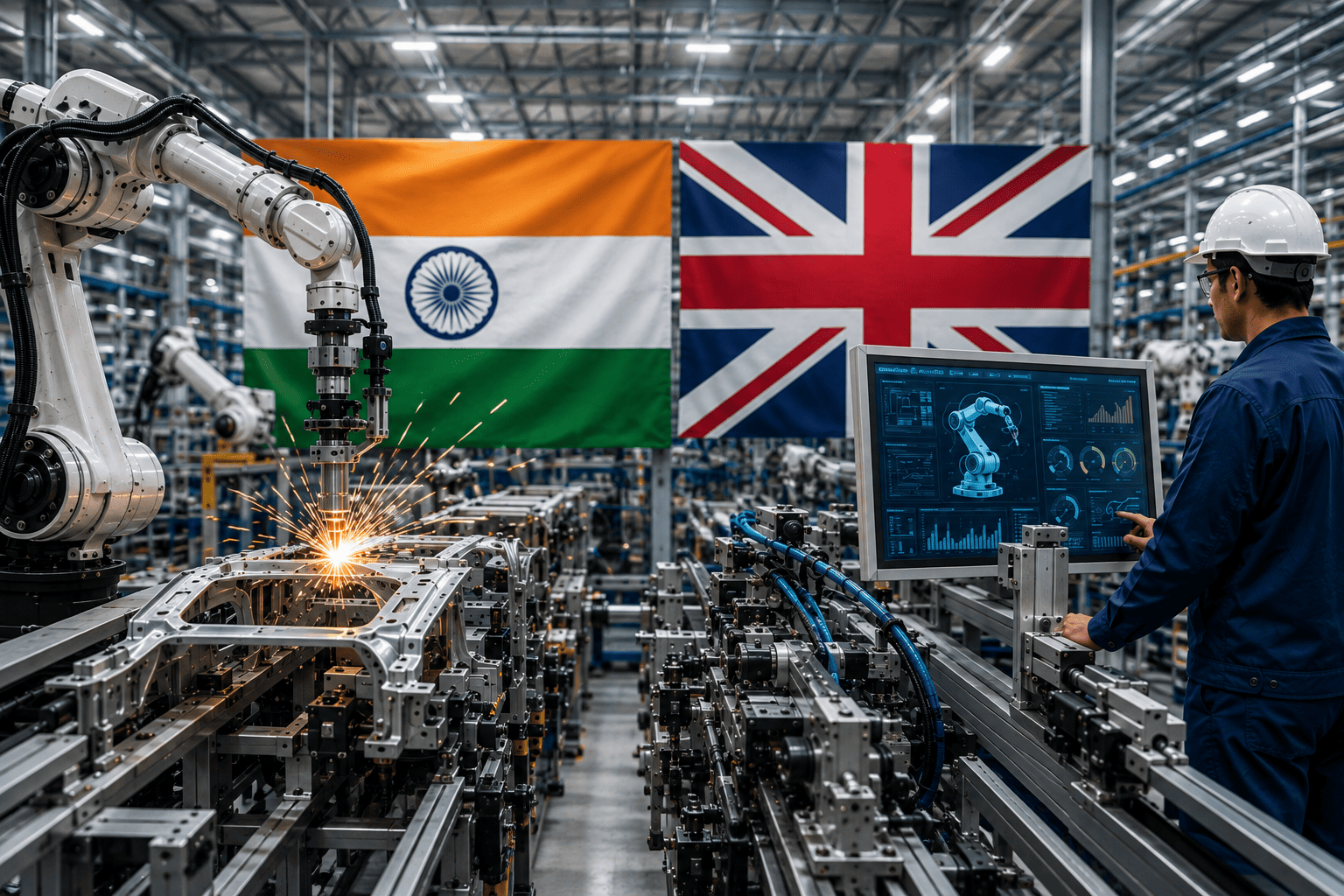
Manufacturing has emerged as one of the most strategically important sectors under the recently concluded India UK Comprehensive Economic and Trade Agreement (CETA). While public attention has largely centred on tariff reductions for automobiles, consumer products and whisky, the agreement’s most enduring impact may be felt elsewhere across factories, industrial parks and global supply chains.
This article is part of our complete guide to the India–UK FTA (CETA), covering rules of origin, the contract clauses the agreement puts in play, and sector-by-sector analysis.
India has positioned manufacturing as a key driver of long-term economic growth through initiatives such as ‘Make in India’, the Production Linked Incentive (PLI) Scheme, and increasing investments in logistics and industrial infrastructure. The United Kingdom, meanwhile, remains a global leader in advanced engineering, industrial automation, precision manufacturing, aerospace technologies and high-value industrial design.
India UK FTA Impact on Manufacturing & Engineering: Summary Table
| Section | Key Focus | Opportunities | Legal/Compliance Considerations |
|---|---|---|---|
| Manufacturing Investment | Long-term capital decisions | India as production hub; UK exports and manufacturing partnerships | Labour availability, tax incentives, regulatory stability, energy costs |
| Rules of Origin | Tariff eligibility for industrial goods | Reassessing sourcing and manufacturing locations | Value-addition requirements, substantial transformation tests, product-specific rules |
| Engineering Goods | Expanded market access | Indian machinery exports to UK; UK automation tech to India | Tariff schedules, product classifications, sector-specific regulatory requirements |
| Technology Transfer | Automation, robotics, AI collaboration | Joint development programmes, software integration | IP ownership, confidentiality, technology licensing, export control regulations |
| Supply Chain Resilience | Multi-country sourcing strategies | Indian suppliers in UK value chains, diversified production | Contractual risk allocation, quality standards, customs compliance, sustainability |
| Foreign Investment | FDI in manufacturing and R&D | Investment in facilities, engineering centres, infrastructure | Corporate structuring, land acquisition, labour and employment laws |
| ESG & Sustainability | Responsible manufacturing partnerships | Meeting international buyer expectations | Sustainability reporting, supplier audits, human rights due diligence |
| Outlook | Integrated industrial ecosystems | Technology transfer, investment, production networks | Customs compliance, IP protection, technology licensing, regulatory governance |
The India–UK FTA has the potential to strengthen these complementary capabilities by encouraging greater trade, investment and technology collaboration. While the agreement does not fundamentally alter domestic industrial regulations, it provides a framework that may influence where products are manufactured, how supply chains are structured and where businesses choose to invest over the coming decade.
For manufacturers, engineering companies and investors, the significance of the FTA extends well beyond customs duties. It is increasingly about building resilient, technology-driven and internationally integrated manufacturing ecosystems.
Manufacturing Decisions Are Driven by Long-Term Investment
Unlike consumer goods, manufacturing investments are rarely influenced by short-term market conditions alone. Decisions to establish factories, expand production facilities or relocate supply chains involve substantial capital expenditure and long planning horizons. Companies evaluating manufacturing locations consider a broad range of commercial and regulatory factors, including labour availability, engineering talent, logistics infrastructure, tax incentives, regulatory stability, energy costs, market access and access to export markets.
The India UK FTA may improve the commercial attractiveness of manufacturing in both jurisdictions by creating greater certainty around bilateral trade and reducing barriers for qualifying industrial products. For UK manufacturers seeking to diversify production or establish an Asian manufacturing base, India may become increasingly attractive as both a production hub and a large domestic market. Conversely, Indian manufacturers could strengthen their presence in the UK through exports, strategic acquisitions and manufacturing partnerships.
Rules of Origin Will Influence Supply Chain Strategy
One of the most commercially significant aspects of any free trade agreement is its Rules of Origin (RoO) framework. Preferential tariff treatment generally applies only where products satisfy prescribed origin criteria, making origin compliance a central element of manufacturing strategy.
Modern industrial products rarely originate entirely within one country. Machinery manufactured in India may incorporate European sensors, Japanese bearings, Korean electronics and software developed in the United Kingdom. Similarly, equipment assembled in the UK may rely on globally sourced components before final production. Manufacturers seeking preferential treatment under the India UK FTA must therefore assess whether their products satisfy applicable value-addition requirements, substantial transformation tests or product-specific rules.
These requirements influence far more than customs compliance. They increasingly shape procurement decisions, supplier selection and manufacturing locations. A seemingly minor sourcing decision can determine whether a finished product qualifies for preferential market access, directly affecting pricing and competitiveness.
Engineering Goods Could Benefit from Expanded Market Access
India has established significant capabilities in engineering goods, including industrial machinery, electrical equipment, heavy engineering, precision components, pumps, valves, forgings, castings and industrial automation systems. Engineering products already represent a substantial share of India’s merchandise exports and continue to play an important role in the country’s manufacturing strategy.
The India UK FTA may improve opportunities for Indian manufacturers supplying industrial products to UK customers, particularly where preferential tariffs enhance price competitiveness. At the same time, UK engineering companies may find greater opportunities to supply specialised machinery, automation technologies and advanced manufacturing equipment to Indian industries investing in modern production facilities.
However, businesses should avoid assuming that all industrial products will automatically benefit from the agreement. Eligibility will depend on tariff schedules, product classifications, rules of origin and sector-specific regulatory requirements. Product-level legal and customs analysis remains essential before restructuring supply chains or making investment decisions.
Technology Transfer Will Become Increasingly Important
The future of manufacturing is increasingly defined by technology rather than labour alone. Automation, robotics, artificial intelligence, additive manufacturing, digital twins, predictive maintenance and industrial data analytics are transforming production across industries.
The India UK FTA may encourage greater collaboration in these areas by facilitating partnerships between Indian manufacturers and UK technology providers. Such collaborations often involve licensing proprietary technologies, transferring technical know-how, establishing joint development programmes or integrating software into manufacturing systems.
These arrangements require carefully structured agreements governing intellectual property ownership, confidentiality, technology licensing, cybersecurity obligations and commercialisation rights. Businesses should also consider export control regulations, competition law and contractual protections when transferring advanced manufacturing technologies across jurisdictions.
Supply Chain Resilience Is Now a Strategic Priority
Global supply chains have undergone significant restructuring in recent years as businesses seek to reduce concentration risks and improve operational resilience. Geopolitical developments, disruptions caused by the COVID-19 pandemic and increasing emphasis on supply chain diversification have encouraged manufacturers to adopt multi-country sourcing strategies.
Against this backdrop, the India UK FTA could support greater integration between manufacturing ecosystems by providing businesses with additional sourcing and production options. Indian suppliers may strengthen their role within UK manufacturing value chains, while UK businesses may increasingly view India as a strategic partner for production, engineering services and industrial innovation.
Nevertheless, supply chain diversification must be accompanied by robust legal due diligence. Manufacturers should evaluate contractual risk allocation, quality standards, product liability, customs compliance, sustainability obligations and environmental regulations before entering long-term sourcing arrangements.
Foreign Investment Could Drive the Next Phase of Growth
Trade agreements often encourage investment by providing businesses with greater confidence in long-term commercial relationships. The India UK FTA could support increased foreign direct investment in manufacturing facilities, engineering centres, industrial research and supply chain infrastructure.
Investment decisions in the manufacturing sector extend well beyond tariff considerations. Businesses must assess foreign investment regulations, corporate structuring, taxation, land acquisition, labour and employment laws, environmental compliance, infrastructure availability and sector-specific licensing requirements. Manufacturers establishing operations in either jurisdiction should therefore adopt a multidisciplinary legal strategy that integrates trade law with broader corporate and regulatory considerations.
Sustainability and ESG Will Influence Manufacturing Partnerships
Industrial businesses are increasingly expected to meet environmental, social and governance (ESG) standards throughout their operations and supply chains. International buyers are placing greater emphasis on carbon emissions, responsible sourcing, labour practices and environmental compliance when selecting manufacturing partners.
As commercial collaboration between India and the UK expands, manufacturers may face increasing contractual obligations relating to sustainability reporting, supplier audits, human rights due diligence and responsible procurement. Companies that proactively integrate ESG considerations into their manufacturing and supply chain strategies are likely to be better positioned to meet evolving customer expectations and regulatory developments in both jurisdictions.
Looking Ahead
The India-UK Comprehensive Economic and Trade Agreement is unlikely to transform manufacturing overnight. Investment decisions in the industrial sector are shaped by a complex combination of infrastructure, technology, regulation, workforce availability and commercial strategy.
Nevertheless, the agreement arrives at a time when manufacturers are actively reassessing global supply chains and seeking trusted partners for long-term growth. India’s manufacturing capabilities, engineering talent and expanding industrial base complement the UK’s expertise in advanced engineering, research and industrial innovation.
For businesses operating in engineering, industrial machinery, electronics, automation and precision manufacturing, the India UK FTA provides an opportunity to build stronger commercial relationships that extend beyond exports to encompass technology transfer, investment and integrated production networks.
Conclusion
The India UK FTA should not be viewed merely as a mechanism for reducing tariffs on industrial goods. Its broader significance lies in its potential to reshape manufacturing strategy, strengthen cross-border supply chains and encourage long-term industrial investment.
As manufacturing becomes increasingly technology-driven and globally integrated, businesses that align their commercial strategies with robust legal planning including customs compliance, intellectual property protection, technology licensing and regulatory governance will be best positioned to capitalise on the opportunities emerging from deeper India UK economic cooperation.
Frequently Asked Questions
1. Will all industrial products automatically benefit from lower tariffs under the India-UK FTA?
2. My machinery is “Made in India,” but it uses foreign parts. Does it still qualify for preferential tariffs?
3. Does the FTA mainly help India-UK trade, or does it also encourage technology partnerships?
4. Is investing in Indian or UK manufacturing facilities purely a tariff and trade decision?
5. Do ESG and sustainability requirements matter for manufacturers under this FTA, or is that a separate issue?
Last Updated on 8 September, 2026

By entering the email address you agree to our Privacy Policy.